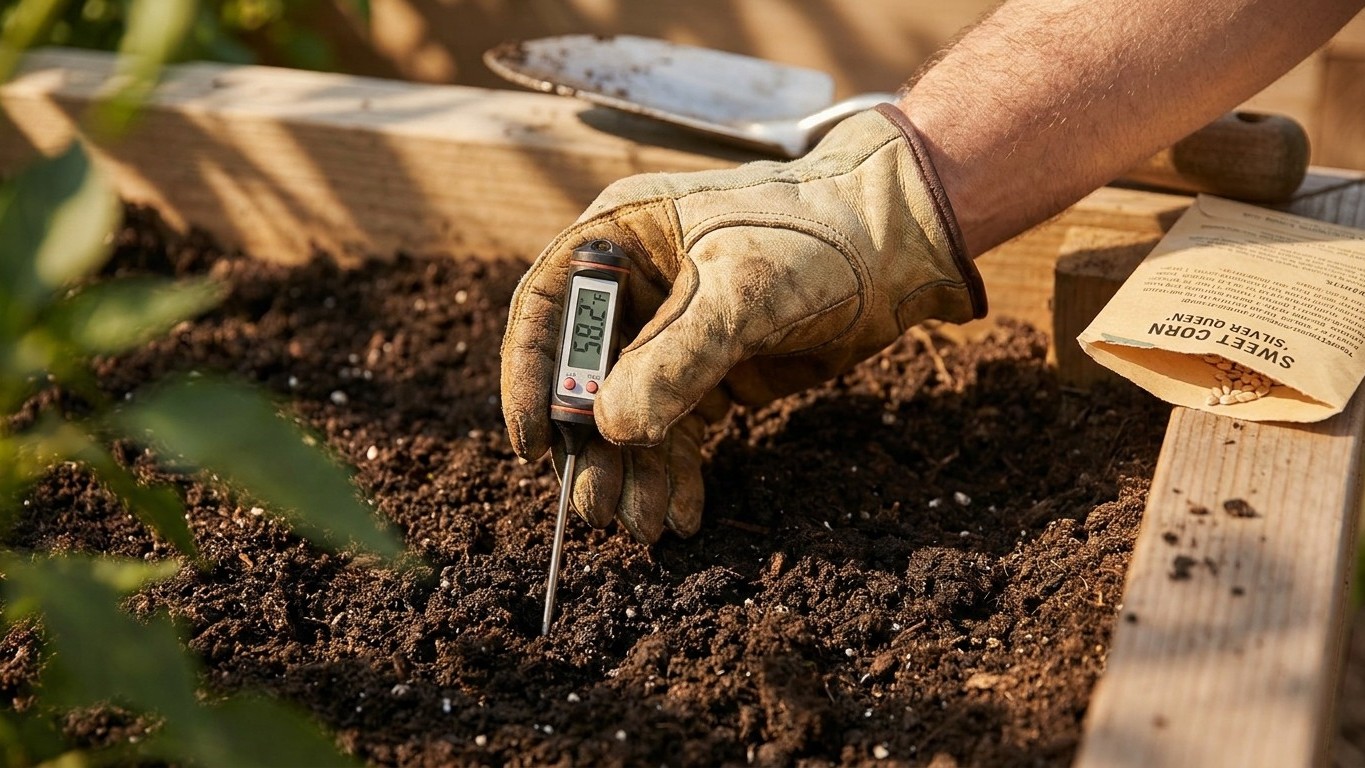

In most Kansas gardens, sweet corn goes into the ground once soil temperature holds above 60°F, which lands well after the last spring frost, not on it. Depending on where you garden in the state, that soil-warming window generally opens sometime after mid-April and stretches into May. From that point, a 60- to 90-day variety has plenty of room before the first fall frost arrives in late October or early November.
The short answer
Soil temperature, not the calendar date of the last frost, is what sweet corn actually responds to. The reference weather station used for this region shows the last spring frost falling somewhere between April 4 and April 18. Soil doesn’t cross the 60°F threshold sweet corn needs on that same day, or even that same week. Bare ground warms slowly, and a cold snap right after the frost date can stall progress for days. So while April 4 to April 18 marks when freezing air temperatures become unlikely, it does not mark when your seed bed is ready. That’s a distinction worth sitting with, because planting on the frost date alone, without checking soil temperature, is one of the most common ways sweet corn gets off to a bad start here.
Once soil does clear 60°F, the next question is whether there’s enough season left to finish the crop. Sweet corn needs 60 to 90 days from planting to harvest, depending on the variety. The first fall frost at the reference station arrives between October 23 and November 2. Doing the arithmetic from the frost-date ranges themselves: the frost-free stretch runs from roughly 188 days (worst case, late spring frost paired with early fall frost) to about 212 days (best case, early spring frost paired with late fall frost). Either way, that’s far more than the 90 days even a slow-maturing variety needs, so the length of the season itself is not the limiting factor for sweet corn in Kansas.
What does matter is heat load during the growing months. The reference station averages 57.6 days a year at 90°F or higher, a heavy dose of summer heat that drives up water demand and can stress corn during pollination if tasseling lands in the hottest stretch of July or August. So the short answer isn’t just a date, it’s a sequence: wait for soil above 60°F, then plant with an eye on when tasseling will fall relative to peak heat, and remember that suburban and rural gardens away from the reference station often see frost arrive later in spring and earlier in fall than these figures suggest, so a soil thermometer and your own county’s pattern matter more than a single fixed date.
Does a late variety fit here?
Given how long the frost-free window runs in this state, both a fast 60-day type and a slower 90-day type generally fit inside the calendar. The real question is less about whether the season is long enough and more about when in that season each type ends up tasseling.
A 60-day variety
A quick-maturing variety planted once soil clears 60°F will typically tassel earlier in the summer, before the heaviest run of 90-plus-degree days sets in. That timing advantage matters in a state where the reference station logs 57.6 such days a year on average. A 60-day type also gives some flexibility for a second, later planting, since it clears the field with weeks to spare before the first fall frost between October 23 and November 2. For gardeners who want a margin of safety against a cool, slow spring, or who want to stagger harvests, the 60-day option is the lower-risk pick.
A 90-day variety
A 90-day type does fit inside the Kansas frost-free window, even in the tighter 188-day scenario. Planted as soon as soil reaches 60°F, it still finishes with a comfortable cushion before the earliest fall frost date. What changes the calculation is how late in the season it gets planted. Push a 90-day variety into a late-May or June planting date, whether because of a cold, slow spring or a deliberate succession planting, and its tasseling window can drift into the hottest weeks of summer, right when the 57.6 average days above 90°F are concentrated. The days-to-maturity fit is not the problem here; the problem is pollen and heat colliding. A 90-day variety belongs in the ground as soon as soil conditions allow, not held back for a later start.
What goes wrong here
- Soil sown too cold. Seed planted before the ground clears 60°F sits wet and sluggish, and germination suffers or fails outright. This is the single most common mistake tied directly to the gap between the last frost date (April 4 to April 18 at the reference station) and the later date when soil actually warms. The remedy is simple: check soil temperature with a thermometer rather than counting days from frost, and expect the safe window to arrive later than the frost date implies, especially in a cooler or shaded garden bed.
- A variety too late for the season. The frost-free stretch here, 188 to 212 days depending on the year, comfortably covers even a 90-day type, so lateness isn’t usually about running out of season. It’s about planting so late in spring or early summer that tasseling lands during the heaviest run of the 57.6 average days above 90°F, which can hurt pollination regardless of how much calendar time is technically left. The remedy is to plant as soon as soil temperature allows rather than delaying a later variety.
- Sweetness lost to cross-pollination. Standard sweet (su), sugary enhanced (se), and supersweet (sh2) types will cross if they tassel at the same time, and the result is starchy, disappointing ears instead of sweet ones. No isolation distance is published for this; what matters is timing. Stagger planting dates so different types tassel in different weeks, or grow only one type per season, and plant sweet corn in blocks of three or more rows rather than a single thin row, which also improves pollination overall.
Common questions
Can I go by the calendar instead of a soil thermometer?
Not reliably. The last frost date at the reference station falls between April 4 and April 18, but soil needs additional time after that to reach the 60°F threshold sweet corn requires. A thermometer pushed a few inches into the bed gives a far more accurate planting signal than any fixed date.
Does my garden match the reference station’s frost dates exactly?
Probably not precisely. Suburban and rural gardens away from the airport-based reference station typically see the last spring frost arrive later and the first fall frost arrive earlier, sometimes by one to two weeks or more at higher elevation. Treat the April 4 to April 18 and October 23 to November 2 windows as a starting reference, then adjust based on your own county’s pattern.
Is a 90-day variety too risky given Kansas summer heat?
Not because of season length, since 188 to 212 frost-free days leaves plenty of room. The risk comes from planting it late enough that tasseling coincides with the heaviest stretch of the 57.6 average days a year above 90°F. Planted promptly once soil clears 60°F, a 90-day type generally avoids that problem.
How do I keep different sweet corn types from crossing?
Focus on timing rather than distance, since no isolation distance is published for su, se, and sh2 types. If they tassel during the same window, cross-pollination and reduced sweetness are the result. Stagger planting dates so tasseling doesn’t overlap, or limit your garden to one type in a given season.