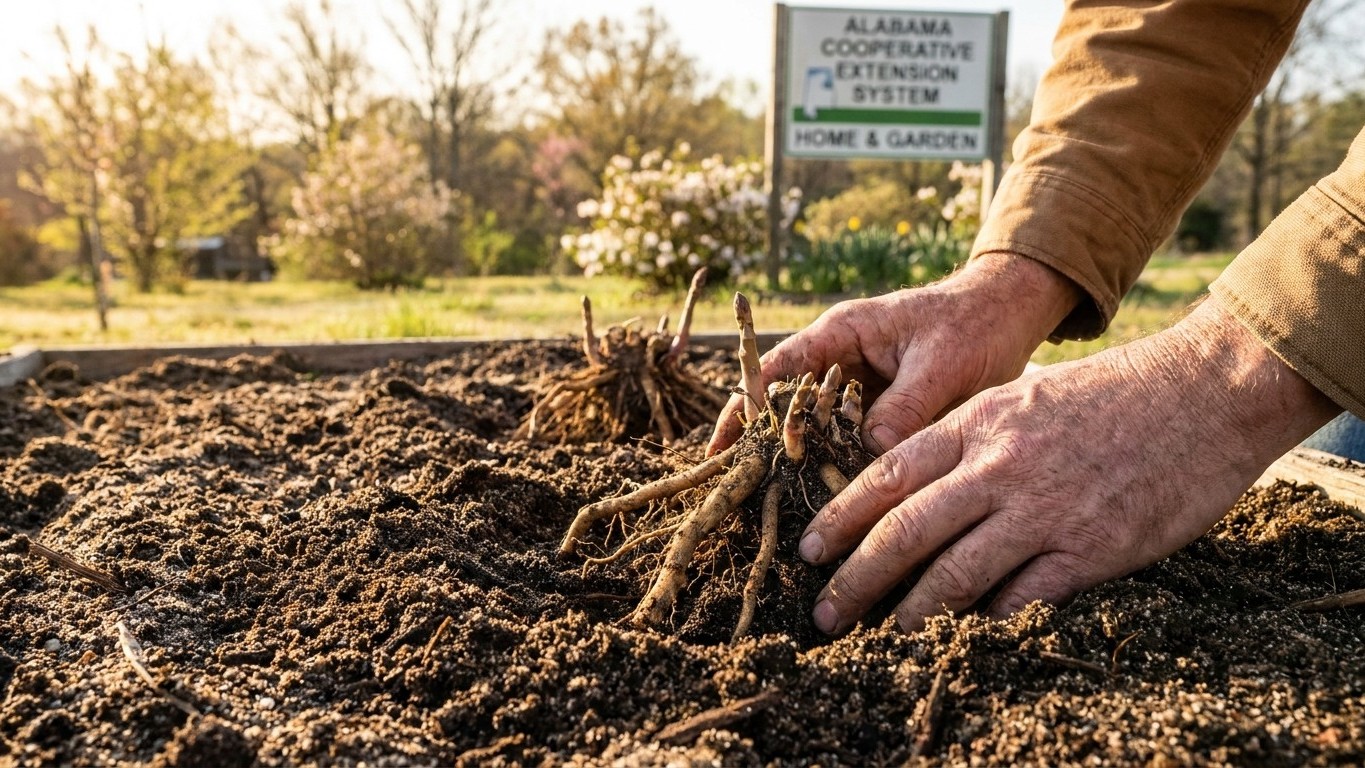

Plant Asparagus Crowns in Louisiana around the tail end of the last frost window, roughly mid-February through early March, once the soil has warmed enough to work. That timing sits right after the state’s typical last freeze date. Before you dig, though, know what you’re signing up for: a bed that stays in that same spot for 10 to 15 years, on soil that must drain well or the whole planting struggles from year one.
The short answer
Asparagus is not a crop you rotate out next season if the spot turns out wrong. Once crowns go into the ground, that bed is committed for a decade or more, and the only hard requirement in the horticultural literature is drainage. According to Utah State University Extension, asparagus crowns are set into furrows about 8 inches deep in early spring, and most soils will support the crop provided they are well drained. That single condition matters more here than the variety picked or the fertilizer used, because a bed that sits wet will rot crowns before they ever produce a spear worth eating.
Louisiana’s representative soil, the Ruston series recognized by USDA NRCS as the state’s benchmark soil, happens to check that box. It’s mapped as well drained, with a sandy surface texture (about 65 percent sand, 11 percent clay, 24 percent silt) that lets water move through rather than pool. The surface pH runs around 5.5, on the acid side, and organic matter sits low, around 1.8 percent. None of that pH figure is something the asparagus source addresses at all, so don’t treat it as a green light or a red flag either way. What the Ruston profile does tell a Louisiana gardener is that sandy, free-draining ground is common across the state, which works in asparagus’s favor.
That said, the Ruston series describes a soil survey composite, not the dirt under any one backyard. Louisiana runs from Mississippi River alluvium to Gulf coastal flatwoods to red clay hill country in the north, and plenty of yards sit on soil nothing like Ruston, especially anywhere a house pad was cut, filled, or compacted during construction. If a shovel of soil holds together in a slick ball and water still sits on the surface an hour after a hard rain, that ground drains poorly regardless of what the state’s representative soil says. The fix in that case is raising the bed, building a mounded row 8 to 10 inches above grade, or choosing a different spot on the property where water visibly moves away after storms. A basic soil test through a local extension office settles the drainage and texture question for that specific spot far better than any state-level average can.
What’s published on varieties
Utah State University Extension names four asparagus varieties, distinguished only by their sex: Jersey Giant and Jersey Knight are all-male, while UC 157 F1 and Purple Passion are male-and-female. No flavor comparison, yield figure, or regional preference is published alongside them, so a gardener choosing between these four is choosing blind on anything beyond plant sex, which affects volunteer seedlings more than the food on your plate.
| Variety | Plant type |
|---|---|
| Jersey Giant | All-male |
| Jersey Knight | All-male |
| UC 157 F1 | Male and female |
| Purple Passion | Male and female |
Will the summer here water it for you?
Asparagus wants 1 to 2 inches of water every other week for its first two years in the ground, then eases to every three weeks once the bed is established. Louisiana’s summer rain totals look generous on paper. Across the reference station’s 1991-2020 normals, June through August brings about 21.3 inches, with June at 7.62 inches, July (the driest of the three) at 6.79, and August at 6.91. That’s more total water than a young asparagus bed technically needs over the same stretch. But a monthly average and a working watering schedule are two different things, and here’s how to bridge them.
- Check the rainfall against the schedule, not the season. A bed needing water every other week wants roughly 6 to 13 inches spread evenly across a 13-week summer. Louisiana’s 21.3 inches clears that bar on total volume, so the shortfall isn’t usually quantity.
- Watch for the gaps, not the average. Gulf Coast rain tends to arrive as heavy, short thunderstorms rather than steady soaking rain, meaning a two- or three-week dry stretch can sit inside a month that still averages out fine on paper.
- Factor in the sandy Ruston-type surface many Louisiana gardens sit on. Sand sheds water fast, so even a decent rain event may not carry a bed through two full weeks the way the same rainfall would on a heavier clay soil.
- Put a rain gauge on the actual bed. That single tool tells a gardener more than any regional normal, since a rain shadow, a nearby structure, or a slope can all shift what falls on one yard versus the station average.
- Supplement by hand or drip whenever 10 days pass without at least an inch of rain, especially through July, the driest of the three summer months on record.
In practice, most Louisiana asparagus beds need occasional supplemental watering during dry spells even though the seasonal total looks sufficient. The rain is there over three months; it just doesn’t always show up on the two-week schedule the plant actually follows.
When to put the crowns in
Crowns go into Louisiana ground in early spring, timed around the state’s last frost rather than a fixed date. NOAA’s 1991-2020 climate normals put the last spring freeze, the 32F threshold, occurring somewhere between January 18 and February 8 in most years at the reference station. That’s an average window, not a guarantee, so treat it as a rough marker for when the freeze risk clears rather than a date circled on a calendar.
South Louisiana’s freeze pattern is unusual enough that it changes how this planting rule reads. A 32F freeze shows up in only about 86.8 percent of years at the reference station, which means roughly one year in seven never dips to freezing at all, and the fall-to-winter freeze window can straddle the turn of the calendar year rather than landing predictably each season. Practically, that means the limiting factor for asparagus timing in south Louisiana isn’t really frost the way it is farther north. It’s how fast the soil warms enough in late winter to work it and set crowns before summer heat arrives. North Louisiana sees freezes far more consistently, so gardeners there can lean on the frost window more literally than someone gardening near the coast.
Given that, most Louisiana gardeners set dormant crowns around mid-February into early March, once soil is workable and the worst of the freeze risk has typically passed. The furrow gets backfilled gradually rather than all at once: about 2 inches of soil added back over the furrow every other month across the first growing season, rather than filling it in on planting day.
Seed is the alternative route, though it adds a full extra year before the planting reaches crown size and can go in the ground the way a purchased crown does. Because of that lag, most home gardeners in Louisiana skip seed starting and buy dormant crowns directly, which is also the method the core planting guidance from Utah State University Extension describes in detail. Whichever route is chosen, the harvest clock doesn’t start moving until the bed is established: no spears get cut in year one or year two, with the first harvest, four weeks of cutting, arriving only in year three. That builds to six weeks the following year and eight weeks after that, with harvest ending each season not on a set date but when most spears emerging from the bed have gone thinner than a pencil, a sign the plant needs its energy back for the rest of the growing season.
Common questions
Can asparagus grow in Louisiana’s acidic soil?
The published planting guidance from Utah State University Extension is silent on soil pH, so no specific acid tolerance figure exists to check the state’s representative 5.5 pH against. What is published is that most soils work as long as they drain well, which is the factor worth testing on any individual plot.
Does asparagus need a period of winter chill in Louisiana?
That’s not addressed in the available planting guidance either. No chilling-hour requirement is published for asparagus crowns, and hardiness zone alone doesn’t translate into a chilling figure, so that detail simply isn’t available to plan around here.
How long before an Asparagus Bed produces anything to eat?
Three years, with no cutting allowed in the first two. Year three brings a four-week harvest window, which extends to six weeks the year after and eight weeks the year after that, provided the bed stays healthy.
What if my yard’s soil doesn’t drain well?
Build up rather than dig down. A raised or mounded bed, 8 to 10 inches above the surrounding grade, sidesteps a slow-draining spot without needing to relocate the entire planting, and it’s a simpler fix than trying to amend heavy ground enough to satisfy a crop that will stay put for over a decade.