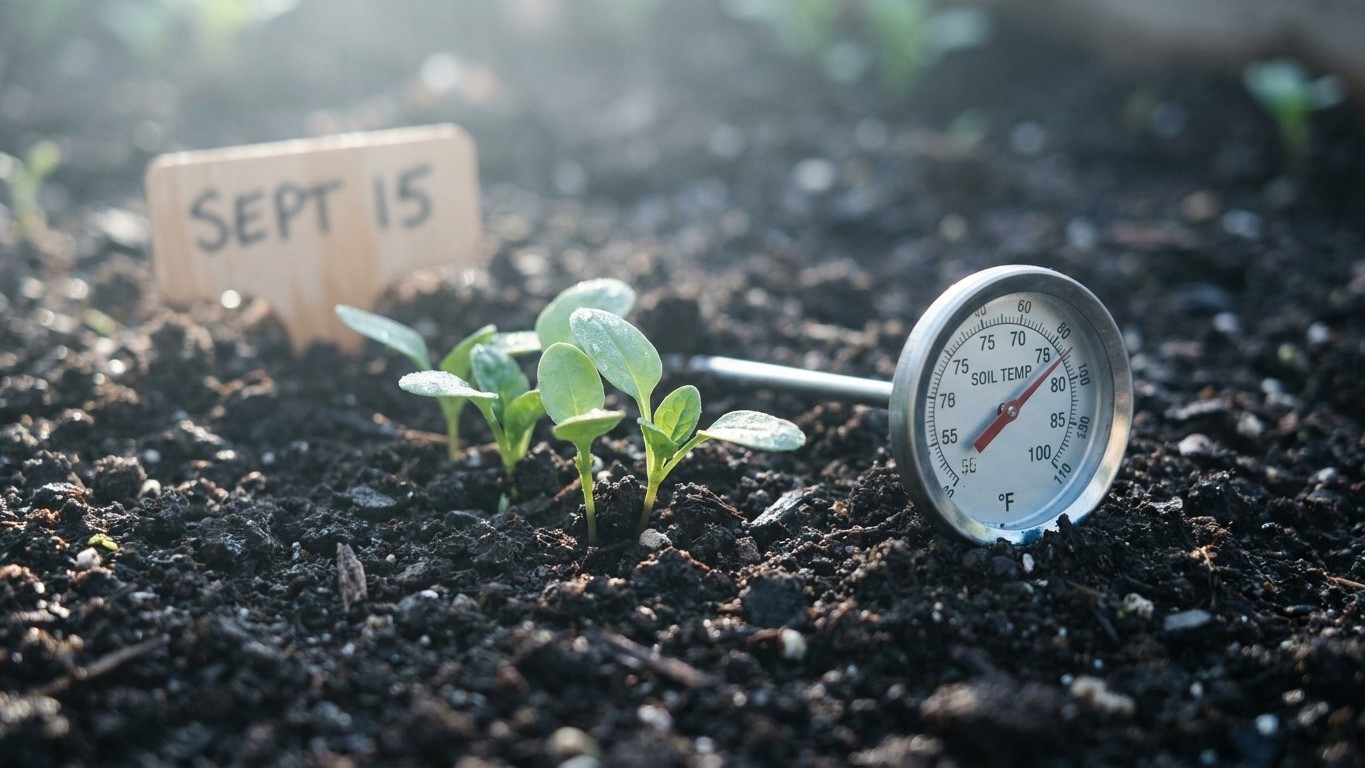

In Louisiana, the safest window for sowing autumn spinach falls roughly between early October and mid-November, once soil temperatures drop back below 80 degrees F. Aim your seed date so harvest lands 50 to 75 days later, ideally before the first widespread freeze in mid-December to early January. The soil, not the calendar, is the real gatekeeper here.
The short answer
On the longest day of the year, Louisiana gets 13 hours and 56 minutes of daylight. That’s not an extreme number as U.S. latitudes go, but it matters because spinach bolts during long days combined with warm temperatures. A cool summer wouldn’t rescue the crop even if Louisiana had one, because the day-length trigger fires regardless of how mild the air feels. The plant doesn’t wait for heat to decide it’s time to flower; the light itself is part of the signal.
But Louisiana doesn’t offer a cool summer to test that theory. The state averages 70.7 days a year above 90 degrees F, measured at the New Orleans reference station. That’s roughly ten weeks of genuinely hot weather stacked on top of a day length that’s already pushing spinach toward bolting. Spinach grows best where temperatures stay under 75 degrees F, and that ceiling isn’t a soft suggestion. Above it, growth slows, leaves turn bitter, and the plant channels its energy into a flower stalk instead of foliage.
So which factor actually limits spinach in Louisiana: day length, heat, or both? Both mechanisms are in play, since long days and warm temperatures act as a combined bolting trigger everywhere spinach grows. But in Louisiana, heat is the more punishing and longer-lasting constraint. Thirteen hours fifty-six minutes of daylight is a fixed, predictable ceiling that shows up for a matter of weeks around the solstice. Seventy days above 90 degrees is a season-long assault that starts well before summer solstice and lingers into early fall. Growers further north deal with the same day-length problem but a shorter, less severe heat season. In Louisiana, heat decides most of the outcome, and day length just closes the door a little earlier on either side.
That combination is exactly why Louisiana gardeners plant spinach twice a year, in narrow windows, rather than treating it as a long-season crop the way warm-climate gardeners treat okra or sweet potatoes. Spring and fall each offer a brief stretch where temperatures sit under that 75-degree ceiling and daylight hasn’t yet stretched into bolting territory.
How long the spring window really is
Working out the spring window means starting from the frost date and moving backward and forward from it, since spinach seed goes into the ground before the last frost, not after.
- Start with the last spring frost. NOAA’s 1991-2020 climate normals put Louisiana’s last spring freeze between January 18 and February 8, based on the 30-70 percent probability band for a 32-degree F freeze at the reference station.
- Subtract two to three weeks for sowing. Spinach seed goes in two to three weeks before that last frost date, which puts the earliest sowing somewhere between late December and mid-January, depending on how the season is running.
- Track how fast the ceiling arrives. Once temperatures climb, they climb fast in Louisiana. The same climate pattern that produces 70.7 days above 90 degrees F in summer means the 75-degree growth ceiling gets crossed early, typically well before most other spinach-growing regions even reach it.
- Add it up. Between a sowing date in late December or January and a growth ceiling reached within a matter of weeks after that, the usable spring window in Louisiana is short, closer to a single stretch of a month or so than to the two- or three-month spring seasons gardeners further north can count on.
That narrow spring window is the main reason autumn carries more weight for Louisiana spinach growers. Spring spinach here is a quick, almost opportunistic crop, sown while the soil is still cold from winter and harvested before the heat arrives. Miss the window on either end, either sowing too late or harvesting too slowly, and the plants bolt before they’re worth eating.
The autumn crop, and when the soil lets you sow
Soil that’s still too warm
Autumn sowing in Louisiana isn’t blocked by cold. It’s blocked by heat lingering in the ground long after the calendar says fall has started. Spinach seed germination drops once soil temperatures climb above 80 degrees F, and Louisiana’s soil holds onto summer warmth for weeks after the air itself starts to feel more comfortable. With 70.7 days a year averaging above 90 degrees F, the ground has a lot of stored heat to shed before it’s hospitable to spinach seed. Practically, that means waiting until well into the fall season, rather than sowing at the first cool morning, gives seed a real chance to germinate instead of sitting dormant or rotting in soil that’s still too warm.
The frost that ends the season
Louisiana’s first fall frost arrives between December 17 and January 8, according to the same NOAA climate normals used for the spring date. That’s a wide, late window compared to most of the country, and it comes with an important caveat: a 32-degree F freeze occurs in only 86.8 percent of years at the reference station. Roughly one year in seven, south Louisiana sees no freeze at all, and the fall growing window simply stretches on, straddling the new year. North Louisiana freezes more reliably than the coastal south, though the exact dates for that region aren’t part of this data set.
Counting back from a harvest target near the first frost gives the actual sowing window. Using 50 to 75 days before harvest, the range Utah State University Extension gives for fall spinach, a harvest planned for mid-December points to sowing sometime between early October and late October. A harvest planned for early January, more realistic in years without an early freeze, pushes the sowing window later, into November. Combined, that gives Louisiana gardeners a sowing range running roughly from early October through mid-November, with the earlier end of that range favoring gardeners who want to harvest before the holidays and the later end favoring those willing to gamble on a mild winter.
Four spinach varieties come up repeatedly in extension guidance: Bloomsdale, Melody, Teton, and Olympia. No days-to-maturity figures or performance data for any of them appear in the sourced material here, so none should be assumed. Choosing among them means relying on seed packet information rather than extension-published comparisons.
Common questions
Can I sow spinach in Louisiana all winter long?
Not reliably as a single continuous season. The autumn crop sown in October or November can carry through winter in years without a hard freeze, since the first freeze sometimes never happens at the reference station. But treating winter as a guaranteed growing season ignores the one-in-seven years when a freeze does show up and ends things early.
Why does soil temperature matter more than air temperature for fall sowing?
Seed sits in the soil, not the air, during germination. Above 80 degrees F soil, germination drops off even if the air feels like a pleasant fall day. Louisiana ground holds summer heat well into what looks, above the surface, like autumn.
Is spring or fall the better season for spinach in Louisiana?
Fall offers the wider, more forgiving window, since the sowing range stretches across roughly six weeks and the harvest deadline is a frost that sometimes doesn’t even arrive. Spring is a narrower, faster crop squeezed between the last frost and the early arrival of the 75-degree growth ceiling.
Does a mild Louisiana summer mean spinach can be grown longer?
No. Bolting is triggered by long days as much as by heat, so even an unusually cool summer wouldn’t extend the harvest. The daylight hours around the solstice, 13 hours 56 minutes at the longest, push spinach toward flowering regardless of temperature.