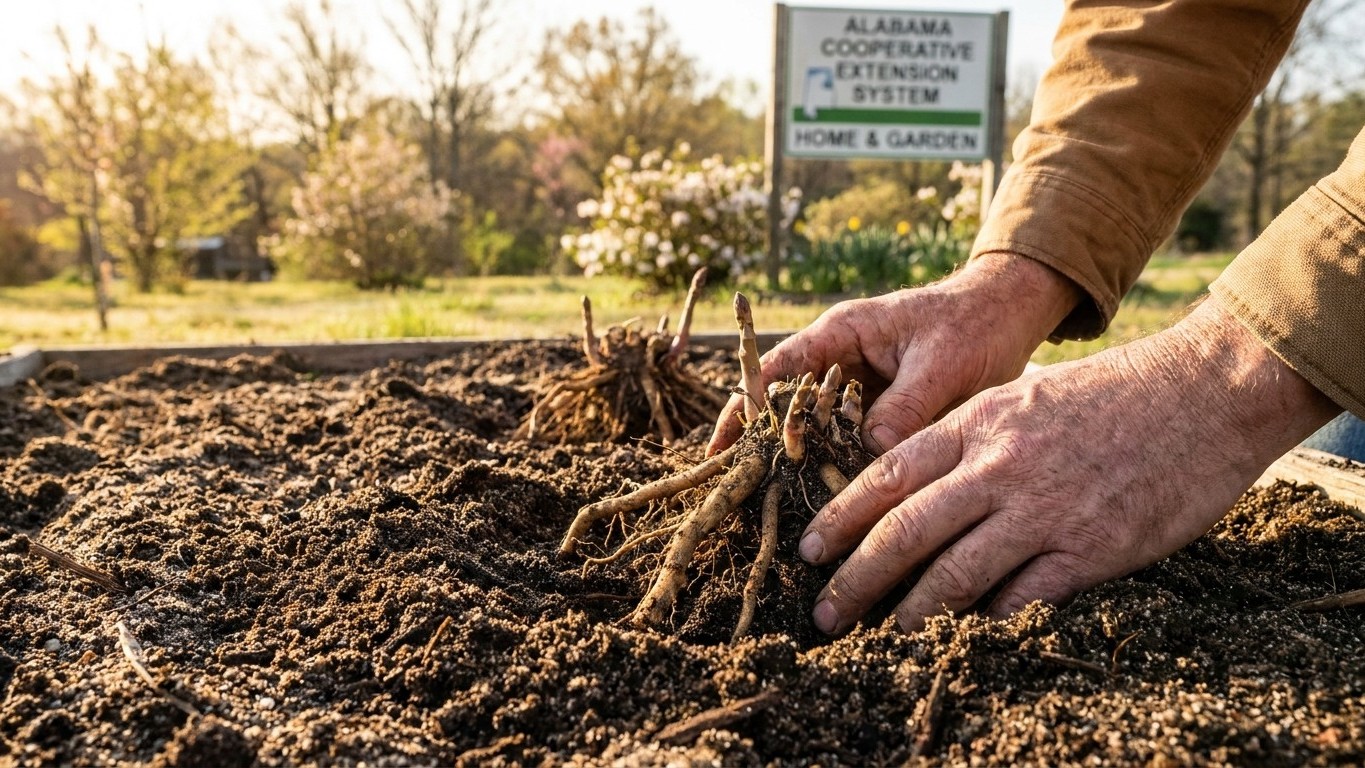

Manitoba gardeners Plant Asparagus Crowns in early spring, timed loosely to the province’s last frost window, and the ground they choose has to earn its keep for a decade or more. The dominant prairie soil drains only imperfectly, which changes how this crop gets planted here more than the calendar does.
The short answer
an Asparagus Bed is not a season’s project. Once the crowns go in, that patch of ground produces for 10 to 15 years, and the crop’s only real soil demand, according to Utah State University Extension, is that the site drains. That single requirement matters more in Manitoba than almost anywhere else on this site, because the province’s most common soil doesn’t clear that bar cleanly.
Across the mapped agricultural surface of Manitoba, the most frequent soil order is Chernozem, the dark, organic-rich prairie soil that covers about 41 percent of the mapped area, with Gleysolic soils close behind. The median surface reading runs alkaline, around pH 7.6, in a loam-to-silt texture (45 percent sand, 24 percent clay, 31 percent silt) carrying roughly 5.5 percent organic matter. On paper that sounds like rich, workable ground, and mostly it is. The catch, per the Canadian System of Soil Classification, is that this typical profile is rated imperfectly drained. That’s the one word that should make an asparagus grower pause before choosing a bed site.
Imperfectly drained doesn’t mean waterlogged. It means water sits a bit longer near the surface than a “well-drained” rating would allow, especially in low spots, heavier clay pockets, or spring melt zones. For a crop harvested once a season, that’s a nuisance you fix with a little compost. For asparagus, where the bed is a fifteen-year commitment, poor drainage compounds year after year, rotting crowns slowly instead of killing them outright, and by the time a gardener notices the stand thinning, most of the decade is already gone.
This provincial figure is a starting point, not a verdict on any one yard. It comes from mapped agricultural soils and says nothing about a specific river-bottom lot, a patch of muskeg, or the fill dirt behind a newer subdivision, all of which can drain completely differently from the median. The province’s far north also sits outside this agricultural survey entirely. Anyone serious about a bed that has to last through the 2030s owes it a real look: dig a foot-deep hole, fill it with water, and time how long it takes to disappear. If it lingers more than a few hours, the fix isn’t complicated. Raise the bed six to eight inches above grade, work in coarse sand and compost to open up the clay fraction, and site the row where water has never been seen to pool after a spring thaw. On land that already drains fast, none of that is necessary and the crowns go straight into native soil.
Will the summer here water it for you?
Asparagus wants water on a schedule that shifts with the bed’s age: 1 to 2 inches every other week for the first two seasons while roots establish, easing back to roughly an inch every three weeks once the planting matures. Manitoba’s summer rainfall, measured at the Winnipeg Richardson station over the 1981-2010 normals period, comes in at about 9.7 inches across June, July and August, with August running driest at 3.03 inches. Here’s how that stacks up against the crop’s needs.
- Early establishment (years one and two): a 1-2 inch requirement every other week works out to roughly 2 to 4 inches a month. June’s average of 3.54 inches sits inside that range if it falls evenly, but July (3.13 inches) and especially August (3.03 inches) land at the low edge or below it.
- The distribution problem: prairie summer rain tends to arrive as thunderstorms rather than steady soakers, so a single 1-inch downpour can run off a young bed faster than it infiltrates, leaving the total rainfall figure looking better on paper than it performs in the ground.
- What that means in practice: a new asparagus bed in Manitoba should not be left to rainfall alone through July and August. A rain gauge on the actual plot, not a regional average, is what tells a gardener whether a given week needs a hose.
- Established beds (year three onward): the lighter target of about an inch every three weeks, roughly 1.3 inches a month, sits comfortably below what even the driest summer month here typically delivers, so mature stands lean far less on supplemental watering.
- The soil crosses this figure too: on the province’s imperfectly drained, silt-heavy ground, rain that does fall tends to linger rather than vanish, which can offset some of the shortfall in an average summer, but works against the bed in a wet spring by keeping crowns sitting in moisture longer than they should.
When to put the crowns in
Crowns go into 8-inch furrows in early spring, according to Utah State University Extension, which for Manitoba growers means working around the province’s last spring frost window rather than a fixed date. The Winnipeg Richardson station’s climate normals put the mean last spring frost at around May 23. That figure is an average, not a guarantee: in roughly half of all years, frost arrives later than that date, so treating May 23 as a safe cutoff is a mistake. It’s better read as the midpoint of a window that can slide either direction, and growers farther from that reference station, particularly in northern or upland parts of the province, should expect their own local window to run later still.
Because the crowns themselves are being planted dormant, the practical approach most gardeners use is to get them into the ground once the soil has thawed and can be worked, roughly around that late-May marker, rather than waiting for the calendar to clear every last frost risk. The furrow itself isn’t filled in all at once. Backfilling happens gradually across the season, adding about two inches of soil every other month as the emerging spears grow taller, until the trench is level with the surrounding bed by year’s end.
The alternative to buying crowns is starting asparagus from seed. It’s a slower road: seed-grown plants need time to build up to crown size before they’re ever transplanted into the permanent bed, which pushes the entire multi-year timeline to first harvest back further than starting with a purchased crown does. For a crop where the first harvest already waits until year three regardless of the starting point, most home gardeners in Manitoba choose crowns simply to avoid adding another full year of waiting on top of that.
Whichever route is chosen, the site decision matters more than the exact planting week. A well-drained spot planted a week later than ideal will outlast a poorly drained spot planted on the perfect day, by a decade or more.
Common questions
How long before an Asparagus Bed can actually be harvested?
Not until the third year, full stop. Utah State University Extension is specific that no spears should be cut in the first two seasons regardless of how vigorous the ferns look; the plant needs that time to build root reserves for the fifteen-year run ahead.
Once harvest starts, how long does it run each spring?
The harvest window lengthens as the bed matures rather than jumping straight to a full season, but the rule that ends each year’s cutting isn’t a date on the calendar. Stop cutting once most of the spears coming up are thinner than a pencil, a sign the plant needs to switch back to growing fern to recharge the crown for next year.
Which asparagus varieties are worth planting in Manitoba?
Utah State University Extension names four: Jersey Giant and Jersey Knight, both all-male varieties, and UC 157 F1 and Purple Passion, which are male/female. The source identifies them strictly by that sex characteristic and publishes nothing about flavor, yield, or a reason to prefer one over another, so no variety recommendation is made here beyond what’s documented.
Does the province’s alkaline soil or its winter cold change what needs to be done?
The median soil reading for Manitoba runs alkaline, around pH 7.6, but the sourced guidance on asparagus is silent on any preferred soil pH, so no target number is given here. The same source is silent on winter chilling requirements as well. Neither should be invented or backed into from the hardiness zone; a soil test remains the only way to know an individual garden’s actual pH.