
The short version: in Manitoba, autumn spinach goes into the ground somewhere between early July and early August, counted backward 50 to 75 days from the harvest you want before the first fall frost. Spring sowing runs from roughly the first week of May through mid-June. Neither window is generous, and neither is set by cold, they’re set by day length and by soil that won’t cooperate.
The short answer
On the longest day of the year, Manitoba sees 16 hours and 8 minutes of daylight. That number matters more than most gardeners realize, because spinach flowers, or bolts, in response to long days as much as it does to heat. A plant sitting under more than 16 hours of light is getting a biological signal to stop making leaves and start making seed, regardless of whether the thermometer is comfortable or not. This is the opposite of what long days do to onions, where extended light builds the bulb. For spinach, long light is the enemy, and Manitoba’s summer sky delivers it in full.
That’s why a cool Manitoba summer doesn’t buy extra growing weeks the way it might for a heat-sensitive crop. Spinach grows best where temperatures stay under 75 F, and Manitoba’s climate record shows almost no days reaching 90 F, an average of 0.0 such days a year at the Winnipeg reference station. So the classic culprit, brutal summer heat, is largely absent here. What isn’t absent is the long daylight of a northern prairie summer, which pushes spinach toward flowering on its own schedule no matter how mild the afternoons feel.
So which is it: day length or heat? In Manitoba, the honest answer is both, but day length carries more of the weight. Typical summer daytime highs still climb past the 75 F growth ceiling often enough to stress the plant and turn the leaves bitter, even without the extreme heat spikes that punish spinach in warmer states. Layer that ordinary summer warmth on top of 16-plus hours of daylight, and the plant gets pushed from two directions at once, even though only one of those directions (day length) is doing the heavy lifting.
The practical result is a plant with a short season of good behavior, bracketed on one side by the point in spring when the days are still short enough and the ground has warmed enough to germinate, and on the other side by the point in late summer when heat has faded and daylight has shortened again but frost hasn’t yet closed things down. Everything else in this guide is about finding those two brackets on the calendar.
How long the spring window really is
Working out the spring window means starting from a fixed point, the average last spring frost, and moving both directions from there.
- Start with the average last frost. Environment and Climate Change Canada’s 1981-2010 normals put the average last spring frost at the Winnipeg Richardson International Airport station at May 23. This is a mean, not a guarantee: in roughly half of all years, frost arrives after that date, so treat it as the middle of a range rather than a safe line to plant against.
- Move back two to three weeks for sowing. Spinach seed goes in the ground two to three weeks before that average last frost, which lands sowing somewhere between roughly May 2 and May 9 in most Manitoba gardens, soil conditions allowing.
- Track forward to the growth ceiling. From early May, the plant has good growing weather until temperatures start regularly pushing past that 75 F ceiling and daylight climbs toward the June solstice peak of 16 hours 8 minutes. In practice that combination arrives by the second half of June.
- Add it up. That leaves a spring window of roughly six to seven weeks, from early May sowing to a harvest that should wrap up before the longest days of June take over.
It’s a workable window, but not a wide one, and it closes from the top down: the calendar doesn’t warn you with cold, it warns you with light. A gardener watching only the thermometer can miss the signal entirely and end up with a patch that’s bolted before the leaves ever reached full size.
The autumn crop, and when the soil lets you sow
Fall spinach doesn’t have to fight long days, since by midsummer the daylight is already shortening again. Its obstacles are different: soil that’s still too warm to sprout the seed, and a frost date that eventually shuts the whole thing down. There’s no published days-to-maturity figure for spinach from the source used here; instead, the guidance is to count back 50 to 75 days from the harvest date you’re aiming for.
Soil still too warm to germinate
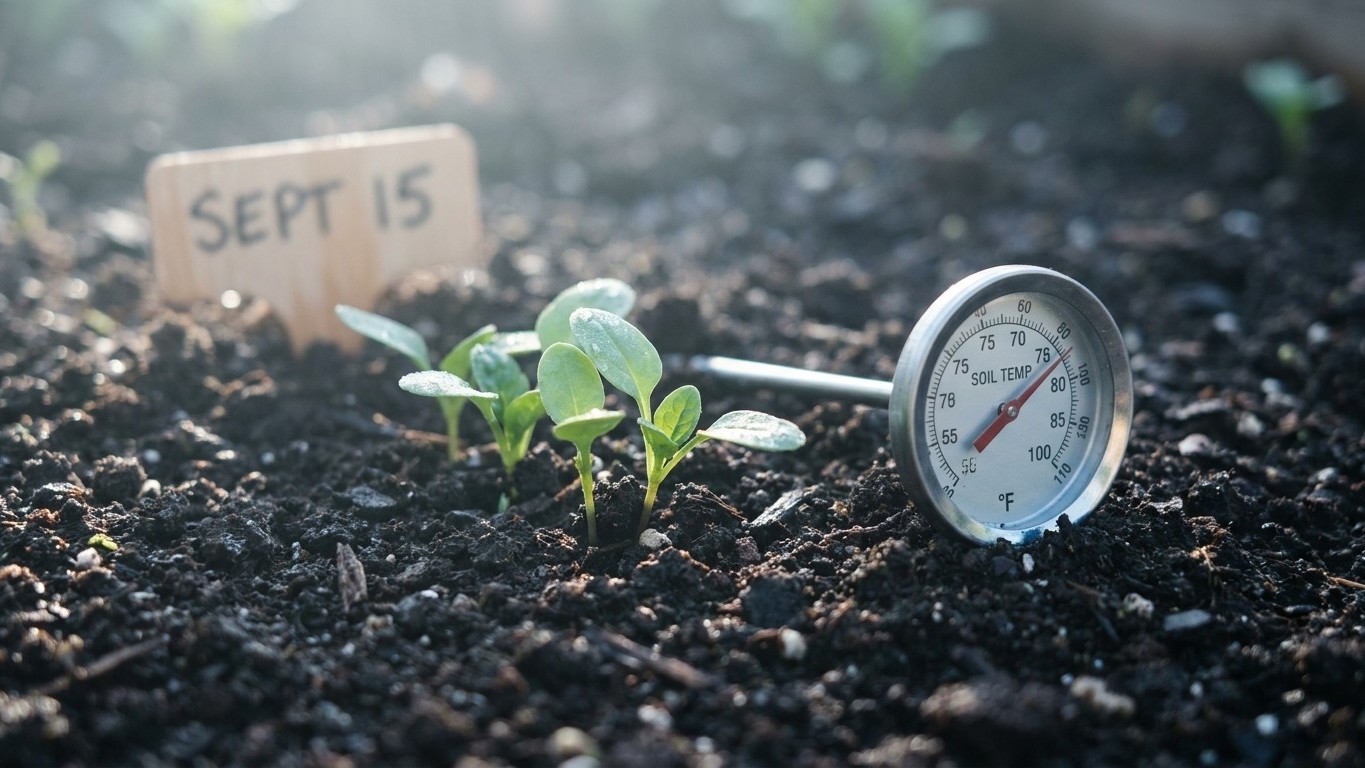
Spinach seed germinates poorly once soil temperatures climb above 80 F, and Manitoba’s July soil, even without extreme air temperatures, holds heat well into late summer. This is the real gatekeeper for a fall crop: not the calendar, but the ground itself. Sowing directly into hot July soil often means poor or spotty germination, so many Manitoba gardeners wait until the soil has started cooling in late July or early August before putting seed down, sometimes shading the row or watering to bring soil temperature down faster.
The frost that ends the season
On the other end sits the average first fall frost, September 22 at the Winnipeg Richardson station, again a mean figure from the 1981-2010 normals rather than a firm cutoff; in about half of all years frost arrives later than that. Counting back from a September 22 target harvest, 50 to 75 days lands sowing between roughly July 9 and August 3. That window overlaps directly with the point when soil is finally cooling enough to germinate reliably, which is exactly why most fall spinach in Manitoba goes into the ground in late July into early August rather than any earlier.
Four varieties are commonly named for garden spinach: Bloomsdale, Melody, Teton, and Olympia. No performance data, days-to-maturity figures, or bolt-resistance ratings for any of them appear in the source used for this page, so none are described further here.
Common questions
Can I sow spinach earlier than early May to stretch the spring crop?
Only if the soil is workable and not frozen, since the two-to-three-week rule is measured back from the average last frost, not from an arbitrary date. Sowing much earlier than that risks seed sitting in cold, wet soil without germinating, while sowing later shortens the window before day length and heat push the plant toward bolting.
Does a cool Manitoba summer mean I can sow spinach again in July for a second crop before fall?
No. Regardless of how mild the temperature stays, daylight in early-to-mid July is still close to the seasonal peak, and long days alone are enough to send spinach toward flowering. The autumn sowing window only opens once daylight has meaningfully shortened and soil temperature has dropped below the 80 F germination threshold, which in Manitoba lands in late July at the earliest.
What happens if I sow fall spinach too early, while the soil is still hot?
Germination drops off sharply once soil exceeds 80 F, so early sowing usually means thin, patchy stands rather than outright failure. Waiting until soil has started cooling, even by a couple of weeks, tends to produce a more even germination rate for the fall crop.
Is the September 22 first frost date safe to plan a harvest around?
Treat it as a midpoint, not a promise. Because it’s an average from the 1981-2010 climate normals, frost arrives later than September 22 in roughly half of all years, and earlier in the other half. Planning a harvest date a week or so ahead of that average, rather than right on top of it, gives more room for a year when frost comes early.