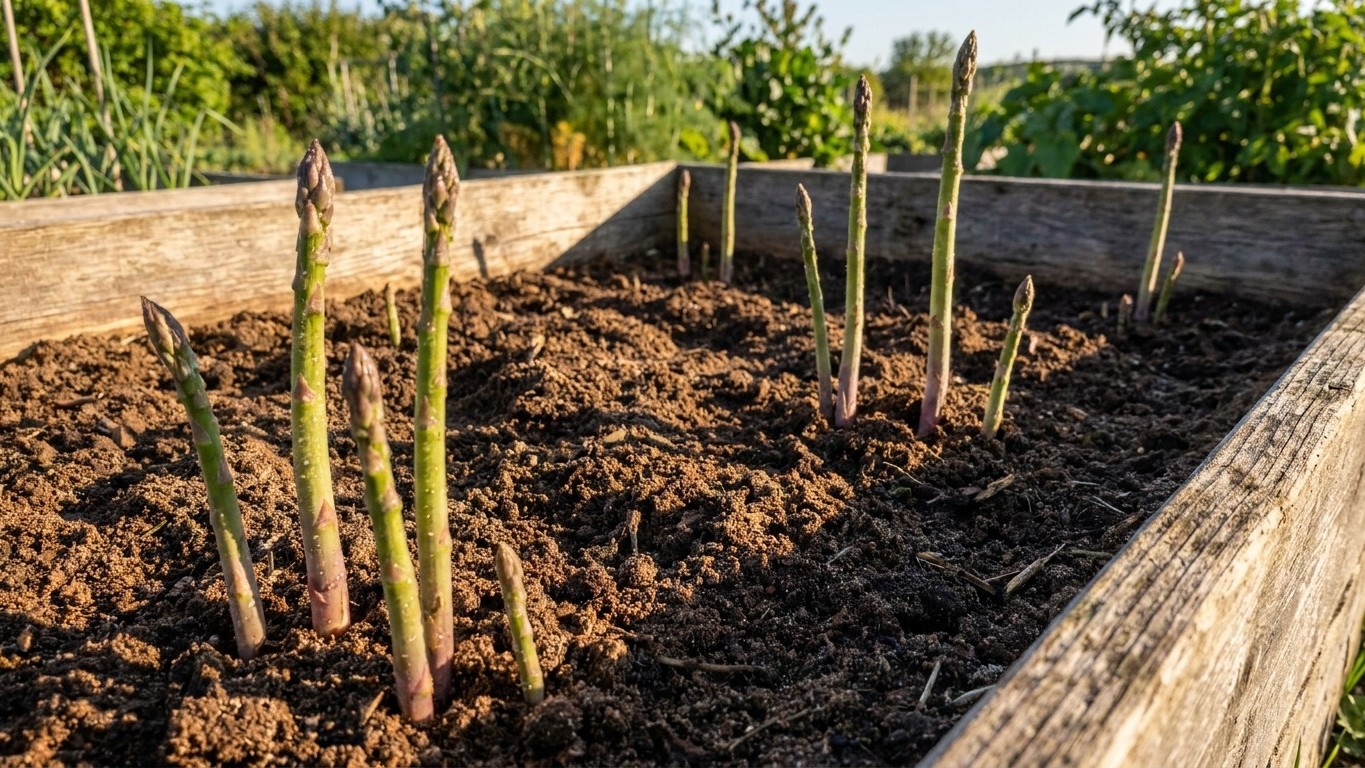

Fifteen years is the outer edge of what an Asparagus Bed can give you, and the ground you plant it in has to hold up for the whole stretch. Minnesota’s representative soil, the Lester series, drains well by nature, which is the one soil trait asparagus actually asks for. That’s a good sign for the state as a whole. It says nothing about the drainage in your particular backyard, which is the number that actually matters.
The short answer
Minnesota’s official state soil is the Lester series, an Alfisol formed under forest cover. It runs loam to silt loam near the surface, about 39 percent sand, 24 percent clay, 37 percent silt, with a pH near neutral at about 6.6 and organic matter around 3.0 percent. The USDA classifies it as well drained. For a crop that asks for exactly one soil condition, drainage, that’s a favorable starting point across much of the state.
Asparagus doesn’t care about pH tolerance ranges or fertility charts here. The published guidance from Utah State University Extension is narrower than that: crowns go into 8-inch furrows in early spring, no harvest happens until year three, and after that the bed can keep producing for 10 to 15 years. Most soils will support that timeline provided they drain. A soil that stays soggy in spring, or that puddles for a day after a heavy rain, is a soil that will rot crowns before they ever get established.
A state figure is not a shovel test
The Lester series numbers describe a mapped surface horizon across 251 sampled components, not the six-foot circle where you’re about to dig a furrow. River bottoms run wetter. Land that’s been graded, filled, or compacted by construction equipment behaves nothing like the undisturbed profile USDA recorded. If water still sits on your planting site an hour after a hard rain, that’s your answer, regardless of what the state soil does elsewhere. The fix in that case isn’t giving up on asparagus. It’s building a raised bed, 8 to 10 inches above grade, and filling it with a well-draining mix, so the fifteen-year clock runs on soil you control rather than soil you inherited.
Variety is the one open question
Utah State University Extension names four varieties gardeners commonly plant, but the source gives only one detail about each: whether the plant is all-male or produces both sexes.
| Variety | Type |
|---|---|
| Jersey Giant | All-male |
| Jersey Knight | All-male |
| UC 157 F1 | Male and female |
| Purple Passion | Male and female |
No flavor comparison, no yield figure, and no reason to favor one over another appears in that source. All-male varieties are generally chosen because they don’t spend energy on seed production, but that reasoning isn’t published here either, so treat it as background, not a verified fact.
Will the summer here water it for you?
Asparagus has a specific watering schedule tied to its age, and Minnesota’s summer rainfall covers part of it, not all of it. Here’s how the two line up.
- Years one and two. The bed wants 1 to 2 inches of water every other week while the root system is establishing. Minnesota’s summer normal, measured at the reference station used for these figures, runs about 13.0 inches across June, July and August, broken down as 4.58 inches in June, 4.06 in July and 4.34 in August. Spread evenly, that’s close to what a young bed needs on paper. Rain rarely spreads evenly, though. A single 2-inch thunderstorm followed by ten dry days leaves the same monthly total but a very different soil moisture curve, and July, the driest of the three months at 4.06 inches, is exactly where that gap tends to show up.
- Year three onward. Once the bed is established, the demand drops to 1 to 2 inches every three weeks. That’s a much lighter ask, and Minnesota’s summer rainfall pattern generally clears that bar without help in most years.
- The variable that decides it. Neither the rainfall normal nor the watering schedule accounts for your own soil texture. A sandy pocket sheds water fast and dries out between rains faster than the Lester series’ loam-to-silt profile would. A rain gauge staked next to the bed, checked weekly through the growing season, is the only way to know if a given July actually delivered its normal or fell short of it.
None of this is a forecast. These are 1991-2020 climate normals for one reference station, and a rain shadow, a slope, or a nearby city can shift the real number on any given plot.
When to put the crowns in
Crowns go into the ground in early spring, and for Minnesota that window sits around the state’s last spring frost dates, which run from April 17 to April 30 depending on location. That’s a mean date, not a guarantee, so treat it as the center of a range rather than a fixed calendar day, and expect it to arrive later the further north you garden. The Twin Cities sit at the mild end of that range; northern Minnesota typically runs two to three weeks tighter on both ends of the frost season.
Planting itself isn’t a single afternoon of work. Crowns go into furrows about 8 inches deep, and the furrow gets backfilled gradually across the year, roughly 2 inches of soil added back every other month rather than filling it in all at once. That staged approach lets the emerging spears keep growing toward light as the trench slowly closes, instead of burying them under a full 8 inches of soil on day one.
Seed is the other route, and it exists as a real alternative to crowns, though it asks for more patience. Starting from seed adds time to an already long wait, since the plant needs to develop into something resembling a crown before it can produce the same way a purchased crown does. Either path lands on the same rule regardless of how the bed got started: no harvest in year one, none in year two, and the first cutting doesn’t happen until year three. What isn’t published in the source material is any chilling-hour requirement or a soil pH target for the crop, so neither figure appears here. If a nursery catalog or another site gives you a specific pH number for asparagus, treat it as their addition, not something tied to the guidance used for this article.
Common questions
Can I harvest anything in the first two years?
No. The guidance is explicit that harvest doesn’t begin until year three. Spears that emerge in years one and two should be left to grow into ferns, which feed the crown for the harvests to come.
How do I know when to stop cutting each spring?
Stop when most of the spears coming up are thinner than a pencil. That’s a signal from the plant itself, not a fixed number of weeks, and it will shift slightly from one growing season to the next.
What if my soil doesn’t drain well at all?
Build up rather than dig down. A raised bed 8 to 10 inches above grade, filled with a mix you know drains, sidesteps a native soil that holds water too long. For a planting meant to stay put for up to fifteen years, that upfront work is cheaper than losing crowns to rot in year one.
Does the Lester series soil mean my specific yard will drain well?
Not necessarily. It describes the state’s representative soil across 251 sampled components, mapped as a surface horizon, not your individual lot. Fill, grading, and natural variation between soil series mean the only reliable answer comes from watching how your own ground handles a hard rain, or from a soil test on your specific site.