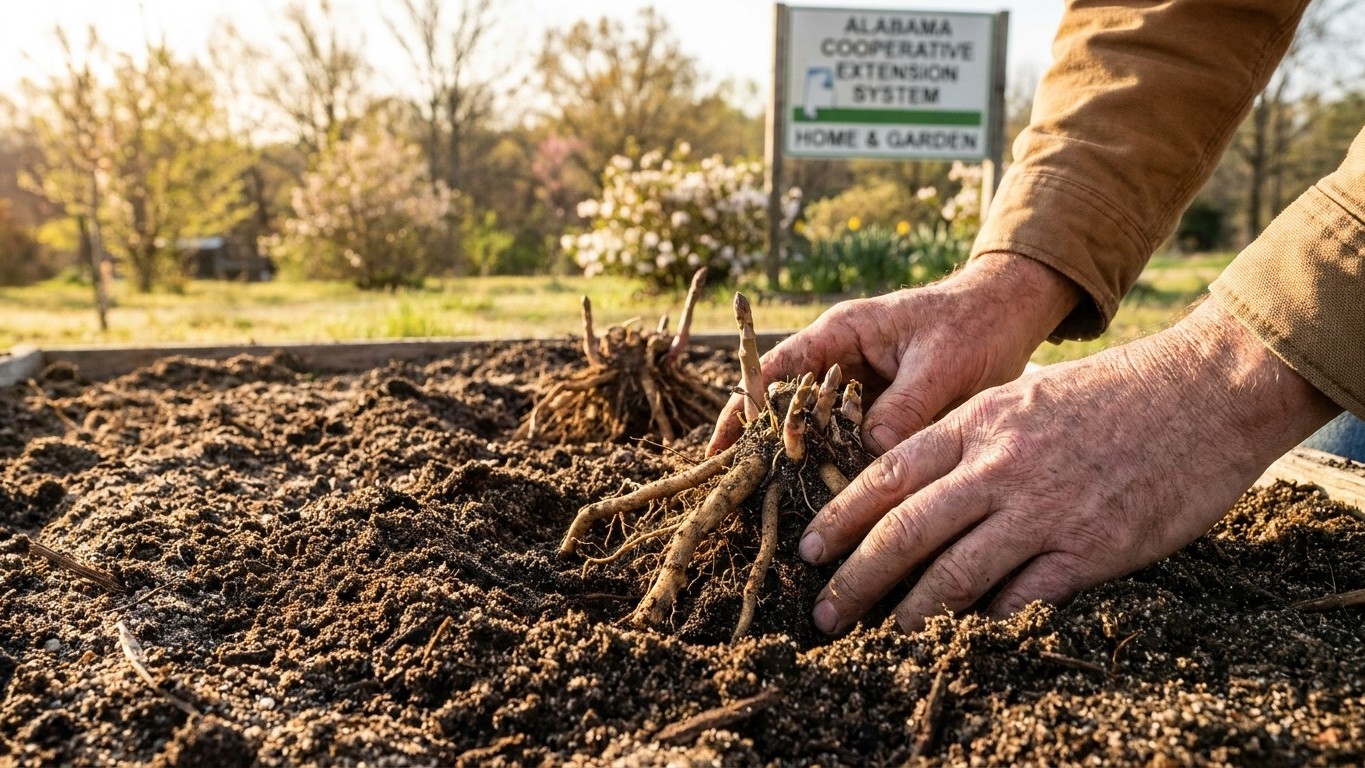

Plant Asparagus Crowns in early spring, once the soil can be worked and the ground has begun to warm, in a spot that drains well because this bed will stay put for 10 to 15 years. In the Twin Cities region, that window sits around the last spring frost, April 17 to April 30. Farther north, tighten both ends by two to three weeks.
The short answer
Asparagus is one of the only crops on a home lot where the planting decision outlives most kitchen renovations. Utah State University Extension puts it plainly: crowns go into 8-inch furrows in early spring, the bed gives nothing back in year one or two, and once it starts producing it keeps going for 10 to 15 years. That single fact should shape where the bed goes more than any other. A tomato patch that turns out to be a bad idea gets rotated out next season. an Asparagus Bed does not.
The one soil condition the source insists on is drainage. Most soils will do, it says, provided they are well drained. That is a low bar on paper, but it is the bar that matters, because asparagus crowns sitting in standing water rot before they ever send up a spear.
Minnesota’s official state soil, the Lester series, gives a useful reference point for what the region’s ground tends to do. The Lester series is an Alfisol, a forest soil of moderate fertility that holds nutrients reasonably well, with a surface texture running loam to silt (39 percent sand, 24 percent clay, 37 percent silt), organic matter around 3.0 percent, and a surface pH near neutral at about 6.6. Critically, it is classed as well drained. That is a favorable starting profile for a bed meant to sit undisturbed for over a decade.
But the Lester series describes what USDA mapped as representative of the state, not what is sitting under any one garden. It is a starting point, not a diagnosis. A river-bottom lot, a hillside parcel, or any yard where a builder scraped and regraded the topsoil can behave nothing like it. The only way to know what a specific bed is working with is to dig a hole after a hard rain and watch what happens: water that lingers for hours signals a drainage problem the Lester numbers say nothing about.
If a garden’s native soil holds water instead of shedding it, the fix is not to abandon asparagus. Raised beds or mounded rows lift the crowns above the saturated layer, and working organic matter into a heavy patch over a season or two improves structure before crowns ever go in the ground. What does not work is planting into wet ground and hoping fifteen years of that spot’s drainage problem sorts itself out.
Will the summer here water it for you?
an Asparagus Bed has a simple watering rule once it is established: about 1 to 2 inches every other week for the first two years while roots are building out, easing to about every three weeks after that. The question for any Minnesota gardener is how much of that the sky already provides.
- What the region’s summer delivers. NOAA’s 1991-2020 climate normals for the reference station put summer rainfall (June through August) at about 13.0 inches total, broken down as June 4.58 inches, July 4.06 inches, and August 4.34 inches. July is the driest of the three, sitting a fraction over an inch a week on average.
- What the bed asks for. At 1 to 2 inches every other week during the establishment years, a bed wants somewhere between roughly 0.5 and 1 inch a week averaged out. On paper, July’s normal of about 4.06 inches for the month covers that baseline in an average year.
- Why the average is not the whole story. Normals are averages over 1991-2020 at one reference station, not a forecast and not a guarantee for any single July. Rain that arrives as one thunderstorm dumps water that runs off a slope rather than soaking into the root zone, and a dry stretch of two or three weeks inside an otherwise average month can still stress young crowns.
- What the soil underneath changes. The same inch of rain acts differently depending on what it lands on. A sandier surface, closer to the Lester series’ 39 percent sand, drains through in a day; a heavier clay surface holds it longer, which can mean less supplemental watering but a higher drainage risk in a wet stretch.
- The practical move. Treat the state normals as a rough baseline and put a rain gauge on the actual bed. If a week goes by with under an inch registered locally, especially during the two-year establishment period, that is the signal to run a hose rather than trust the average.
When to put the crowns in
Crowns go into the ground in early spring, timed around the point when the soil has thawed and dried enough to work but before the season’s growth gets underway. For gardeners in the Twin Cities area, that lines up with the region’s last spring frost window of April 17 to April 30. That is a mean date drawn from 1991-2020 normals, so treat it as a guide to plant around rather than a fixed calendar day; some years run earlier, some later.
Farther north in Minnesota, that window tightens by two to three weeks on both the spring and fall ends of the season, which means northern gardeners should plan on getting crowns in earlier relative to their own local thaw rather than copying the Twin Cities date directly. A local frost record or a call to a county extension office fills in the gap the statewide figure cannot.
Crowns are the standard route, and the one Utah State University Extension describes: dormant, one-year-old roots set into 8-inch furrows. The furrow itself is not filled in all at once. As the season progresses, soil is added back gradually, about 2 inches every other month, rather than backfilling the whole trench the day of planting. That gradual fill lets the emerging spears push through loose soil instead of being buried under a full furrow’s depth immediately.
Seed is the alternative route, though it adds a full growing season before anything resembling a crown exists in the ground. Starting from seed means growing seedlings on for a year before transplanting what is essentially a homegrown crown, which pushes the eventual harvest timeline back accordingly. For most home gardeners, buying dormant crowns and planting them directly in that early spring window is the faster path to an established bed.
On varieties, the source names four without ranking them by flavor or yield: Jersey Giant and Jersey Knight are both all-male selections, while UC 157 F1 and Purple Passion are male/female types. No taste comparison, no yield figure, and no reason to prefer one over another appears in that guidance, so the choice comes down to what a given supplier stocks rather than a documented performance difference.
Common questions
How long until an Asparagus Bed can actually be harvested?
Not until year 3. Utah State University Extension is specific that no harvest happens in year one or two while the crowns establish. In year 3, harvest runs about 4 weeks; that stretches to about 6 weeks the following year, then about 8 weeks in the years after that once the bed is fully mature.
How do I know when to stop cutting spears each season?
Stop when most of the spears coming up are thinner than a pencil. That is the rule the source gives, tied to the plant’s condition rather than a specific week number. Cutting past that point pulls energy the plant needs to rebuild its root system for next year.
Does asparagus need a certain amount of winter cold, or a specific soil pH, in Minnesota?
That is not published in the source used here. It covers planting depth, timing, harvest schedule, and the drainage requirement, but it is silent on any winter chilling requirement and silent on soil pH. Rather than guess at a number, treat both as open questions best answered by a local soil test and a county extension office rather than a hardiness zone assumption.
What if a backyard soil test comes back heavy on clay?
A heavy, slow-draining soil is manageable with a raised bed or mounded row that lifts the crowns above the wettest layer, or by working organic matter into the site over a season before planting. What matters is not matching Minnesota’s Lester series exactly, since that series describes the state’s representative surface soil rather than any one yard, but confirming the actual planting site drains within hours rather than days after a heavy rain.