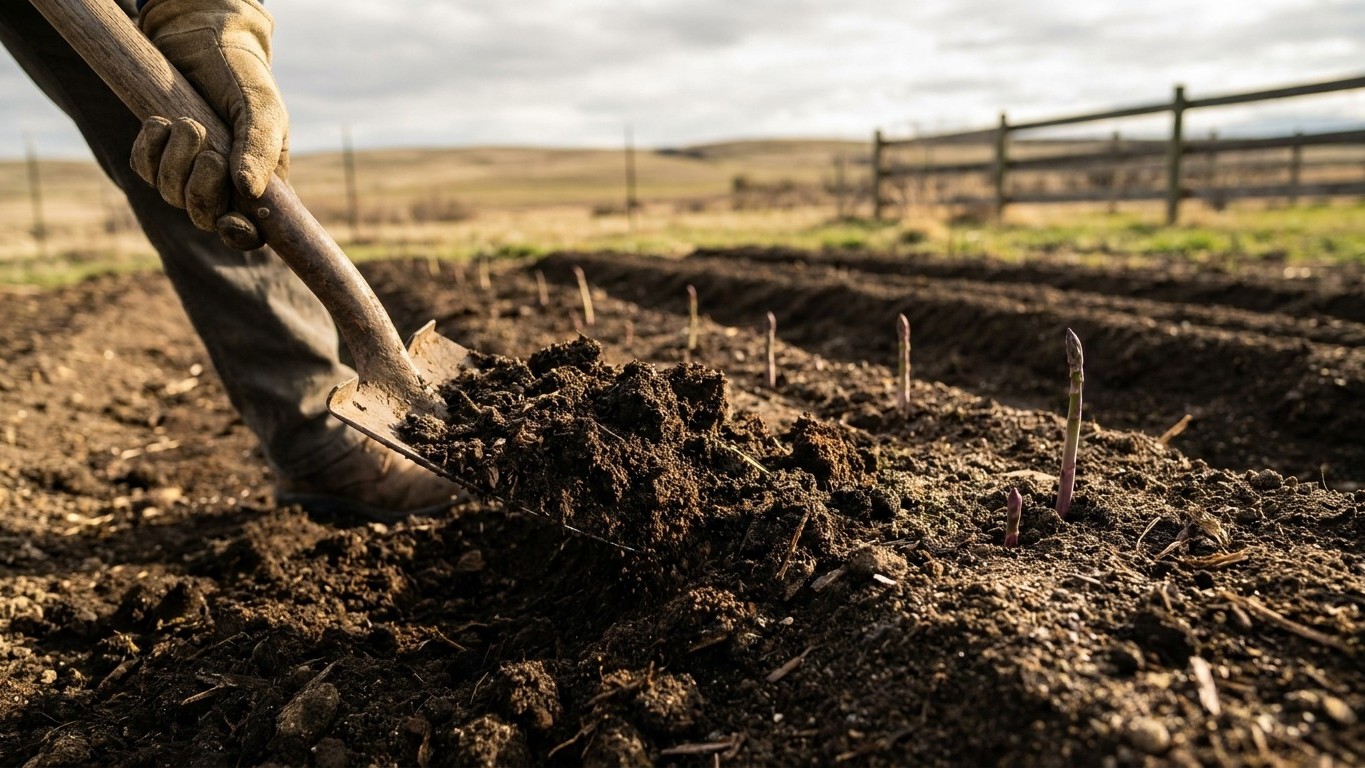

Minnesota gardeners can grow asparagus successfully, and the commitment is real: once a bed is established it stays productive for a decade and a half. Utah State University Extension names one soil requirement for asparagus, that it drains, and the state’s representative soil generally clears that bar. When to Plant Asparagus Crowns in Minnesota comes down to the last frost window in spring, but no spears come up for eating until the third year after planting.
The short answer
Minnesota’s official state soil, the Lester series, is an Alfisol, a forest soil built up under hardwood cover with moderate natural fertility and a decent ability to hold nutrients. Its surface horizon runs close to neutral, with a pH near 6.6, and its texture sits in loam-to-silt territory: about 39 percent sand, 24 percent clay, and 37 percent silt, carrying roughly 3.0 percent organic matter. USDA records it as well drained. That combination, an even mix of sand and silt rather than a clay-heavy profile, is exactly the kind of ground water moves through instead of pooling on.
That matters more for asparagus than for almost anything else planted in a home garden. A tomato bed with drainage trouble is an annual headache, fixed or ignored fresh each spring. Will Minnesota Soil Hold an Asparagus Bed for Fifteen Years? Plant crowns into ground that stays wet and the crowns rot before they ever earn their keep, and there is no starting over without tearing out mature plants and losing years of production.
The Lester series is a starting point, not a verdict on any one backyard. It describes a mapped surface horizon across the region, not a dug bed behind a specific house. River bottoms hold water differently than hill ground, and any lot a builder has scraped, filled, or graded will behave nothing like the undisturbed profile USDA measured. If a shovel test after a rain shows standing water an hour later, or the soil balls up sticky and stays that way, the practical fix is a raised bed built 8 to 12 inches above grade, or picking higher ground on the same property rather than fighting a wet low spot for fifteen years.
The other half of the commitment is patience. Crowns go into 8-inch furrows and produce nothing to eat the first two years. Year three brings a first harvest of about four weeks. That window stretches to roughly six weeks the following year, then to about eight weeks once the bed is fully established. The stopping point each season is not a date but a condition: harvest ends when most of the spears coming up have gone thinner than a pencil, a sign the plant needs to stop feeding you and start feeding itself for next year.
Will the summer here water it for you?
An asparagus bed asks for 1 to 2 inches of water every other week through its first two years, easing to about every three weeks once it is established. Minnesota’s summer rainfall comes close on paper but rarely lines up week to week with what the plant actually needs, which is where a gardener’s own attention has to fill the gap.
- What the bed asks for: 1 to 2 inches every other week for the first two growing seasons, then roughly the same amount every three weeks once roots are established.
- What the region delivers: normal rainfall across June, July and August totals about 13.0 inches, broken out as June 4.58 inches, July 4.06 inches, and August 4.34 inches, based on the 1991-2020 climate normals for the reference station used here.
- Where the gap shows up: July is the driest of the three summer months at 4.06 inches, meaning the stretch when the bed still wants biweekly water during its establishment years is also the month least likely to deliver it on its own.
- Why the average understates the risk: these are seasonal totals, not weekly deliveries. Rain that arrives as one heavy thunderstorm largely runs off rather than soaking into the root zone, so a month can hit its normal total and still leave a young bed dry for stretches of two or three weeks.
- Soil changes the math: a bed on sandier ground drains, and dries, faster than these averages suggest; a bed on heavier clay holds moisture longer but risks the standing-water problem covered above. The same inch of rain behaves differently depending on what it lands on.
- The heat factor: days that push into the 90s pull moisture out of the soil faster than a normals table can capture, adding another reason not to treat a monthly average as a watering schedule.
- The practical answer: a rain gauge on the actual bed, checked weekly through the first two summers, tells a gardener more than any regional average. Supplemental watering should fill whatever gap shows up between what fell and the 1-to-2-inch, every-other-week target.
When to put the crowns in
Crowns go into the ground in early spring, and in this part of Minnesota that means timing the planting around the last spring frost, which runs from April 17 to April 30 based on the 1991-2020 freeze-probability normals for the reference station used here. That is an average window, not a fixed date, and it should be read as “around” rather than a calendar promise; some springs run earlier, some later. It is also worth remembering that this window describes the milder southern part of the state. Northern Minnesota runs two to three weeks tighter at both ends of the season, so a gardener up north should shift the planting window later into spring accordingly.
Crowns are set into furrows dug about 8 inches deep. The furrow is not filled in all at once. Soil goes back in gradually across the season, roughly 2 inches every other month, giving the emerging shoots room to push upward through loose ground rather than forcing them up through a fully packed trench from day one.
Seed is the other way into an asparagus bed, though the guidance used for this article addresses crown planting specifically rather than seed timing, so no seed-based schedule is offered here. Crowns remain the more direct route for a home gardener who wants a defined starting point and a known depth to plant at.
On variety, the source used for this article names four asparagus varieties and gives no more than their sex, nothing on flavor, yield, or which performs better in which soil. That is worth stating plainly rather than filling in with a guess.
| Variety | Type |
|---|---|
| Jersey Giant | All-male |
| Jersey Knight | All-male |
| UC 157 F1 | Male/female |
| Purple Passion | Male/female |
All-male varieties tend to be favored by gardeners because the plants put energy into spear production rather than seed production, but that preference is not something the source itself weighs in on, so it is offered here only as context, not as a recommendation.
Checking this against your own county
Everything above describes regional averages: a representative state soil, a reference weather station, a statewide frost window. None of it substitutes for what is actually true on one particular lot. The most direct way to check any of it is a call or visit to University of Minnesota Extension, which runs county-level offices with staff who can talk through local soil conditions, order a soil test, and confirm frost timing for a specific address rather than a statewide average.
Extension offices are also the place to ask about drainage concerns before committing a fifteen-year bed to a particular spot, since a county agent has usually seen how the local ground behaves across multiple seasons in a way a single soil series map cannot capture. Find county-specific contact information through University of Minnesota Extension.
Common questions
How long before an asparagus bed in Minnesota produces anything?
No harvest happens in the first two years after planting. The third year brings the first real harvest, running about four weeks, and the harvest window lengthens in the following seasons as the bed matures.
Does Minnesota’s state soil guarantee good drainage in my yard?
No. The Lester series describes the state’s representative soil at a regional scale, drawn from mapped surface horizons, not a measurement of any individual garden. A specific lot, especially one that has been graded, filled, or sits in a low spot, can drain very differently.
Can I rely on summer rain alone to water a young asparagus bed?
Not reliably. Regional summer rainfall averages come close to the 1-to-2-inch, every-other-week target the bed wants during its first two years, but rain arrives unevenly, and July, the driest summer month on average, is exactly when the establishing bed still needs consistent moisture. A rain gauge on site is the only way to know for certain.
Does the source give a preferred asparagus variety for Minnesota conditions?
No. The four varieties referenced here, Jersey Giant, Jersey Knight, UC 157 F1, and Purple Passion, are identified only by whether they are all-male or male/female. No information on flavor, yield, or regional suitability is published in that source.