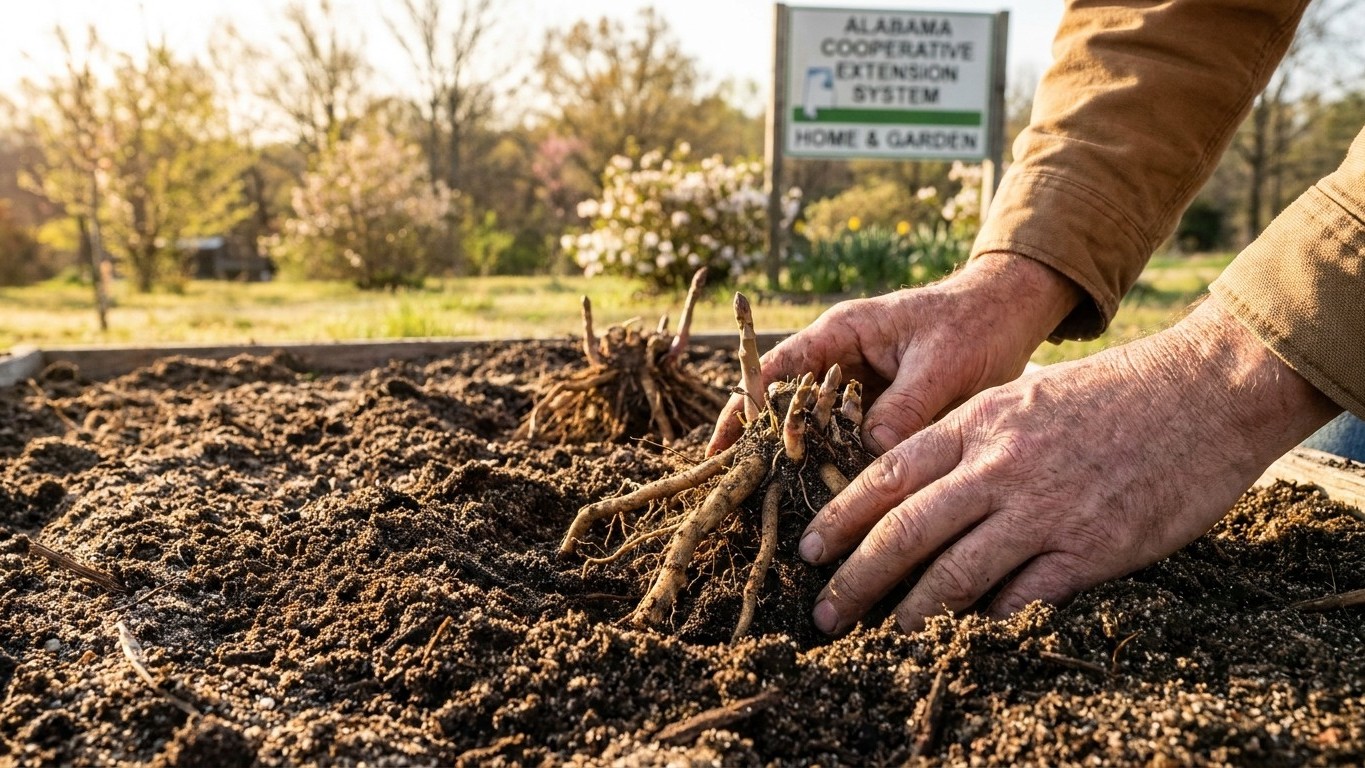

Plant Asparagus Crowns in Missouri in early spring, timed to the region’s last frost window of April 6 to April 20. That’s the short version. What actually decides whether those crowns thrive for the next decade or so comes down to two things this state hands you unevenly: what your soil does with water, and how much rain you’ll need to make up yourself once summer hits.
The short answer
an Asparagus Bed isn’t a crop you rotate next year if it disappoints. Once crowns go into the ground, that patch of yard is spoken for. The plant takes three years before you cut a single spear, then it settles in and keeps producing for 10 to 15 years, according to Utah State University Extension. That’s longer than most homeowners keep the same car. Choosing the spot, then, isn’t a small decision, and the soil under it matters more here than for almost anything else in the vegetable garden.
The good news is that asparagus isn’t picky about fertility or texture. Utah State University Extension notes that most soils will do, with one condition: they have to drain. Sit water in the crown zone for any length of time and the roots rot, no matter how well you fed the bed beforehand.
Missouri’s representative soil, the Menfro series, actually works in the gardener’s favor here. USDA NRCS lists it as a well-drained forest soil, silty in texture (77 percent silt, 19 percent clay, just 4 percent sand), with a surface pH around 6.2 and organic matter near 2.0 percent. That’s a loam-to-silt profile with moderate natural fertility, and drainage that doesn’t fight the plant’s one real requirement.
The Menfro series is what USDA uses to represent Missouri broadly, not a soil test of your specific yard. River bottoms drain differently than hill ground, and anywhere a builder graded or filled the lot, the native profile is long gone. If your own soil holds water after a hard rain, puddles that linger, ground that stays sticky for days, that’s the sign to act before crowns go in, not after. Raised beds or mounded rows solve the problem directly, since they let excess water move off rather than sit around the roots. A basic soil test through your local extension office will tell you where you actually stand, which beats guessing based on a statewide average.
None of this touches soil pH as a planting rule, or how much winter cold the plant needs to grow well the following spring. Neither figure is published in the source behind this guide, so this article won’t invent one. What’s settled is drainage, and in most of Missouri, the ground itself isn’t the obstacle.
Will the summer here water it for you?
an Asparagus Bed has a simple watering rule for its first two seasons: 1 to 2 inches every other week. After that establishment period, it drops to about 1 to 2 inches every three weeks. The question is whether Missouri’s summer sky delivers that on its own, and the honest answer is: partway.
- What the bed asks for: roughly 1 to 2 inches every 14 days through the first two summers, tapering to the same amount every 21 days once the crowns are established.
- What summer actually brings: NOAA’s 1991-2020 normals put Missouri summer rainfall at about 14.1 inches across June, July and August, broken down as 5.25 inches in June, 4.58 in July, and 4.24 in August, the driest of the three.
- Spread that over the calendar: 14.1 inches across roughly 13 weeks of summer averages out to a little over an inch a week, which sounds close to the bed’s need, but rain doesn’t fall on a schedule. A single thunderstorm can drop an inch in an afternoon and then leave three dry weeks behind it.
- Where it falls short: August is the gap month, at 4.24 inches for the entire 31 days. That’s the stretch most likely to leave a two-year-old bed under its every-other-week target, especially on a well-drained soil like Menfro, where water moves through the profile rather than lingering for the plant to use.
- What to add: a rain gauge on the actual bed is the only way to know for certain. When a week goes by with less than an inch showing in that gauge, that’s the cue to run a hose or soaker line and close the gap yourself, rather than trusting the seasonal average to even out.
The normals come from one long-term reference station and describe what the region usually gets over three decades, not what falls on any single yard in any single summer. A slope, a nearby tree line, or a few miles’ difference in elevation can shift the number either way. Treat 14.1 inches as the baseline expectation, and let your own gauge settle the rest.
When to put the crowns in
Crowns go into the ground in early spring, once soil can be worked and the hardest freezes have passed. In Missouri, that window sits around the region’s last spring frost dates, which NOAA’s 1991-2020 climate normals place between April 6 and April 20. That’s a mean date built from three decades of freeze data, not a guarantee for any single spring, so treat it as a general target rather than a fixed calendar entry.
There’s a wrinkle worth knowing if you’re gardening near Kansas City. The reference station behind that April 6 to April 20 window sits well north of downtown, and the urban core there tends to see its last frost run about five days earlier. Head south through the rest of the state and the frost window opens earlier still, since southern Missouri’s milder climate pushes the last freeze further back on the calendar. None of that changes the basic method, just the exact week you act on it locally.
Utah State University Extension describes the planting method itself plainly: crowns go into furrows about 8 inches deep, set in early spring. The furrow isn’t filled in all at once. Instead, soil gets pulled back in gradually over the season, about 2 inches every other month, rather than burying the crown completely on day one. That staged backfill gives the emerging shoots room to push upward without fighting a full 8 inches of soil right away.
Crowns aren’t the only route in. Starting asparagus from seed is the alternative Utah State University Extension names, though it adds a year or more to the timeline before that first real harvest, since seedlings need a season to grow to transplant size before they even reach crown stage. For most home gardeners working around a 10 to 15 year bed, crowns remain the faster path to a producing patch, and timing that planting to the region’s frost window is the one decision that matters most before the first spear ever shows.
Whichever variety ends up in the ground, remember what’s actually published about them. Utah State University Extension names four: Jersey Giant and Jersey Knight, both all-male varieties, and UC 157 F1 and Purple Passion, both male-female types. The source stops there. No flavor comparison, no yield ranking, no stated reason to prefer one over another appears in that guidance, so any claim beyond the sex of the plant isn’t coming from this source.
Common questions
Can I harvest asparagus the first year after planting crowns?
No. Utah State University Extension is direct on this point: no harvest happens until year 3. The plant spends its first two seasons building the root system that will support a decade or more of spears, and cutting early weakens that foundation.
How do I know when to stop cutting spears each spring?
Watch the spears themselves rather than counting days. The signal to stop harvesting is when most spears coming up are thinner than a pencil, an object-based cue rather than a fixed date, since a warm spring or a cool one shifts the calendar either way.
What’s Missouri’s soil pH for asparagus, and does it matter?
The Menfro series, the soil USDA lists as representative of Missouri, runs a surface pH around 6.2. That’s a general regional figure, though, not a planting rule. Utah State University Extension is silent on any pH requirement for asparagus, so this guide won’t turn a soil-survey number into a target you need to hit.
Does Missouri’s winter cold affect asparagus the following spring?
That’s not addressed in the sourcing behind this guide. Utah State University Extension doesn’t publish a winter chilling requirement for asparagus, and no hardiness-zone figure here should be read as one. What’s established is the spring planting window and the drainage requirement, and those are the two factors worth acting on.