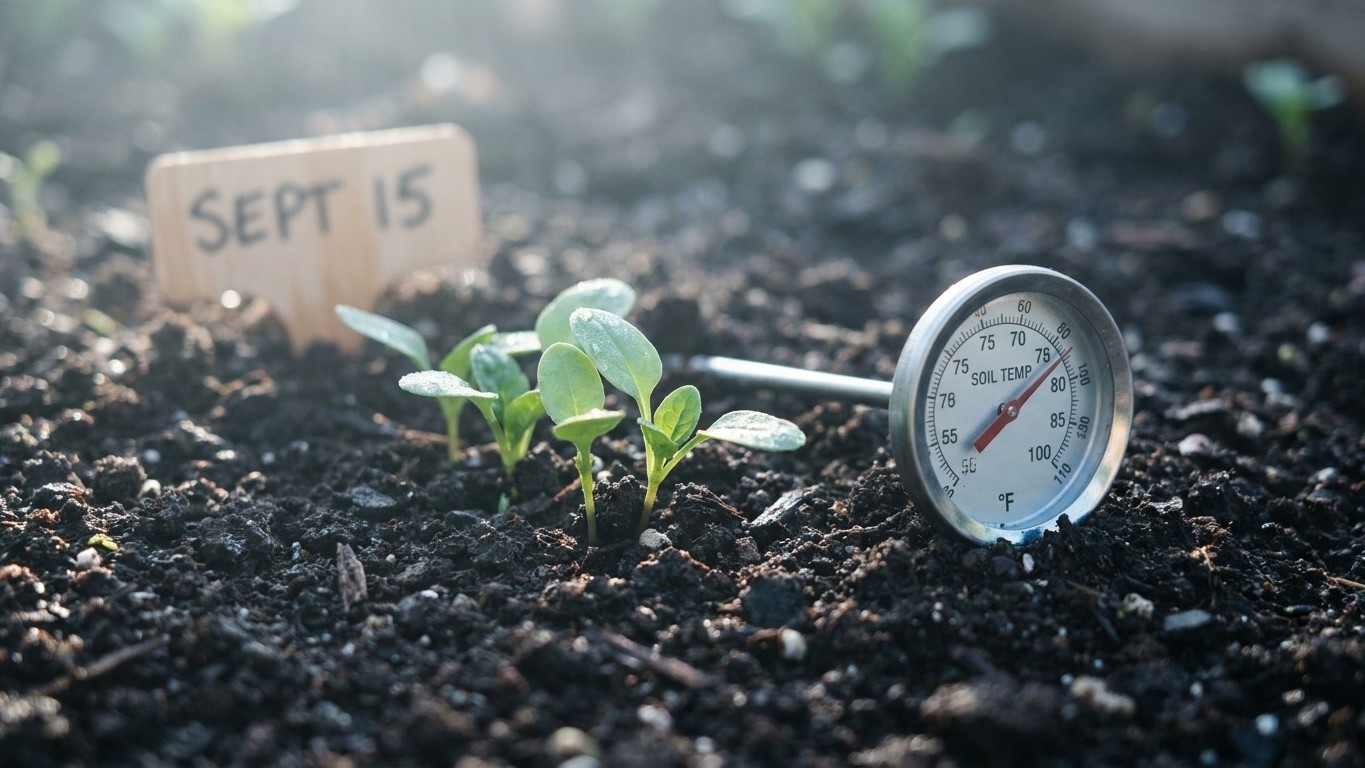

Spinach can go in the ground twice a year around Billings, but both windows are short. Spring sowing runs roughly two to three weeks before the last frost, so early-to-mid April. The fall crop needs the soil to cool first, which usually pushes sowing into late July or August, counted back 50 to 75 days from the first fall frost of October 1 to 14. Long summer daylight cuts off everything in between.
The short answer
Billings sits at a latitude where the longest day of the year runs 15 hours and 32 minutes of daylight. For spinach, that number works against you. Long days trigger bolting, the process where the plant sends up a flower stalk and the leaves turn bitter, and that happens on a calendar tied to day length as much as to temperature. A mild or cool summer does not cancel this out. The plant is responding to how much light it gets each day, not just how hot it feels, so a cooler-than-average July in Montana still won’t buy extra weeks of harvest once daylight stretches past a certain point.
Heat piles on top of that. Utah State University Extension notes spinach grows best where temperatures stay at or below 75°F, and that same 75°F mark doubles as the point where leaves start turning bitter. Billings averages 28.3 days a year at 90°F or hotter, a measure of how much heat load the region carries through summer. That heat arrives on roughly the same schedule as the long days, so the two pressures land together rather than one canceling the other.
So which one actually closes the window here: day length, heat, or both? Both, and they reinforce each other. The long daylight pushes spinach toward flowering regardless of how much you water or shade it, while the string of 90-degree-plus days stacks additional stress on a plant that already grows poorly above 75°F. There’s no trick that gets around the daylight trigger, and there’s no amount of irrigation that undoes weeks of heat above the growth ceiling. That combination is why Montana gardeners split spinach into two short seasons instead of one long one: a narrow run in spring before the days get long and hot, and a second narrow run in fall after the days shorten and the soil cools back down.
Practically, this means treating spinach here less like a crop you plant once and more like two separate short sprints. Missing the spring window by a couple of weeks usually means bitter, bolted plants by early summer. Missing the fall window means either the seed won’t germinate in soil that’s still too warm, or the plants run out of season before frost ends things.
How long the spring window really is
- The last spring frost at the reference station falls between April 29 and May 10, based on NOAA’s 1991-2020 climate normals for the 30-70 percent freeze probability band.
- Sowing two to three weeks ahead of that frost date puts seed in the ground somewhere between April 8 and April 19 if you’re planning around the earlier end of the frost range, or as late as April 29 if you’re working from the later end.
- From there, the clock starts running toward the 75°F growth ceiling. Once daytime temperatures push consistently past that mark, spinach quality declines and the plant starts moving toward bolting.
- With Billings averaging 28.3 days a year at 90°F or above, the stretch of days sitting comfortably below 75°F doesn’t last long once June arrives. Heat tends to build quickly once it starts.
- Adding it up: a sowing date in early-to-mid April, followed by roughly eight to ten weeks before heat and day length combine to end good-quality growth, is a realistic picture of the spring season here.
- Mountain valleys elsewhere in Montana can see frost in any month, so gardeners outside the milder Billings-area valleys should expect that window to shrink further, not stretch.
The autumn crop, and when the soil lets you sow
Fall spinach faces a different obstacle than spring spinach. In spring, the enemy is heat and long days arriving too soon. In fall, the enemy is soil that’s still too warm from summer, followed not long after by the season’s first hard frost.
Soil too warm to germinate
Utah State University Extension is specific on this point: spinach seed germination drops once soil temperature climbs above 80°F. Billings’ summer heat load, that same 28.3-day average of 90°F-plus air temperatures, keeps soil warm well past the point when the calendar says “late summer.” Soil holds heat longer than air does, so even after daytime highs start easing off, the ground itself can stay above that 80°F mark for weeks. Sowing into soil that’s still too warm means poor or spotty germination, no matter how good the seed is. The practical fix is patience: wait until soil has actually cooled, not just until the worst of the 90-degree days have passed.
Counting back from the first fall frost
The first fall frost at the reference station arrives between October 1 and October 14, based on the same NOAA climate normals dataset. Utah State University Extension’s guidance for a fall spinach crop is to sow 50 to 75 days before the date you want to harvest, since the source publishes no separate days-to-maturity figure for spinach. Working backward from a harvest date near that October frost window puts sowing somewhere in the range of mid-July to late August, depending on which end of the 50-to-75-day range you’re planning around.
Layering the soil-temperature constraint on top of that math narrows things further. The earliest part of that mid-July window likely still has soil running too warm for reliable germination, so the more realistic sowing target sits toward the back half of that range, into August, once soil has had more time to cool from the summer’s heat load. Four spinach varieties commonly mentioned for garden use are Bloomsdale, Melody, Teton, and Olympia, though no maturity data or growth comparison for any of them is published in the sources behind this guidance.
Common questions
Can I sow spinach in mid-summer to fill the gap between spring and fall crops?
Not reliably. Mid-summer combines the two problems at once: day length is still long enough to trigger bolting, and soil temperatures are climbing toward or past the 80°F mark where germination drops off. Neither obstacle clears until later in the season.
Does a cooler-than-normal summer extend the spring spinach harvest?
Not by much. Bolting in spinach is tied to day length as well as heat, so even a mild summer won’t stop the long daylight hours from pushing the plant toward flowering. Cooler weather can soften the heat side of the equation, but it doesn’t remove the daylight trigger.
Is there a hard frost date I should use for fall harvest instead of the October 1-14 range?
The NOAA climate normals data behind this guidance gives that October 1-14 window as the 30-70 percent freeze probability band. No second, lower threshold is published here, so treat that range as the planning point rather than looking for an earlier or later cutoff.
Should I expect the same windows in mountain valleys elsewhere in Montana?
No. The Billings-area figures used here come from one of the state’s milder valleys. Mountain valleys elsewhere in Montana can see frost in any month of the year, which compresses both the spring and fall sowing windows well beyond what’s realistic in the Billings area.