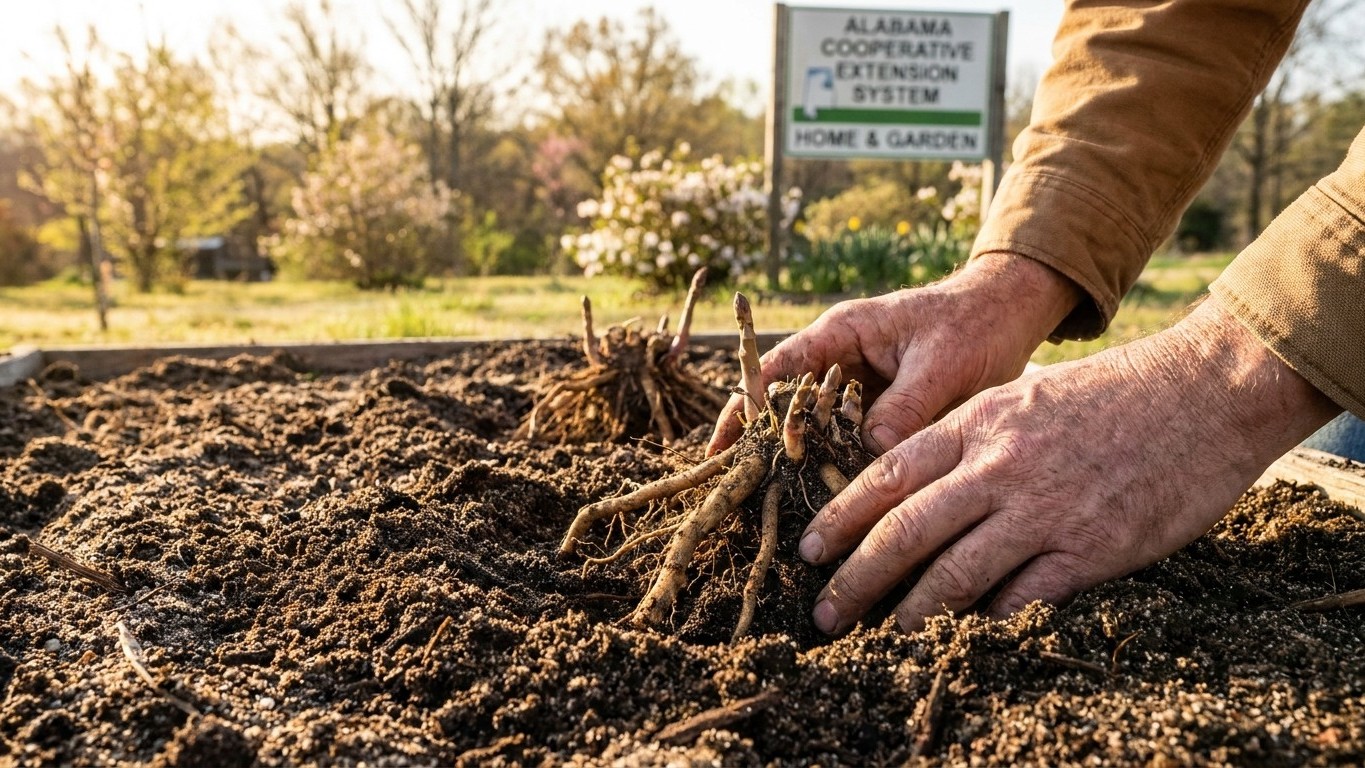

The honest answer is “early spring,” but Nevada is a state where that phrase can mean February in one county and May sixty miles away. The mean last spring frost recorded at the Las Vegas reference station falls between January 7 and February 1, and that single data point should not be mistaken for a statewide planting calendar. Before any date matters, the soil under the crowns matters more, because an Asparagus Bed is not a plant you replace next season.
The short answer
Asparagus is planted as crowns set into furrows about 8 inches deep, and once that bed is established it stays put for 10 to 15 years. That single fact should change how anyone in Nevada picks a planting spot. A tomato bed that turns out to sit on heavy, slow-draining ground is a one-season headache, fixable next year with a different bed or a truckload of compost. An asparagus bed on the wrong ground is a decade-long problem. The source on this crop is direct about the one requirement that actually matters: most soils will work, provided they are well drained. Nothing else about soil type is specified, and no soil pH figure for asparagus is published here.
What Nevada’s representative soil tells you
Nevada’s official state soil, the Orovada series, is an Aridisol, which is simply the technical name for a dry-climate soil. Where it’s been measured across 223 sampled components, its surface layer runs about 66 percent sand, 8 percent clay, and 26 percent silt, with organic matter around 1.4 percent and a surface pH near 7.5, alkaline. Crucially for this crop, USDA records it as well drained. A sandy, low-clay profile like that sheds water quickly rather than pooling around a crown’s roots, which is exactly the behavior asparagus tolerates well.
That said, the Orovada series describes a representative soil mapped across the state, not the dirt in any one backyard. Nevada also holds river-bottom ground, clay-heavy valley floors, and any lot a builder has graded and filled, and those can behave nothing like the sandy norm. If a spot holds standing water an hour after a hose runs, or a shovel comes up sticky and compacts into a ball, that ground is not draining the way this crop needs. The fix isn’t complicated: build a raised bed, work coarse sand or compost into the top foot, or simply choose higher ground on the property. A basic soil test through a county extension office settles the drainage and texture question far better than guessing from a statewide series.
Will the summer here water it for you?
An established asparagus bed asks for 1 to 2 inches of water every other week during its first two seasons, then eases to about every three weeks once it’s mature. Nevada’s summer sky delivers almost none of that on its own. Here’s what the numbers actually look like set side by side.
- What the bed needs: roughly 1 to 2 inches every two weeks for the first two years, tapering to once every three weeks after that, regardless of what falls from the sky.
- What summer supplies: across June, July and August the reference station averages about 0.7 inches of rain combined, out of roughly 4.2 inches for the whole year.
- The driest stretch: June is the leanest month at just 0.04 inches, with July at 0.38 inches and August at 0.32 inches, meaning the exact weeks a young bed needs steady moisture are the weeks the sky provides almost nothing.
- The gap to fill: a gardener is effectively responsible for supplying the full 1 to 2 inches every two weeks by hose or drip line during those first two summers, since natural rainfall covers only a small fraction of it.
- Why sandy soil raises the stakes: on the well-drained, sandy ground typical of much of the state, water moves through fast rather than lingering, so irrigation needs to be applied more often in smaller amounts rather than one heavy soak every two weeks.
These are long-run climate averages for one reference station, not a promise for any single summer or any single yard. A rain gauge staked next to the bed, checked weekly, is the only way to know what a given plot is actually receiving.
When to put the crowns in
Crowns go into the ground in early spring, once the soil has thawed and can be worked, and that timing is built around the last frost. At the reference station, the mean last spring frost falls somewhere around January 7 to February 1, but that figure comes from a low-elevation desert site and should not be read as a statewide window. Anywhere with elevation, from Reno and Carson City on up into the mountain valleys, frost lingers months later in spring and arrives months earlier in fall than that reference figure suggests. A county extension office is the right place to get a frost window for a specific location rather than relying on one desert station’s normals.
Furrows, varieties, and the years before a spear is cut
Crowns are set into furrows dug about 8 inches deep, and the furrow is not filled in all at once. It’s backfilled gradually across the season, adding roughly 2 inches of soil back over the crowns every couple of months as the new growth pushes up, rather than burying them in one pass. Four varieties are named in university guidance: Jersey Giant and Jersey Knight, both all-male types, and UC 157 F1 and Purple Passion, which produce both male and female plants. No flavor difference, yield comparison, or reason to favor one over another is published, so the choice comes down to what’s available locally rather than any documented performance edge.
Patience is the real requirement here. There is no harvest at all in the first year or the second. Cutting doesn’t begin until the third year, and even then it starts light, about 4 weeks of harvest, extending to roughly 6 weeks the following year and 8 weeks after that once the bed is fully mature. The signal to stop cutting each season isn’t a date on a calendar; it’s the spears themselves. Once most of the emerging spears come up thinner than a pencil, harvest stops for the year so the plant can rebuild its root reserves for the following season.
For gardeners who want to start from seed rather than buying crowns, that route exists as an alternative, though the university source used for the timing and depth figures above is focused specifically on crown planting and doesn’t detail a seed-starting schedule. Anyone going that route is a year further out from any harvest, since seed-grown plants need a season to become transplant-sized crowns before they even go into the furrow.
Common questions
Can asparagus crowns be planted in fall in Nevada instead of spring?
The guidance behind this article covers early spring planting specifically, tied to the region’s last frost date. No fall planting window is published here, so a spring start remains the documented approach.
Does Nevada’s alkaline soil need to be corrected before planting asparagus?
No pH requirement for asparagus is published in the source used for this article, so no specific correction target can be given. The state’s representative soil runs alkaline at a surface pH near 7.5, but a soil test on the actual planting site is the only way to know what that particular ground is doing.
How many years until an asparagus bed is fully productive in Nevada?
There’s no cutting in year one or year two at all. Harvest begins in year three at about 4 weeks, moves to roughly 6 weeks the year after, and reaches about 8 weeks once the bed matures, at which point the bed keeps producing for 10 to 15 years total.
What if a Nevada garden’s soil doesn’t drain well?
Since drainage is the one condition this crop truly requires, poor-draining ground calls for a raised bed, working coarse sand or compost into the top foot of soil, or picking a higher spot on the property rather than planting directly into ground that holds water.