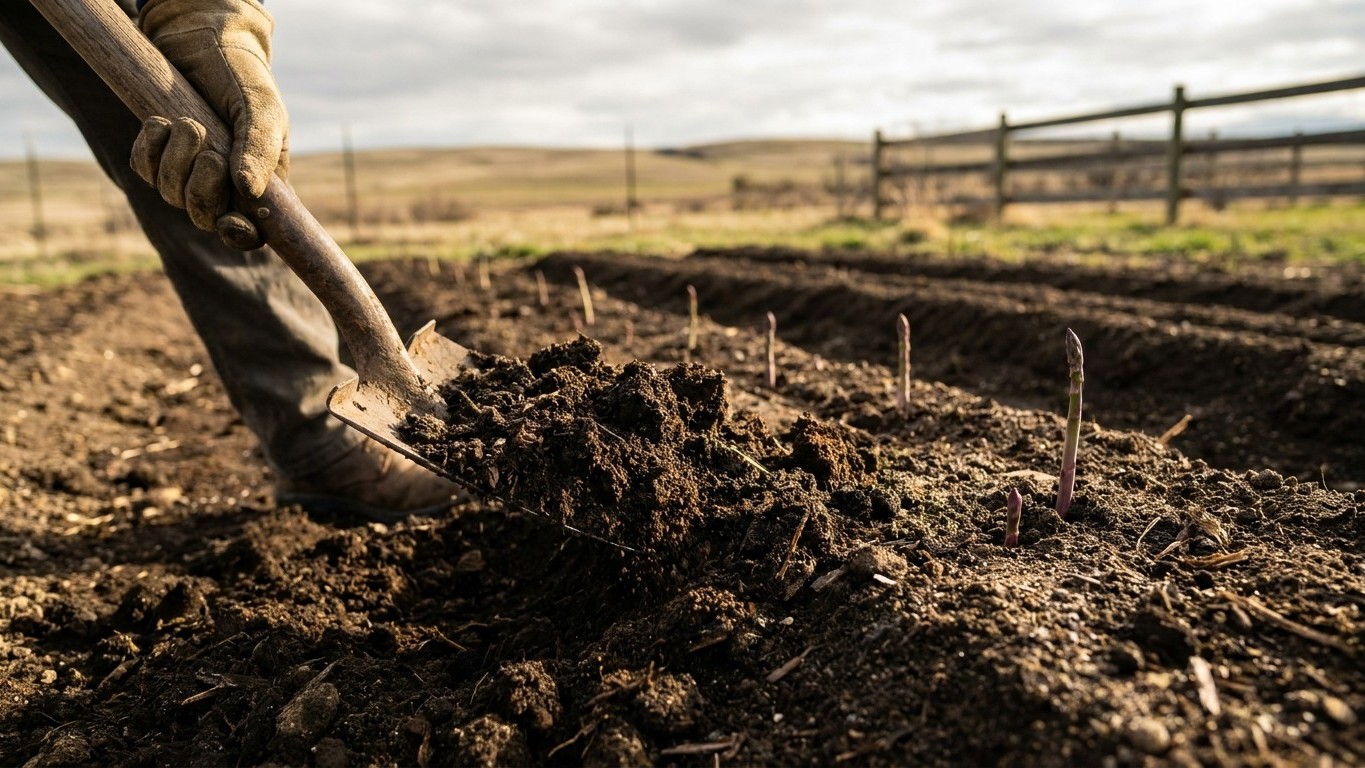

A fifteen-year commitment to one patch of ground sounds like a big ask anywhere, and Nevada adds a wrinkle most other states don’t: a soil profile that’s sandy, alkaline, and built to shed water fast. The good news is that’s mostly what asparagus wants. The catch is that “mostly” isn’t “always,” and the difference matters when you’re not moving the bed again for a decade or more.
The short answer
Nevada’s official state soil, the Orovada series, is an Aridisol, the kind of dry-climate ground that tends toward alkaline and often carries salts near the surface. Sampled surface values put it at roughly 7.5 pH, 66 percent sand, 8 percent clay, 26 percent silt, and about 1.4 percent organic matter. It’s classified well drained. That last word is the one that matters most here, because Utah State University Extension is specific about what asparagus actually requires from soil: most types will do, provided they drain. A bed on Orovada-type ground, sandy and low in organic matter, tends to shed water rather than hold it, which lines up with what the crop needs.
That said, a state soil describes a representative surface horizon across hundreds of mapped components, not the six hundred square feet behind your house. River bottoms, old lakebeds, and anywhere a builder has cut, filled, or compacted ground will behave nothing like the mapped series. If your own plot holds water in puddles a day after rain, or your shovel hits a hardpan a foot down, treat that as the soil you’re actually working with, not the state’s. A raised bed, or a season spent working coarse sand and compost into a heavy spot, solves the problem before you plant. Skipping that step doesn’t show up as a failure this year. It shows up in year six, when roots that should be spreading are sitting in standing water instead, which is exactly the question worth settling before committing: Will Nevada Soil Hold an Asparagus Bed for Fifteen Years?
Once the site passes that test, the timeline is fixed and worth knowing in full before the first crown goes in the ground, and When to Plant Asparagus Crowns in Nevada is the first piece of that timeline to get right. Crowns are set into furrows and then left alone: there’s no harvest at all in year one or year two. Year three brings the first cutting, and even then it’s limited, roughly four weeks of picking. The following year stretches to about six weeks, then eight the year after that, before the bed settles into full production for the remaining stretch of its ten-to-fifteen-year life. The signal to stop cutting each spring isn’t a date on the calendar. It’s the spears themselves: when most of what’s coming up is thinner than a pencil, that’s the plant telling you to let it grow into fern for the rest of the season.
Will the summer here water it for you?
Short answer: no, not close. Nevada’s summer rainfall, measured across June, July, and August, totals about 0.7 inches, with June running nearly bone-dry at 0.04 inches, July at 0.38, and August at 0.32. Set that against what an asparagus bed actually asks for and the gap is stark.
- Young bed, first two years: 1 to 2 inches of water every other week. Across a thirteen-week summer that’s roughly six watering cycles, adding up to somewhere between 6 and 12 inches of water the bed needs over that stretch.
- Established bed, year three onward: 1 to 2 inches every three weeks. That works out to roughly four cycles across the same summer, or 4 to 8 inches total.
- What the sky delivers on its own: about 0.7 inches across the entire summer, most of it in July and August, with June contributing almost nothing.
- The shortfall: irrigation has to make up nearly all of the difference, somewhere in the range of 3 to 11-plus inches depending on the bed’s age and the season’s timing. This isn’t a state where you plant and let nature take it from there.
- What that means day to day: a drip line or soaker hose on a schedule, plus a couple of inches of mulch to slow evaporation off that sandy, low-organic-matter surface. A rain gauge staked in your own bed tells you more than any regional average, since a single afternoon thunderstorm can dump water that runs off a sandy slope before it ever soaks in.
When to put the crowns in
Crowns go into the ground in early spring, set about 8 inches down in a furrow rather than planted at the surface. The furrow isn’t filled in all at once either: soil gets pulled back in gradually, about 2 inches every other month across the first year, as the crown pushes growth upward. Getting the timing right depends entirely on when your ground has warmed and the last hard freeze has passed, and that’s where Nevada gets genuinely complicated.
The low desert around Las Vegas records a mean last spring freeze somewhere around early January to the start of February, an unusually early window driven by an urban heat island in an extreme desert setting. That figure is real, but it isn’t a Nevada planting calendar. Gain elevation anywhere in the state, or head north toward Reno or Carson City, and the picture changes entirely: frost lingers months longer into spring and arrives months earlier in fall at higher elevations. Treat any single frost date as a mean, an average built from years of variation, not a guarantee for this particular spring. “Around” is the operative word, never an exact day.
Seed is the alternative to crowns, and some gardeners prefer starting that way rather than buying dormant roots. The planting details published for this crop cover crown planting specifically, not seed timing, so if you go that route, expect it to add a growing season before you’re setting out young plants rather than crowns. On variety, the choices are named by sex rather than by flavor or yield, since neither is published for any of them: Jersey Giant and Jersey Knight are all-male varieties, while UC 157 F1 and Purple Passion carry both male and female plants. No nursery or supplier is specified here, and nothing in the source ranks one above another for taste or production.
Checking this against your own county
Everything above describes tendencies across a state that runs from low desert to high mountain valleys, and no single number covers all of it. Your actual last frost date, your actual soil texture, and your actual summer watering needs depend on where in Nevada you’re standing, sometimes down to which side of a valley. The University of Nevada, Reno Extension keeps county-level frost data and offers soil testing that will tell you, in your own dirt, whether you’re dealing with something close to the Orovada series or something entirely different. Before crowns go in the ground for what’s meant to be a decade-plus commitment, a call or visit to your local extension office is worth more than any statewide average.
Common questions
Does asparagus need acidic or alkaline soil?
The planting guidance used here doesn’t specify a soil pH requirement, and the state soil’s pH figure describes the Orovada series specifically, not a target for every Nevada garden. Drainage is the one condition the source is explicit about; pH isn’t addressed and shouldn’t be assumed from the state soil alone.
Do I need a special cold-hardy variety for Nevada winters?
No winter chilling requirement is published for any named variety, and the hardiness of a location doesn’t translate directly into a chilling number. The four varieties named, Jersey Giant, Jersey Knight, UC 157 F1, and Purple Passion, are distinguished only by whether they’re all-male or male/female, with no published guidance tying any of them to Nevada’s climate specifically.
How long until I actually get to eat any of it?
Two full years with no harvest at all, then a limited four-week picking window in year three, six weeks in year four, and eight weeks in year five, before the bed reaches its full production stretch. That patience is part of the deal with this crop more than almost any other in a home garden.
What if I test my soil and it doesn’t drain well?
Given how long this bed stays put, that’s worth solving before planting rather than after. A raised bed sidesteps the issue entirely, and working coarse sand and compost into a heavy or compacted spot over a season can shift a slow-draining patch into workable ground. Skipping that step tends to show up years into the bed’s life, not the first season.