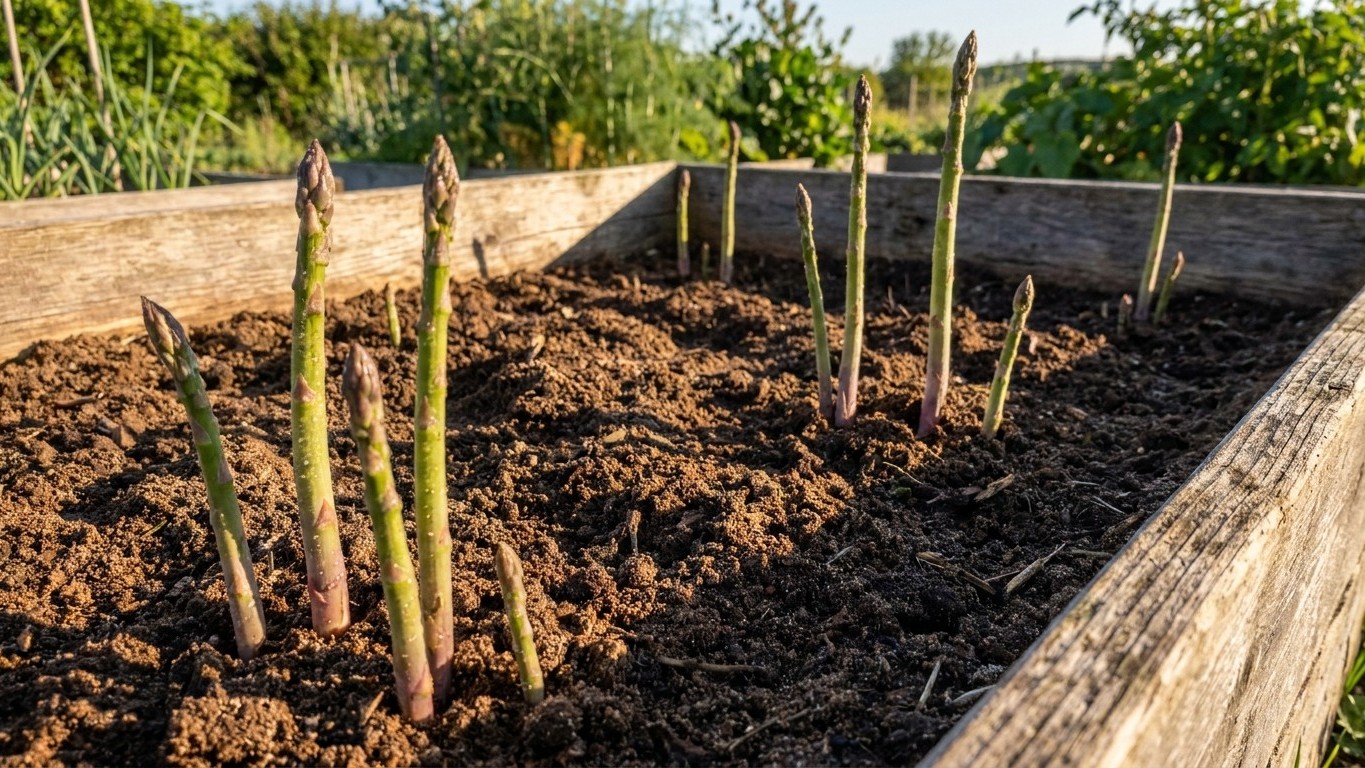

Nevada’s official state soil, the Orovada series, drains well by nature: it’s sandy, alkaline, and built to shed water rather than hold it. an Asparagus Bed needs exactly that for the ten to fifteen years it will occupy the same patch of ground. So the short answer is yes, provided the soil under your own feet actually behaves like the state’s namesake dirt and not like the compacted fill a builder left behind.
The short answer
Asparagus is not a crop you replant every spring. Crowns go into the ground once, and if the bed thrives, it keeps producing for a decade or more before it needs to be dug up and started again. That single fact changes how you should think about soil. A heavy, slow-draining patch is an annual annoyance for a tomato bed; you amend it every year and move on. For asparagus, the same patch is a decision you’re locked into for the length of a mortgage refinance cycle.
What Nevada’s soil actually offers
The Orovada series carries a surface texture that’s roughly two-thirds sand, with only a small share of clay and the rest silt. Organic matter sits low, around one and a half percent, and the surface reads alkaline, close to a pH of 7.5. None of that is unusual for a dry-climate Aridisol, and none of it should worry an asparagus grower. The one requirement the Utah State University Extension guidance places on soil for this crop is drainage, and a sandy, well-drained profile like Orovada clears that bar without much argument.
Where the plan can still go wrong
Here’s the catch: the state soil describes a representative profile mapped across hundreds of locations, not the six inches of dirt in your backyard. A river-bottom lot, a subdivision built on scraped and re-graded fill, or a low spot where water pools after a storm can behave nothing like the Orovada series even if it sits in the same county. If you dig a hole, fill it with water, and it’s still standing after an hour, that ground drains too slowly for a bed meant to last fifteen years. The fix isn’t complicated: raise the bed, work in coarse sand and compost to open up the structure, or move the planting to a spot on your property that clears water faster. A simple soil test, run through your county extension office, tells you where you actually stand before you commit a decade of garden space to it.
Will the summer here water it for you?
Once crowns are in, the schedule calls for 1 to 2 inches of water every other week through the first two full growing seasons, then a lighter rhythm of every three weeks once the root system is established. Compare that against what a Nevada summer delivers on its own, and the answer is blunt: almost none of it. Reference-station normals put summer rainfall at about 0.7 inches total across June, July, and August, with June running driest at a mere 0.04 inches, July at 0.38, and August at 0.32. A full year of rain at that station adds up to about 4.2 inches, meaning summer barely registers as a fraction of the annual total.
- Year one and two, growing season: the bed wants 1 to 2 inches every other week. Summer rainfall supplies a rounding error toward that total, so the irrigation system carries essentially the entire load.
- Later years, once established: the target eases to 1 to 2 inches every three weeks. The gap between that and natural rainfall narrows slightly in percentage terms, but the absolute shortfall barely changes, since summer rain stays thin regardless of the plant’s age.
- June specifically: at 0.04 inches for the entire month, June is effectively a dry month on paper. Any watering schedule that assumes June rain will help is planning around a number that isn’t there.
- July and August: both months post totals under half an inch. Even stacked together, the two wettest summer months don’t approach a single scheduled watering session for an established bed.
The practical read: treat Nevada summer rainfall as background noise, not a watering plan. Sandy Orovada-type soil compounds the problem, since water that does fall drains through quickly rather than lingering in the root zone. A rain gauge on your own property, checked against your own irrigation log, is the only way to know how much you’re actually short in a given month.
When to put the crowns in
Asparagus crowns go into 8-inch furrows in early spring, timed to the ground thawing and warming enough to work. Nevada’s frost dates vary enormously depending on where in the state you’re standing. The only figures with a documented source here come from a Las Vegas reference station, where the last spring freeze falls somewhere around January 7 to February 1. That window is a genuine outlier: it reflects a low-desert, urban-heat-island location and should not be read as a statewide planting calendar. Reno, Carson City, and anywhere at real elevation see frost linger months later into spring and arrive months earlier in fall, which pushes their planting window well past what the Las Vegas figures suggest. Say “around” when you use any of these dates, because a mean frost date is an average built from decades of records, not a promise for this particular spring. Your county extension office holds the frost data specific to your elevation and microclimate, and that’s the number to plant by, not a statewide guess.
Crowns versus seed
Crowns are the faster route: a year-old root system that gets you to a harvestable bed sooner. Seed is the alternative, cheaper per plant but slower, since seedlings need an extra season in a nursery bed before they’re ready for transplant to their permanent furrows. Either way, the furrow itself isn’t filled in all at once. Soil gets backfilled gradually over the season, roughly 2 inches every other month, gradually raising the level around the crowns as they grow rather than burying them under a full 8 inches on planting day.
What’s published about varieties, and what isn’t
Utah State University Extension names four asparagus varieties, distinguished only by their reproductive type. No flavor comparison, no yield ranking, and no stated reason to favor one over another appears in that guidance.
| Variety | Type |
|---|---|
| Jersey Giant | All-male |
| Jersey Knight | All-male |
| UC 157 F1 | Male/female |
| Purple Passion | Male/female |
Whichever variety and route you choose, the harvest itself doesn’t start the first year, or the second. Year three is the earliest cutting, and even then it’s a short 4-week window. That stretches to 6 weeks the following year and 8 weeks after that, once the crowns are fully established. The cutoff each season isn’t a date on a calendar; it’s a visual signal. When most of the spears coming up are thinner than a pencil, harvest stops for the year, letting the plant put its energy into building next year’s crown instead of feeding a harvest basket.
Common questions
Does Nevada’s alkaline soil hurt asparagus?
Soil pH isn’t addressed in the Utah State University Extension guidance this article draws from, so no pH requirement or preference is published here. What is published is a drainage requirement, and the state’s representative soil meets it.
Can I plant asparagus in a raised bed if my yard doesn’t drain well?
Yes. Since the only documented soil requirement is drainage, a raised bed filled with a sandy, well-draining mix sidesteps a heavy or slow-draining native soil entirely, without needing to amend the whole yard.
How much water does an established asparagus bed need in a dry Nevada summer?
The schedule calls for 1 to 2 inches every three weeks once a bed is established, and given that summer rainfall totals well under an inch across the entire season, nearly all of that has to come from irrigation.
Is there a single Nevada planting date for asparagus crowns?
No single statewide date exists in the data available here. The only sourced frost figures come from a Las Vegas station and don’t apply to higher-elevation parts of the state, so a county extension office is the right place to get a local frost window before planting.