
Spinach in Nevada goes in the ground twice a year, and both windows are short. Sow in late winter to very early spring, two to three weeks ahead of your local last frost, and again in late summer to early fall once soil temperatures drop back down. In between, the state’s long summer days and heavy heat load make spinach bolt and turn bitter almost as fast as it germinates.
The short answer
On the longest day of the year, the reference station used for this guide sees 14 hours and 27 minutes of daylight. That number matters more than most gardeners realize, because spinach reads day length as a trigger to flower. Once days stretch out past a certain point, the plant shifts from making leaves to sending up a seed stalk, and once that happens the leaves turn bitter and the crop is done. This is the opposite of what long days do to a bulb onion, where extra daylight builds the crop instead of ending it. For spinach, a long day is a countdown clock, and Nevada’s early-summer daylight is plenty long enough to start it.
That clock alone would be a problem anywhere in the state, but Nevada layers heat on top of it. The reference station averages 131.3 days a year at 90 degrees Fahrenheit or hotter, which is a measure of how much heat load builds up across a season, not an average temperature. Spinach grows best where conditions stay under 75 degrees, and once that ceiling is crossed the plant bolts faster and the leaves turn bitter, regardless of what the calendar says about day length. In the low desert around Las Vegas, both mechanisms hit at once: the days get long right as the heat ramps up, so the spring window slams shut hard and early.
Higher, cooler parts of the state change the balance but don’t erase it. Reno, Carson City, and other elevated valleys don’t rack up anywhere near 131 days above 90 degrees, so the heat side of the equation is far gentler. But those same areas sit at a similar latitude, so the long-day trigger for bolting still arrives on roughly the same summer schedule. In practice that means the limiting factor in Nevada’s low desert is both day length and heat working together, while in the higher valleys day length still ends the spring crop, but heat isn’t what’s forcing the issue.
What that means for timing is straightforward. Spinach needs to do its growing while days are still short-to-moderate and temperatures are still under that 75-degree ceiling. In Nevada, that’s a narrow band in late winter and again in fall, with a long stretch in between where the plant simply won’t perform, no matter how much water or shade you throw at it.
How long the spring window really is
Spinach seed goes into the ground two to three weeks before the last expected frost, and it keeps growing well only as long as temperatures stay under 75 degrees. Stack those two rules against Nevada’s climate and the spring window turns out to be tight almost everywhere in the state, just for different reasons depending on elevation.
- Find your local last frost date. The reference station used for statewide climate data is a Las Vegas airport site, and its last-frost window runs from January 7 to February 1. That date is a desert urban heat-island extreme and should not be used as guidance for the rest of Nevada. Reno, Carson City, and any higher-elevation valley freeze weeks to months later in spring, so the only reliable number is the one from your county extension office.
- Count back two to three weeks from that local date. That’s your earliest safe sowing point, whether it lands in January in the low desert or well into March or April at elevation.
- Count forward to the point where daytime highs start regularly crossing 75 degrees. In the low desert, with 131.3 days a year at 90 degrees or hotter, that threshold arrives early, often within a matter of weeks of the last frost. At elevation, with far fewer extreme-heat days, the climb toward 75 degrees is slower and the growing stretch is more forgiving.
- The gap between those two points is your real spring window. In much of Nevada’s low desert, that gap can be short enough that a single sowing barely has time to bulk up before bolting starts. In the higher valleys, the window opens later on the calendar but tends to stay usable for longer once it does.
Either way, the spring crop in Nevada is a race against rising temperatures more than a leisurely season, and the reference station’s heat numbers make clear why gardeners here often get better, more reliable results from the fall planting instead.
The autumn crop, and when the soil lets you sow
Fall sowing flips the spring problem around. Instead of racing rising heat, the goal is to wait until the ground itself has cooled enough to let seed germinate, then get the crop up and growing before the season’s first hard freeze shuts it down. Two obstacles bracket that window, one at each end.
Soil still too warm to germinate
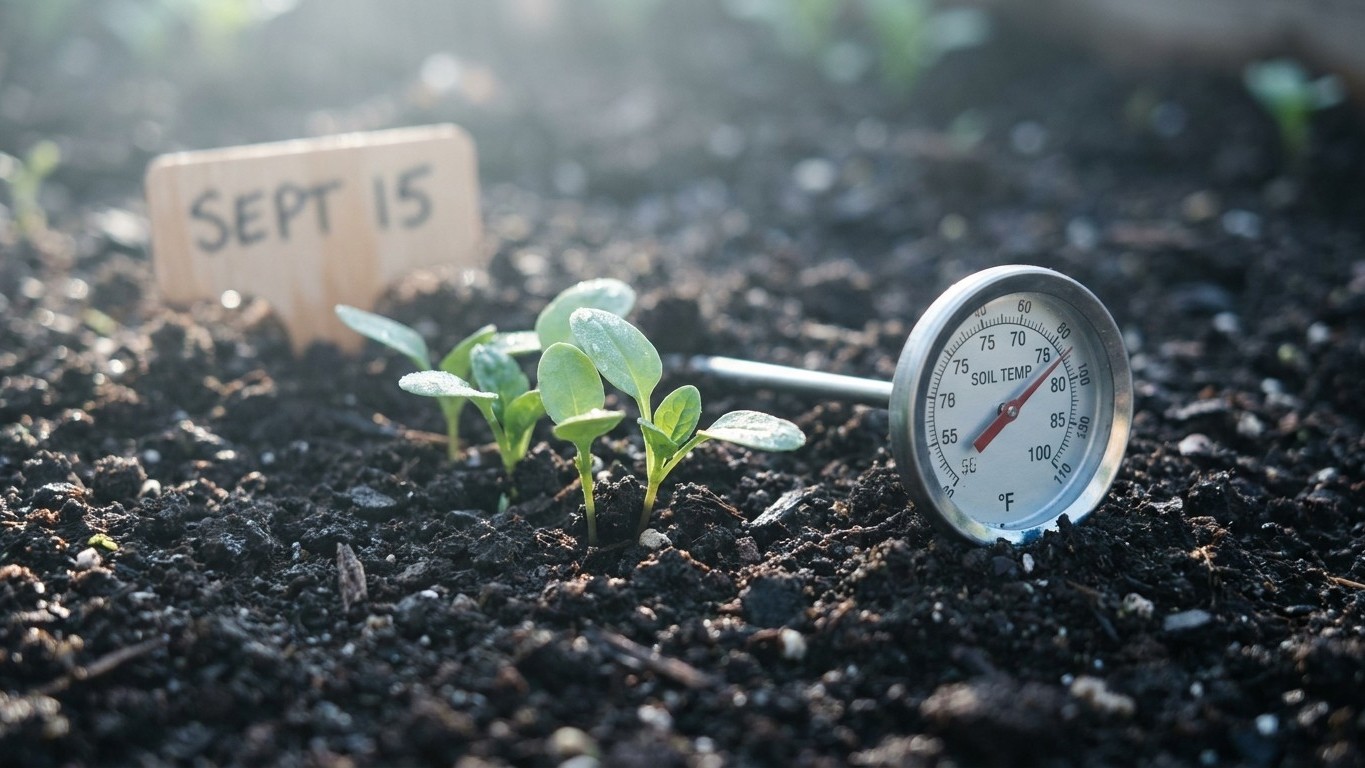
Spinach seed germination drops off once soil temperatures climb above 80 degrees Fahrenheit, according to Utah State University Extension. That threshold is a soil reading, not an air-temperature guess, and in Nevada’s low desert it can take a while to clear. With 131.3 days a year hitting 90 degrees or more in the air, the ground underneath holds heat well past the point where the weather app starts calling for cooler afternoons. The practical fix is to check soil temperature directly with a probe thermometer rather than sowing by the calendar. In the higher valleys, where extreme-heat days are far less common, soil cools off sooner, and the fall sowing window can open earlier in the season than it does down in the Las Vegas basin.
The frost that ends the season
On the other end of the window sits the first fall frost, and this is where Nevada’s geography matters most. At the reference Las Vegas station, the first fall frost falls between December 8 and December 23, another figure shaped by that site’s desert urban heat-island effect. It is not usable as guidance for the rest of the state. Reno, Carson City, and other elevated communities can see their first frost land months earlier in the fall, which compresses the entire autumn growing window for spinach in those areas. Anyone gardening outside the low desert should get the actual local first-frost date from their county extension office before working backward.
Utah State University Extension’s guidance for a fall crop is to plant 50 to 75 days ahead of the date you want to harvest. Using the desert reference station’s frost window as one illustration only, counting back 50 to 75 days from early-to-mid December lands sowing somewhere in the September to October stretch for that specific site. Gardeners elsewhere in Nevada need to run that same math against their own local frost date, because a first frost that lands in October instead of December pushes the ideal sowing date back into August.
Seed catalogs commonly list spinach varieties such as Bloomsdale, Melody, Teton, and Olympia for home gardens. The climate data behind this guide doesn’t include days-to-maturity or heat-tolerance figures for any of them, so matching a variety to your specific window means checking the information printed on that seed packet rather than relying on general climate averages.
| Nevada region | Heat load (days ≥ 90°F) | Frost timing pattern | Fall sowing implication |
|---|---|---|---|
| Low desert (Las Vegas basin) | 131.3 days/year at reference station | Late fall frost, warm soil lingers | Wait for soil to drop below 80°F; sow later in fall |
| High desert / mountain valleys (Reno, Carson City area) | Well below the low-desert figure | First frost arrives much earlier in fall | Soil cools sooner, but sowing must start earlier to beat frost |
Common questions
Can spinach survive light frost in fall?
The climate data used here covers frost timing but doesn’t break out a separate light-frost threshold from a hard freeze. The safest approach is to plan the sowing date around your local first fall frost as reported by your county extension office, rather than assuming the crop will tolerate any particular degree of cold beyond that point.
Why does spinach bolt even when the weather feels mild?
Bolting in spinach is triggered by long days as well as by warmth. Even on a cool day, once day length has stretched out enough, the plant can still shift into flowering mode. That’s why a mild, overcast stretch in early summer doesn’t necessarily buy extra harvest time.
Is there a difference between spinach and onions when it comes to day length?
Yes, and it’s the opposite effect. Long summer days push onions to form their bulb, which is why northern gardens with very long summer days grow long-day onion varieties successfully. Those same long days push spinach toward bolting instead, which is why Nevada’s long summer daylight hours work against a spinach crop rather than for one.
Should I test my soil temperature before fall sowing?
It’s the most reliable way to time the planting correctly. Since germination drops off above 80 degrees Fahrenheit soil temperature, a simple soil probe thermometer pushed a couple inches down gives a far more accurate answer than guessing from the air temperature or the calendar date alone.