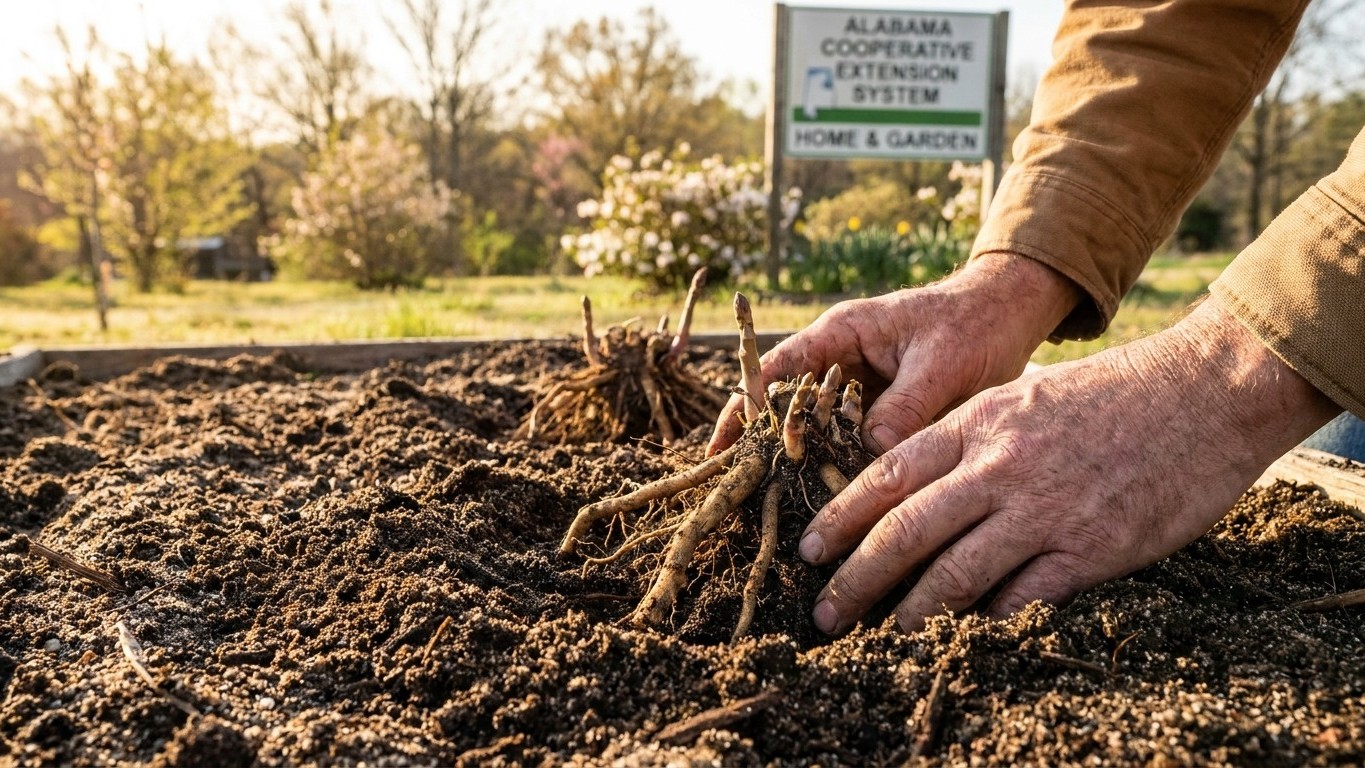

New Brunswick gardeners Plant Asparagus Crowns in early spring, once the ground has thawed and dried enough to work, roughly around the region’s average last frost near May 23. This isn’t a weekend project. A bed started now will still be sending up spears a decade and a half from now, provided the ground underneath drains the way asparagus needs it to. Get the timing and the site right at the start, because there’s no redo once the roots are in.
The short answer
Asparagus crowns go into 8-inch furrows and simply sit there working for a long time: no harvest at all in year one or two, a first light cutting in year three, and then a bed that keeps producing for 10 to 15 years. That span is the whole reason the site matters more here than it does for a tomato patch you can move next season. According to Utah State University Extension, most soils will grow asparagus fine, with one real condition attached: the ground has to be well drained. Wet feet, over a decade and a half, is the one mistake a gardener can’t quietly fix later.
So what’s actually under New Brunswick gardens? Data from Agriculture and Agri-Food Canada’s Canadian Soil Information Service, drawn from 418 mapped soil components across the province’s agricultural regions, points to Podzol as the dominant soil order, the acidic, leached profile that forms under conifer cover, where rain has stripped the bases out of the topsoil over time. The median surface reading runs strongly acid, around pH 4.7, with a loam-to-silt texture (47 percent sand, 37 percent silt, 16 percent clay) and organic matter near 3.4 percent. Classified this way, Podzols are typically well drained. That’s good news for a 15-year commitment: on paper, the province’s most common soil clears the one bar asparagus actually sets.
But “typical” is not a diagnosis of your own backyard. That 4.7 median pH and that texture describe the middle of 418 sampled points across farmland, not the low corner of your lot where snowmelt pools every March, and not a lot near a river bottom or a patch of muskeg, both of which behave nothing like the provincial median. The survey also only covers the agricultural belt, so it says little about the far edges of the province. If your ground stays soggy a day or two after a heavy rain, or if you can squeeze water out of a handful of soil from six inches down, that’s your answer regardless of what the province-wide numbers say. The fix in that case isn’t to abandon the spot, it’s to raise it: a mounded bed or a framed raised bed lifts the crowns above the standing water and lets the same soil work. A basic soil test, run before you dig the furrows, will tell you where your own ground actually sits, and that number matters more than any provincial average once you’re fifteen years into a planting.
Will the summer here water it for you?
Once crowns are in, asparagus asks for 1 to 2 inches of water every other week through its first two growing seasons, then eases back to roughly every three weeks once the root system is established. New Brunswick’s summer rainfall, measured at Moncton over the 1981-2010 normals period, comes in around 10.5 inches across June, July and August combined, a number that looks generous on paper but arrives unevenly.
- June is the wettest of the three months, averaging 3.73 inches, which usually covers a newly planted bed’s every-other-week need without much help from a hose, assuming that rain falls in more than one or two big storms.
- July drops slightly to 3.63 inches, still close to what a two-year-old bed wants, but this is also when temperatures climb and evaporation starts eating into whatever rain does fall, so a dry stretch of ten days or more can leave the root zone short even in a “normal” July.
- August is the driest month at 3.18 inches, and it’s also the stretch where an established bed is meant to be settling into its lighter, every-three-week rhythm. A rainfall total near an inch a week sounds close to what’s needed, but a single week with no rain at all, which happens most summers, means the gardener is the one filling the gap, not the sky.
- The number that actually decides the watering can is the soil, not the rain gauge. A Podzol running 47 percent sand drains fast, which is exactly why the bed clears the drainage bar in the first place, but that same fast drainage means rain moves through and past the root zone quickly rather than lingering. On a sandy New Brunswick bed, a dry week in July or August can mean supplemental watering even in a month where the seasonal average looks adequate on paper.
- Track it locally rather than trusting the average. A rain gauge staked next to the bed, checked weekly through the first two summers, tells a gardener far more than a 30-year normal ever will. If a week comes in under an inch, that’s the cue to run a hose or soaker line rather than wait for the average to catch up.
When to put the crowns in
Crowns go into the ground in early spring, as soon as the soil can be worked, dug 8 inches deep into furrows rather than dropped into a shallow trench. In New Brunswick, that window sits around the region’s average last spring frost, which Environment and Climate Change Canada’s 1981-2010 normals for the Moncton station place at May 23. That date is a mean, not a guarantee: in roughly half the years on record, frost actually arrived later than that, which means a gardener working strictly from the calendar can still get caught. The safer read is to treat late May as the middle of a planting window rather than the starting gun, watching the soil itself, whether it’s dry and workable rather than cold and waterlogged, before committing crowns to the furrow.
Once the crowns are set at the bottom of that 8-inch furrow, the covering isn’t a one-time job. Soil gets backfilled gradually across the season, adding roughly 2 inches every other month rather than filling the trench in a single afternoon. That staged fill lets the emerging shoots push through loose soil rather than fighting a deep, compacted cover right from the start, and it spreads the workload across a full growing season instead of one planting day.
Crowns aren’t the only route into an Asparagus Bed. Seed is the alternative, and it simply asks for more patience: a gardener starting from seed is adding time onto an already long timeline before the plants reach the size of a purchased crown, since seedlings need a season of growth before they’re ready for the same furrow treatment. For a New Brunswick garden, where the growing season is already bounded on both ends by frost, crowns are the route most gardeners choose precisely because they skip that extra year. Whichever route is chosen, the source stays silent on any chilling requirement tied to winter cold, and it says nothing at all about soil pH preferences, so neither figure belongs in a planting decision here. What decides the outcome is the same pairing that decided the site in the first place: workable, dry-enough soil, timed to that late-May window rather than to it exactly.
Common questions
Can I Plant Asparagus Crowns in New Brunswick’s acidic soil without adjusting the pH first?
The published source on planting asparagus is silent on soil pH preferences, so no target number or amendment is specified here. What is documented is drainage: as long as the site drains well, whatever the province’s Podzol soils commonly measure, the crop’s one stated requirement is met. A soil test on your own plot is the way to know your actual starting point.
Do I need to pick a specific asparagus variety for New Brunswick?
Utah State University Extension names four varieties by their flowering type only: Jersey Giant and Jersey Knight are all-male, while UC 157 F1 and Purple Passion are male and female. No flavor, yield or regional suitability is published for any of them, so the choice among these four rests on availability rather than a documented performance difference.
How long before I can actually harvest spears?
Not until year three, and even then the harvest starts light, around four weeks of cutting, before easing up to six weeks and eventually eight weeks in later seasons as the crowns mature. Cutting stops for the season once most of the spears coming up are thinner than a pencil, a sign the plant’s energy is running low rather than a fixed date on the calendar.
What if my part of New Brunswick isn’t near the Moncton weather station?
The May 23 average last frost and the 10.5-inch summer rainfall figure both come from the Moncton station specifically, and a province is never one single climate. Inland, northern or upland districts commonly run behind coastal averages, so a gardener further from that station should treat these numbers as a general reference point and lean on local observation, and their own rain gauge, for the final call.