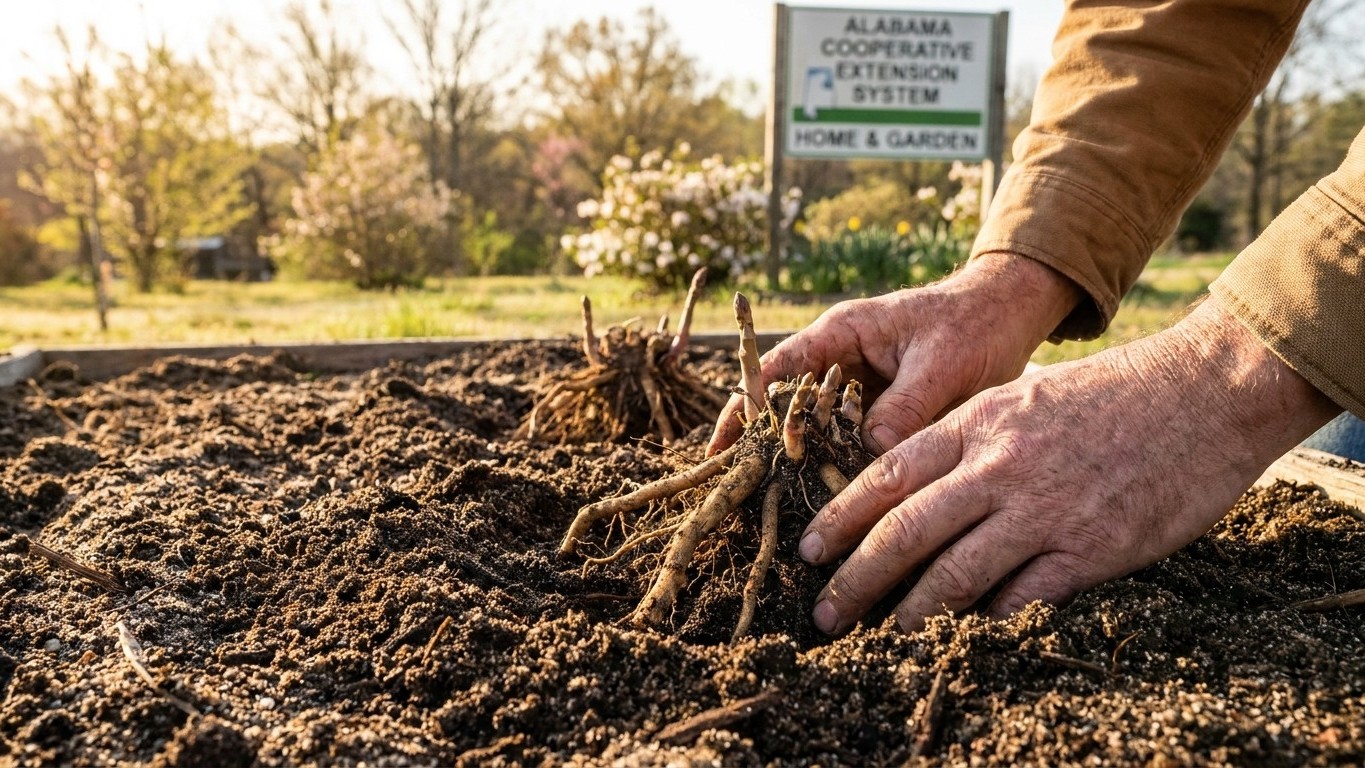

Plant Asparagus Crowns in Newfoundland and Labrador around early spring, roughly as the ground thaws and dries after the last spring frost near St. John’s, which falls on average around May 30. That timing matters less for the crowns’ survival than for what happens underneath them for the next decade and beyond, because this is a bed you’re asking the ground to hold for 10 to 15 years.
The short answer
Here’s the part that doesn’t get said enough about asparagus: the planting date is the easy decision. The hard one is the ground itself, because once those crowns go into an 8-inch furrow, you’re not moving them again for a decade or more. Utah State University Extension, whose guidance underlies most home asparagus planting in North America, is blunt about the one requirement that actually matters: the soil must drain. Most soil types will support a healthy bed, provided that condition is met.
in Newfoundland and Labrador, that condition is not automatic. The province’s dominant mapped soil is a Podzol, the acid, leached soil that forms under conifer cover where rain has stripped the bases out of the topsoil over time. It shows up across 59 percent of the province’s mapped agricultural surface, with Organic soils as the runner-up. The texture leans loam to silt (56 percent sand, 9 percent clay, 35 percent silt), and organic matter sits around 3.3 percent, which is respectable. But the drainage class recorded for this profile is imperfectly drained. That’s the word to sit with before you dig a 15-year furrow.
Imperfectly drained doesn’t mean swampy. It means water moves through slowly enough that a bed sited in the wrong low spot will sit wet longer than asparagus roots tolerate, especially through a Newfoundland spring when snowmelt and rain overlap. Asparagus crowns rotting in standing water is a slow, invisible failure, not a first-year washout, and by the time you notice thinning spears, the decision to plant there is already several years old.
None of this is a verdict on your own yard. A provincial soil profile is a starting point built from surveyed agricultural land, not a diagnosis of the raised bed behind your house or the strip along a fence line that’s been filled and graded at some point. If your ground has stayed damp for days after a normal rain, or if you can see standing water in a low corner come spring, that’s your signal, not the provincial average.
The fix, if your plot leans toward that imperfectly drained pattern, is straightforward: raise the bed. A mounded row or a framed raised bed lifts the crowns above the saturated layer and lets excess water shed sideways instead of pooling around the roots. Working in coarse organic matter helps the structure, though the source is silent on any pH target, so don’t chase a number that isn’t published here. Get a soil test done on your own plot before you commit a furrow to a 15-year run. That’s cheap insurance against a decision you can’t undo.
Will the summer here water it for you?
Once the crowns are in, asparagus wants water on a schedule that shifts as the bed matures: 1 to 2 inches every other week for the first two seasons, then roughly every three weeks once the root system is established. That’s the target. What St. John’s actually delivers in summer is a separate question, and it’s worth laying out step by step.
- Total summer rainfall. The St. John’s A station averages about 11.4 inches of rain across June, July and August combined, out of 60.4 inches for the year. That’s a wet climate by most garden standards, and it’s spread fairly evenly rather than concentrated in one soggy month.
- Month by month. June averages 3.84 inches, July 3.61 inches, and August 3.94 inches. July is the driest of the three, but barely, and none of the three months look like a drought stretch.
- Set against the bed’s need. The target is 1 to 2 inches every other week, which works out to roughly 2 to 4 inches over a typical month during establishment. July’s 3.61 inches sits comfortably inside that range on paper.
- Why the paper number isn’t the whole story. These are climate normals for one station, covering 1981-2010, not a forecast and not a reading from your own yard. Rain that falls as one heavy event and runs off a slope behaves differently from the same total spread across ten gentle days. And on that imperfectly drained provincial soil, a wet week can leave the root zone waterlogged even while the monthly total looks adequate on a chart.
- The practical takeaway. A gardener on typical local ground in an average summer likely won’t need to run a hose often for an established bed. But “likely” isn’t “always,” and a new bed in its first two seasons, when roots are shallow and unforgiving of dry spells, is worth checking with a rain gauge rather than assuming the sky is handling it.
The honest summary: Newfoundland’s summer rainfall is close enough to what asparagus wants that supplemental watering should be occasional rather than routine, especially past the establishment years. A rain gauge staked next to the bed settles the question far better than a provincial average ever will.
When to put the crowns in
Crowns go into the ground in early spring, while the soil is workable but still cool. In this territory, that window sits around the last spring frost date near St. John’s, which averages May 30. That’s a mean date, not a guarantee, meaning in roughly half of all years frost arrives later than that. Treat it as the middle of a window rather than a green light, and hold off breaking ground until the soil has actually dried enough to dig an 8-inch furrow without it collapsing into mud.
That May 30 figure comes from the St. John’s A weather station specifically. Newfoundland and Labrador is not one climate zone stretched across the whole province; inland, northern, and upland districts commonly run weeks behind the coast on both warming up in spring and cooling down in fall. If you’re gardening away from the immediate St. John’s area, treat the date as a rough anchor and watch your own soil rather than the calendar.
Once the furrow is dug and the crowns are laid in, the trench isn’t filled all at once. It’s backfilled gradually across the season, adding about two inches of soil every other month as the new shoots grow up through it. That gradual cover protects the crowns while still letting the emerging spears reach light, and it’s part of why the first planting season looks unfinished even after the crowns are technically “in.”
Whatever you plant, don’t expect a harvest that first year, or the second. Utah State University Extension is explicit: asparagus isn’t harvested until the third year after planting, and even then the picking window is short and light before easing into the full multi-decade harvest routine. That patience is baked into the crop; it’s not a sign anything went wrong.
Seed is the alternative to crowns, and it exists mostly for gardeners who don’t mind adding an extra year to an already long timeline. Starting from seed means growing a season of seedlings before you ever transplant something resembling a crown into the permanent bed, which pushes the eventual harvest out further still. Crowns skip that step, which is why most home gardeners default to them. Variety choice at that point comes down to almost nothing published beyond sex type: all-male types such as Jersey Giant and Jersey Knight, and male/female types such as UC 157 F1 and Purple Passion. Utah State University Extension names no flavor difference, no yield advantage, and no reason to prefer one over another, so there’s no authoritative basis here for picking one variety over the rest.
Common questions
Can I Plant Asparagus Crowns in a low, damp corner of the yard?
Not without changing the site first. Newfoundland’s dominant provincial soil is recorded as imperfectly drained, and a low corner will hold water longer than a raised or sloped spot. Given that the bed is meant to last 10 to 15 years, raising the planting area is a safer bet than hoping a damp spot dries out on its own.
How soon can I harvest after planting crowns?
Not until the third year. That timeline is fixed regardless of variety or how vigorous the ferns look in year one or two; cutting spears earlier weakens the crown’s root reserves before the bed has had a chance to establish.
Does July’s lower rainfall mean I need to water more that month?
July averages 3.61 inches at St. John’s, only slightly below June’s 3.84 and August’s 3.94, and it still falls within the range the bed typically needs. A rain gauge on your own plot is the only way to know for certain in a given year, since normals describe an average, not this season.
Is there a pH or chilling requirement I should meet before planting?
Not according to the source used for this guidance. Utah State University Extension is silent on both winter chilling hours and soil pH for asparagus, so no target is published here to aim for. Don’t treat a hardiness zone as a substitute for a chilling figure; that’s an assumption, not a documented requirement.