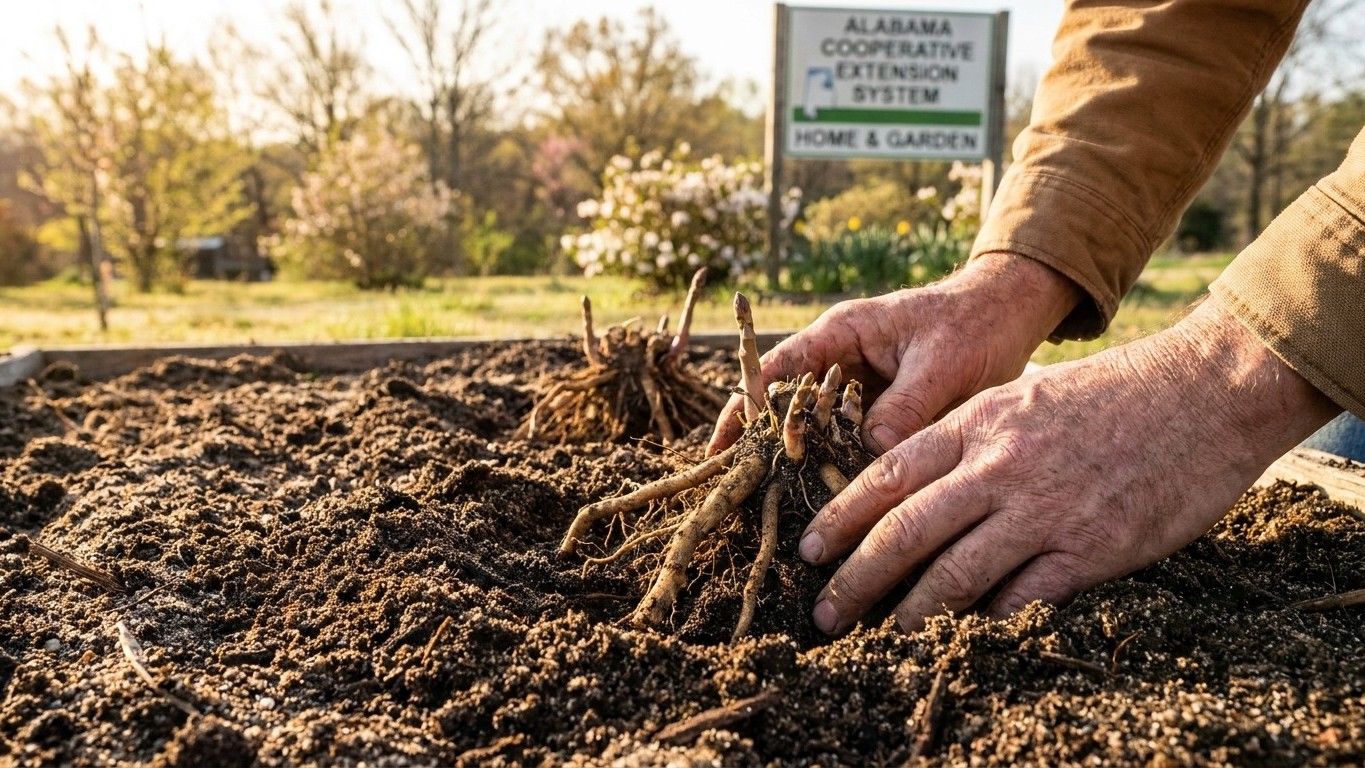

North Carolina gardeners set Asparagus Crowns in early spring, timed around the region’s last frost. In the Piedmont, that window runs roughly March 23 to April 5; the coastal plain tends to clear a bit earlier, the mountains later. Get the crowns into the ground while they’re still dormant, into a bed that won’t need to move, because once it’s in, it’s staying for years.
The short answer
an Asparagus Bed isn’t one a grower replants next spring if the spot turns out wrong. Once the crowns settle in, they occupy that ground for 10 to 15 years, and the plant asks for exactly one thing from the soil: that it drains. Nothing else about texture, fertility, or pH is a deal-breaker, according to Utah State University Extension’s guidance on the crop. Just drainage.
North Carolina’s dominant mapped soil, the Cecil series (an Ultisol that USDA lists as representative of the state), checks that box without much help. It’s a sandy profile: 68 percent sand, 13 percent clay, 20 percent silt, with organic matter running around 0.8 percent in the surface layer. Water moves through sand fast, and USDA records this series as well drained. For a crop going in for over a decade, that’s a decent starting point.
A starting point, not a verdict on any one yard. The Cecil series represents North Carolina broadly on a soil survey map; it says nothing about the low corner of a particular lot, a spot near a downspout, or ground a builder graded and compacted before the landscaping went in. River bottoms run heavier and hold water longer than the state soil suggests. Fill dirt behaves nothing like undisturbed subsoil. The only way to know what a specific bed does after rain is to watch it: dig a hole a foot deep, fill it with water, and check whether it’s still standing there a day later.
If it is, the fix isn’t complicated, but it does mean work before the crowns go in. Raised rows, or a bed built up several inches above grade, lift the crowns above standing water without disturbing the rest of the yard. Working in organic matter helps too, since the Cecil series’ surface layer only carries about 0.8 percent naturally, though it won’t turn a soggy corner into a well-drained one on its own. The site decision matters more here than with almost anything else grown in a home garden, because asparagus doesn’t offer a do-over three years in.
That three-year figure catches new growers off guard. Nothing gets cut the first year, or the second. Harvest starts in year three, and even then it’s a short window, about four weeks, then six weeks the following year, then eight, the bed building toward full production gradually. The rule for knowing when to stop cutting each spring isn’t a date circled on a calendar. It’s when most of the spears coming up are thinner than a pencil. That’s the plant signaling it needs to put its energy into ferns for the rest of the season, not more spears.
Will the summer here water it for you?
An asparagus bed has a fairly specific thirst, and North Carolina’s summer rainfall doesn’t automatically match it. Working through the numbers in order shows where the gap sits.
- What the bed asks for. For the first two years, the bed wants 1 to 2 inches of water every other week. After that establishment period, the schedule relaxes to about the same amount every three weeks.
- What summer here delivers. NOAA’s 1991-2020 climate normals for the reference station put June through August rainfall at about 12.1 inches total, broken out as 3.99 inches in June, 3.74 in July, and 4.35 in August. July is the dry month of the three.
- What that averages out to weekly. Spread across four weeks, July’s 3.74 inches works out to under an inch a week on average, and summer rain rarely falls evenly. A single thunderstorm can dump most of a week’s total in twenty minutes and run off before it soaks in, leaving the days in between dry.
- What the soil does with it. The Cecil series that represents much of the state’s ground is sandy, 68 percent sand at the surface, which lets water pass through fast rather than holding it near the roots. A rainy month on paper can still mean a dry root zone within days on that kind of profile.
- What that leaves to add. During the two establishment years, a grower on average-to-dry ground should plan to supplement with irrigation most weeks in July and many in June and August, rather than counting on rainfall to cover the every-other-week target. Once the bed matures and the schedule eases to every three weeks, the margin for natural rainfall to carry part of the load improves, though a rain gauge on the actual plot, not a regional average, is what settles it for any given season.
When to put the crowns in
Crowns go into the ground in early spring, while they’re dormant and before new growth pushes hard. For the Piedmont, that lines up around March 23 to April 5, the window NOAA’s 1991-2020 normals give for the last spring freeze at the reference station. That’s a mean date, an average built from three decades of records, not a guarantee for any single year. Frost can still show up after it, or the ground can warm early and make the window feel late. The coastal plain generally clears frost earlier than the Piedmont date implies, and the Blue Ridge mountains to the west run several weeks behind it, so a grower there is planting well into what would be late spring on the Piedmont calendar.
Crowns get set into furrows about 8 inches deep. The furrow doesn’t get filled in all at once. Instead, soil goes back in gradually across the season, roughly 2 inches every other month, covering the crown a little more each time as new growth reaches up through it. That staged backfill is part of how the roots settle into depth rather than being buried under a full foot of soil on day one.
Crowns aren’t the only route in. Asparagus can also be started from seed, though the source used for these guidelines addresses crown planting specifically and doesn’t lay out a seed-starting calendar, so that timeline isn’t detailed further here. Crowns remain the faster path to an established bed for most home gardeners, since they’re already a year or more old when purchased.
Variety selection is straightforward but limited in what’s actually published about it. Utah State University Extension names four: Jersey Giant and Jersey Knight, both all-male varieties, and UC 157 F1 and Purple Passion, both male and female. That’s the extent of what the source specifies, sex type only. No flavor comparison, no yield figures, no stated reason to favor one over another appears in the guidance.
| Variety | Sex type |
|---|---|
| Jersey Giant | All-male |
| Jersey Knight | All-male |
| UC 157 F1 | Male and female |
| Purple Passion | Male and female |
Common questions
Does the state soil mean my garden will drain well too?
Not automatically. The Cecil series is the soil USDA maps as representative of North Carolina overall, and it happens to be sandy and well drained. But that’s a statewide average, not a reading on any specific yard. River bottoms, compacted fill, and low corners can all behave very differently. A simple hole-and-water test on the actual planting site is the only way to know for sure.
What’s the soil pH for asparagus in North Carolina?
Not published in the guidance used here. Utah State University Extension’s asparagus guidelines are silent on pH requirements, and the Cecil series’ surface pH of about 5.5 describes the mapped state soil, not a target number for a cultivated bed. A soil test is the way to get an actual reading for a specific garden.
Can I harvest asparagus the first year after planting crowns?
No. The guidance is firm that no spears get cut in year one or year two. Harvest begins in year three, starting with about four weeks of cutting, then six weeks the following year, then eight, as the bed works up to full production.
Is there a winter chilling requirement for asparagus in North Carolina?
That figure isn’t published in the source used for this guidance. It covers planting depth, spacing, watering, and harvest timing, but it’s silent on chilling hours, so no number is given here rather than guessed at.