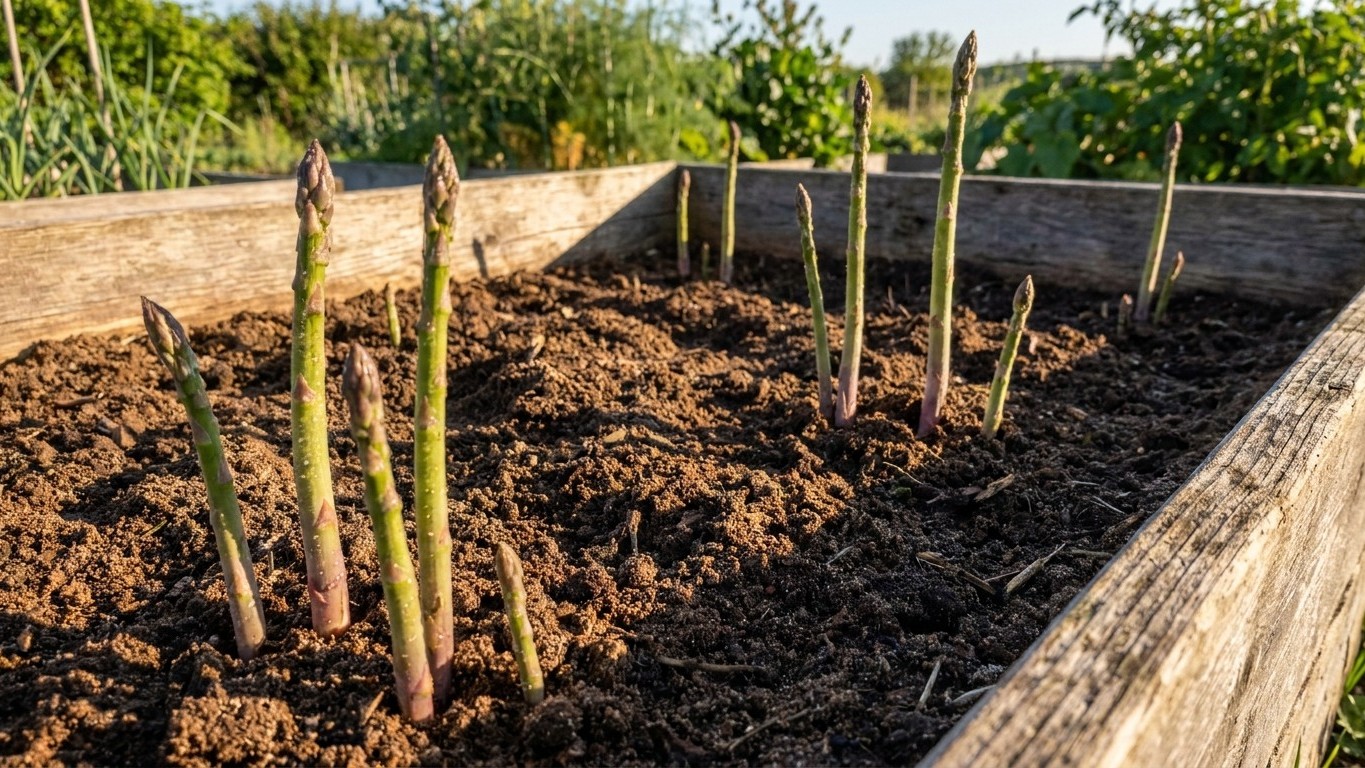

Yes, in most cases the ground here will carry an Asparagus Bed through its full ten-to-fifteen-year run. The soil records list North Carolina’s representative surface soil, the Cecil series, as well drained by nature, and drainage is the one soil condition asparagus actually asks for. That’s the state-level picture, though. A backyard on fill dirt, a low spot that ponds after rain, or a clay pocket the builder left behind can behave nothing like the mapped average, so the real answer still depends on what’s under your own feet.
The short answer
Asparagus is unusual among garden crops because the decision gets made once and then lives with you for a decade or more. Crowns go into an 8-inch furrow, and once they’re settled there, the planting is expected to produce for 10 to 15 years before it’s worth starting over. That timeline is why the soil question matters more here than it does for tomatoes or squash, where a bad match just costs you one disappointing season. Get the spot wrong with asparagus and you’re stuck amending, replanting, or working around a struggling bed for years.
The soil records don’t ask for a particular pH, a certain fertility level, or a specific texture. The only requirement stated is that the ground drains. That’s a low bar, but it’s not a trivial one, because asparagus crowns sitting in standing water rot before they ever send up a spear.
North Carolina’s representative soil, the Cecil series, clears that bar comfortably. It’s classified as well drained, and its composition explains why: about 68 percent sand, 13 percent clay, and 20 percent silt in the surface layer. Sand-heavy soils shed water quickly rather than holding it around root crowns, which is exactly the behavior asparagus needs. The same soil is naturally on the acid side, with a surface pH around 5.5, and it runs low in organic matter, about 0.8 percent. Neither of those numbers is a problem the source flags for asparagus specifically, since drainage is the stated concern, not chemistry.
The catch is that “the state soil” describes a soil series mapped as representative, not a certificate for any one yard. A river-bottom lot, a subdivision built on scraped and re-graded ground, or a low corner where water collects after storms can sit nowhere near that Cecil-series profile, even in the same county. A basic soil test, or simply watching how fast a filled hole drains after a hard rain, tells you more about your actual bed site than any state-level figure can. If water is still standing eight or ten hours after a downpour, that spot needs a raised bed or a different location, not an asparagus crown.
Will the summer here water it for you?
Asparagus has a fairly specific thirst schedule once it’s in the ground, and the region’s summer rainfall doesn’t match it evenly month to month.
- What the bed asks for: during the first two years, the planting wants 1 to 2 inches of water every other week. After that establishment period, the interval stretches to every three weeks.
- What June typically delivers: the 1991-2020 climate normals put June rainfall at 3.99 inches for the month, which works out to roughly an inch a week if it fell evenly, though real rainfall almost never does.
- What July typically delivers: July is the driest of the three summer months, averaging 3.74 inches. That’s the stretch most likely to leave a new bed short, especially since sandy, well-drained soil like the Cecil series lets rain pass through fast rather than banking it for later in the week.
- What August typically delivers: August averages 4.35 inches, the wettest of the summer months, often arriving as thunderstorms that dump a lot of water at once and then leave a dry stretch behind.
- The total picture: summer as a whole averages about 12.1 inches across June, July and August, against 43.6 inches for the full year. That’s a reasonable seasonal supply on paper, but a bed on fast-draining sandy ground during establishment years will still need a hose in the gaps, particularly through July.
None of these normals describe any single summer, and they say nothing about your particular yard. A rain gauge on the actual bed site, checked weekly during those first two establishment years, is the only way to know whether nature is covering the 1-to-2-inch requirement or whether it’s time to drag out the hose.
When to put the crowns in
Crowns go into the furrow in early spring, which for this region means timing the planting around the point when hard frost has mostly passed. The 1991-2020 climate normals put the last spring frost window here at around March 23 to April 5. That’s a mean date built from three decades of records, not a promise about any particular spring, so treat it as a planning target rather than a calendar lock.
That window applies to the Piedmont, where the reference station sits. Ground further west, toward the Blue Ridge, tends to stay frost-prone several weeks longer into spring, while the coastal plain generally clears earlier. A gardener working from either edge of the state should shift the planting window in that direction rather than using the Piedmont date as a fixed rule.
Once that frost window has passed, the crowns go into their 8-inch furrow, and the covering happens gradually rather than all at once. The standard approach is to backfill in stages, adding about 2 inches of soil every other month across the first year, rather than filling the trench flat on planting day. That staged backfill lets the emerging shoots keep working toward daylight without being buried under the full depth immediately.
Seed is the other route into an Asparagus Bed, and it’s a legitimate alternative to buying crowns. The tradeoff is time: starting from seed adds a full extra growing season before the young plants are sturdy enough to move to their permanent spot, compared to setting crowns directly. For a bed that’s already asking for a ten-to-fifteen-year commitment, most home gardeners lean toward crowns simply to skip that extra year of waiting, though seed remains a valid option where crowns aren’t available or where a gardener wants to raise a specific variety from scratch.
Common questions
How soon can I actually harvest asparagus after planting?
Not in the first two years, and not lightly in the third. No harvest happens until year three. That first harvest year is limited to about 4 weeks of cutting. The following year stretches to about 6 weeks, and the year after that to about 8 weeks. Beyond that, the harvest window each spring is governed by the condition of the spears rather than a fixed number of weeks: cutting stops for the season once most of the spears coming up are thinner than a pencil, since that’s the plant’s signal that it needs to stop producing shoots and start building energy in its ferns for next year.
How deep should the planting furrow be, and do I fill it in all at once?
The furrow is dug about 8 inches deep. It is not backfilled in one pass. Instead, soil goes back in gradually, roughly 2 inches every other month over the course of the first year, which gives the young shoots room to grow upward as the trench fills rather than smothering them under a full 8 inches of soil on day one.
Which asparagus variety grows best in North Carolina?
That comparison isn’t published in the source material used here. What is documented is the sex type of four named varieties: Jersey Giant and Jersey Knight are all-male varieties, while UC 157 F1 and Purple Passion are male/female types. No data on flavor, yield, or regional performance is attached to any of the four, so choosing among them comes down to availability and personal preference rather than a documented advantage for this state’s growing conditions.
What if my own soil doesn’t drain well?
The state’s representative soil, the Cecil series, drains well on its own, but plenty of individual yards sit on ground that doesn’t behave that way, especially in low spots, compacted subdivision lots, or areas with a heavier clay pan close to the surface. Since drainage is the one requirement asparagus actually needs, a raised bed is the standard workaround for a site that holds water. Building the planting area up rather than digging it into poorly drained native soil sidesteps the problem entirely, and it’s a far more reliable fix than trying to amend a wet spot year after year for a bed that’s supposed to last over a decade.