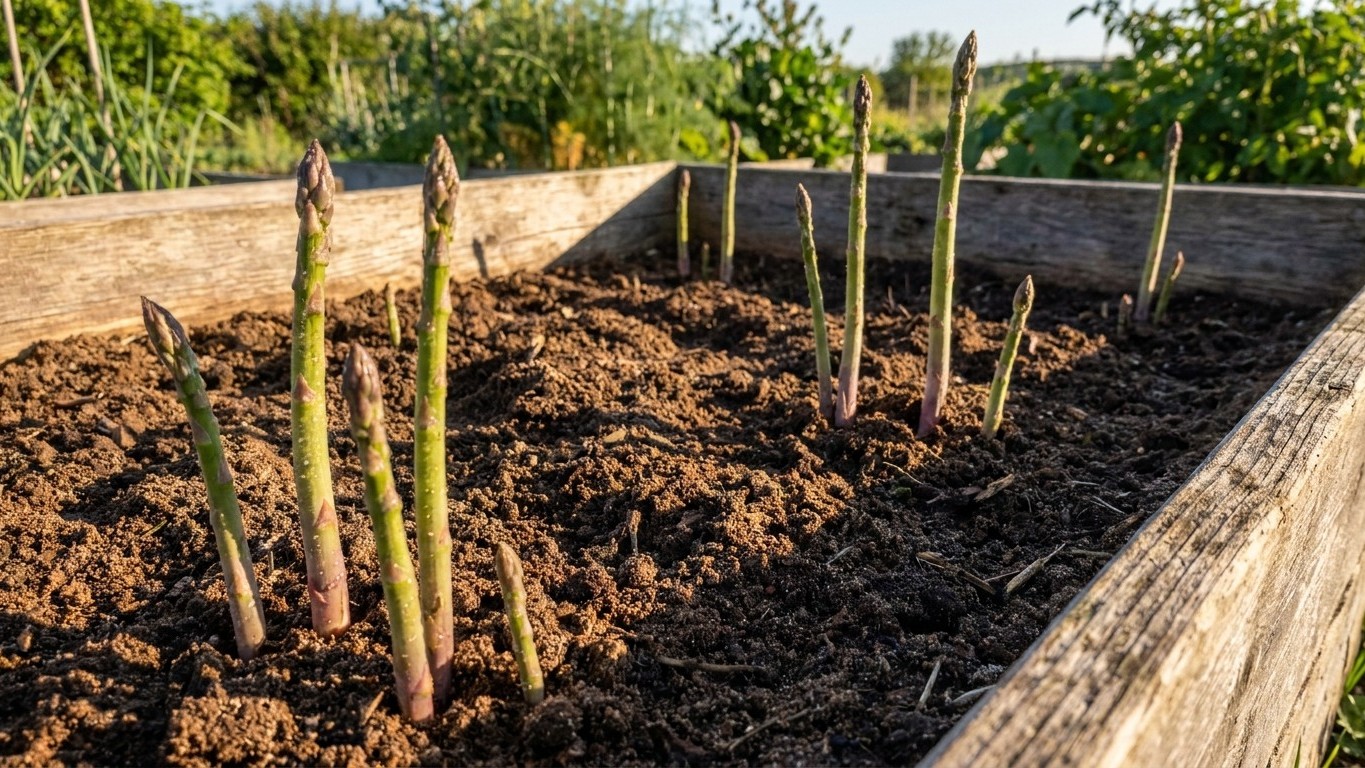

Yes, with a caveat: Nova Scotia’s ground can carry an asparagus bed through its full 10-to-15-year run, but only where drainage is actually good. The source behind this crop’s timeline sets one requirement, and only one: the soil has to drain. Most soils qualify. Nova Scotia’s dominant profile, an acid Podzol, is classed as imperfectly drained, which means the gardener’s first job is checking that their own patch of ground clears water faster than the provincial average.
The short answer
The soil that shows up most often across Nova Scotia’s mapped surface, 53 percent of it, is a Podzol: the acid, leached type that forms under conifer cover, where decades of rain have carried the mineral bases down and out of the topsoil. The median surface reading sits at pH 5.2, strongly acid, and the texture runs loam to silt, about 52 percent sand, 10 percent clay, 38 percent silt, with organic matter around 2.1 percent. Drainage across that dominant profile is rated imperfectly drained.
That word, imperfectly, is the one that matters for a fifteen-year crop. Asparagus crowns sit underground for the entire run of the bed, and a crown that sits in standing water through a wet spring or a soggy November doesn’t get a second chance the way an annual vegetable does. Root rot in an asparagus bed isn’t a bad season, it’s the end of the bed. So the dominant Nova Scotia profile isn’t disqualifying, but it isn’t a green light either. It’s a soil that needs help clearing water before a gardener commits fifteen years of the same patch of yard to it.
What that help looks like is straightforward. A raised bed, even a modest six to eight inches above grade, gets the crowns above the water table that an imperfectly drained silt-loam tends to hold. Working coarse sand or compost into the planting trench loosens the structure enough for water to move through rather than pool. On a slope, simply choosing the higher end of the yard over the low corner solves half the problem before a shovel goes in. None of this is exotic work, but skipping it on ground that’s already inclined to hold water is the kind of shortcut that shows up as a dying bed in year six, not year one.
None of this is a diagnosis of any one backyard. The provincial figures come from mapped agricultural soil components across the province, a median of nearly 500 sampled surface horizons, and they describe a tendency, not a guarantee. A garden on an old riverbank, a lot with fill brought in during construction, or ground near a bog will behave nothing like that median. The only way to know what’s actually under a specific bed is a soil test, and for a planting this long-lived, that test is worth the modest cost before the crowns go in the ground, not after.
Will the summer here water it for you?
The asparagus bed’s water needs change as it ages. For the first two years, while the crowns are still building the root system that will feed the bed for a decade, it wants 1 to 2 inches every other week. After that establishment period, the requirement eases to 1 to 2 inches every three weeks. Whether Nova Scotia’s summer covers that on its own depends on doing the math against the region’s actual rainfall normals.
- What the sky delivers. Halifax Stanfield’s climate normals put summer rainfall at about 11.2 inches across June, July and August combined: June averages 3.79 inches, July 3.76 inches, and August, the driest of the three, 3.68 inches.
- What that works out to per two weeks. Spread evenly, roughly 3.7 to 3.8 inches a month comes out close to 1.7 to 1.9 inches every two weeks, which lands inside the 1-to-2-inch target the young bed asks for. On paper, an average Nova Scotia summer comes close to covering the establishment-year requirement without a hose.
- Why paper isn’t the yard. Rain rarely arrives as a tidy weekly ration. A summer’s worth of inches can fall in three heavy storms with dry stretches between them, and on an imperfectly drained silt-loam a downpour is as likely to run off or pool as to soak down to root depth. A rain gauge on the actual bed, checked weekly, tells a gardener more than the seasonal average ever will.
- Where a hose still earns its keep. During any stretch of a week or more without measurable rain, especially in August when the normal drops to its lowest point of the summer, supplemental watering closes the gap. Once the bed reaches its third year and the requirement eases to every three weeks, Nova Scotia’s summer normals cover that lighter demand comfortably in most years.
When to put the crowns in
Crowns go into the ground in early spring, set into furrows about 8 inches deep. In Nova Scotia, “early spring” has to be read against the region’s own frost calendar rather than a generic date. The Halifax Stanfield station’s mean last spring frost falls around May 7, and that figure is an average, not a promise: in roughly half of all years, the last frost arrives later than that date, sometimes considerably later. A gardener working off this number should treat it as the midpoint of a window that can run into late May, not a green light to plant on a fixed day, and should watch the soil itself, whether it’s workable and has warmed past the point of being cold and wet, before digging the furrow.
The furrow isn’t filled in one pass. Crowns are set at the bottom of that 8-inch trench and covered gradually as the season goes on, with about two inches of soil added back every other month rather than the whole furrow backfilled at planting. That staged approach lets the emerging shoots keep pushing up through loose soil instead of fighting through a deep, compacted fill all at once.
Seed is the alternative route, for a gardener who wants to grow their own crowns rather than buy them, or simply has seed on hand. It takes longer: a season started from seed pushes the eventual three-year wait for the first harvest out further, since the plant needs an extra season just to grow to crown size before it goes through the same establishment clock as a purchased crown. For a bed meant to produce for a decade and a half, most gardeners find the time saved by starting with crowns worth the extra initial cost.
Variety selection is limited to a short, named list, and the published information on it doesn’t go past sex type:
| Variety | Sex type |
|---|---|
| Jersey Giant | All-male |
| Jersey Knight | All-male |
| UC 157 F1 | Male and female |
| Purple Passion | Male and female |
No flavor comparison, yield figure, or reason to prefer one variety over another is published in the source behind this guide. All-male varieties are generally chosen because they don’t spend energy producing seed, but beyond the sex designation itself, there’s no further published detail to lean on here.
Common questions
Does Nova Scotia’s soil pH matter for asparagus?
The source behind this crop’s timeline is silent on any pH preference, so no ideal number is given here. What is measured is the province’s median surface pH, about 5.2, strongly acid, on the dominant Podzol profile. A soil test on the actual planting site is the only way to know the reading that matters.
How long before the bed produces anything?
Nothing is harvested in the first two years. Harvest begins in year three, and even then it’s limited: about 4 weeks of cutting that first harvest year, extending to roughly 6 weeks the following year, and about 8 weeks once the bed matures. That gradual ramp-up protects the crown’s energy reserves while the root system finishes establishing.
How does a gardener know when to stop cutting each spring?
The cutoff isn’t a date on the calendar. Harvest stops for the season once most of the spears coming up are thinner than a pencil, a sign the crown’s stored energy for that push is running out and needs to go toward growing ferns instead of spears.
Is there a winter chilling requirement to worry about?
Not according to the source used for this guide, which doesn’t address winter chilling at all. Nova Scotia’s hardiness zone isn’t a substitute for that figure, and no chilling number should be assumed from it here.