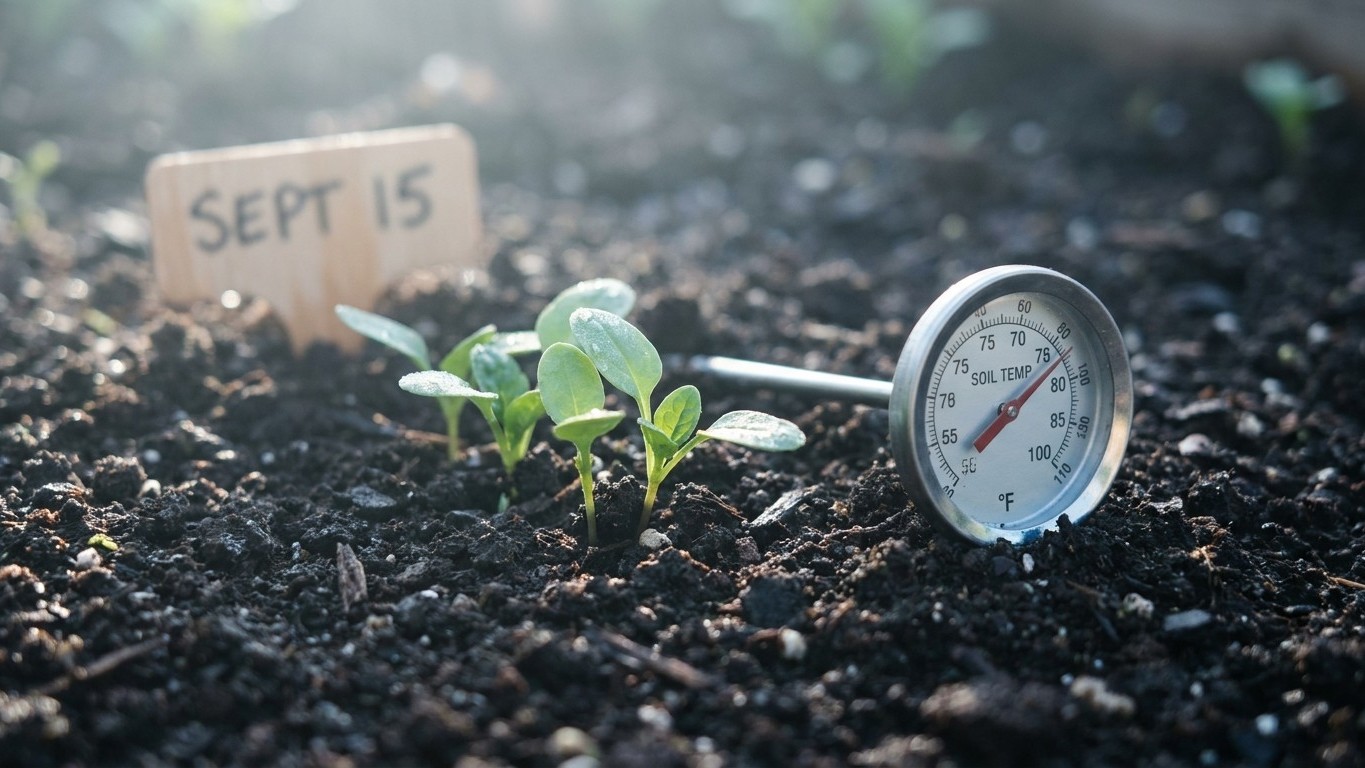

Autumn spinach in North Carolina‘s Piedmont goes into the ground between mid-August and mid-September, timed so the crop matures 50 to 75 days later, ahead of the first fall frost, which typically lands between October 30 and November 8. The real gatekeeper isn’t the calendar, though. It’s soil temperature: seed germination drops off sharply once the ground holds above 80 F, and late-summer soil in this region often does exactly that.
The short answer
On the longest day of the year, the reference station near Charlotte logs 14 hours and 23 minutes of daylight. That number matters more than most gardeners realize, because spinach bolts under long days as reliably as it bolts under heat. A cool summer wouldn’t rescue the crop here even if one showed up, since the trigger isn’t temperature alone. It’s day length crossing a threshold the plant reads on its own schedule. And the Piedmont doesn’t offer a cool summer anyway.
Spinach grows best where temperatures stay under 75 F, and above that line the leaves turn bitter even before the plant bolts outright. Charlotte averages 35 days a year at 90 F or hotter, which tells you how fast the region blows past that 75 F ceiling once late spring turns to early summer. So the limiting factor for a spring-sown crop is both day length and heat, arriving almost together. As days lengthen toward the June solstice, the plant’s internal clock starts pushing it toward flowering, and the same weeks bring the temperature spikes that finish the job. There’s no way to out-wait one problem while the other is still building.
Autumn works differently, and this is the part gardeners often miss. As the calendar moves past the solstice, day length is shrinking, not growing, so the bolting pressure from long days actually eases through late summer and fall. That removes one obstacle. What’s left is heat lingering in the soil from a summer that logged those 35 days above 90 F, and eventually the frost that ends the growing season outright. the spring crop in North Carolina fights day length and heat at the same time; the fall crop only has to wait out the heat, then race the frost.
That’s why the practical advice for this region always centers on soil temperature rather than air temperature or sunset times. A thermometer pushed a few inches into the bed tells you more about when to sow than any date on a seed packet. Once that reading falls consistently below 80 F, typically as August gives way to September in the Piedmont, the window for a reliable fall stand opens.
How long the spring window really is
Working out the usable spring season here means stacking a few facts on top of each other, in order.
- The last spring frost at the reference station falls between March 23 and April 5. Standard practice is sowing spinach seed 2 to 3 weeks before that date, which puts a realistic start somewhere in the first half of March for the Piedmont.
- Spinach seed germinates in cool soil, so an early March sowing isn’t fighting the ground the way an August sowing does. The obstacle in spring isn’t germination. It’s how quickly the season closes behind the seedlings.
- Growth stops being good once temperatures climb past 75 F, and the Piedmont’s climb toward the June solstice brings both longer days and hotter afternoons at roughly the same pace.
- With 35 days a year averaging 90 F or better at the reference station, the region’s heat load builds fast once late spring turns the corner. That heat, combined with day length pushing past the point that triggers flowering, closes the spring window well before summer officially arrives.
- Counting from an early-to-mid March sowing to the point where both day length and heat turn against the crop leaves a usable spring stretch of roughly ten to twelve weeks, and even that assumes no late cold snap delays the start.
- That’s a shorter run than gardeners in cooler climates get, and it’s the reason many Piedmont growers treat spring spinach as a bonus crop and put their real effort into the fall planting instead.
The autumn crop, and when the soil lets you sow
The fall crop in North Carolina isn’t blocked by cold at the start. It’s blocked by heat, and that surprises people who assume a fall vegetable should go in once the weather starts feeling like fall.
Soil still too warm to germinate
Spinach seed germination drops once soil holds above 80 F, and after a Piedmont summer that averages 35 days at 90 F or hotter in the air, ground temperature stays elevated well past Labor Day in many years. Sowing too early, while the bed is still baking from August sun, means a thin, unreliable stand even if the seed technically survives. The practical fix is patience: wait for a stretch of cooler nights to pull soil temperature down, and check it directly with a thermometer rather than guessing from the air temperature on a given afternoon. Raised beds and lighter soils cool faster than dense clay, so timing can shift by a week or two even within the same yard.
The frost that ends the season
The first fall frost at the reference station arrives between October 30 and November 8. Counting backward 50 to 75 days from that window, the range that Utah State University Extension gives for a fall crop, points to a sowing date somewhere between mid-August and mid-September for a harvest that finishes before hard frost shuts things down. Split the difference between the two obstacles and the sweet spot for most Piedmont gardens sits in early-to-mid September, once soil has cooled below that 80 F line but there’s still enough runway before the frost date to reach a usable harvest.
Four spinach varieties come up often in extension guidance for fall planting: Bloomsdale, Melody, Teton, and Olympia. None of them come with published days-to-maturity figures or performance data from the sources behind this guidance, so treat variety choice as a separate decision from timing rather than something that changes the sowing math above.
Gardeners in the Blue Ridge foothills to the west should expect the whole schedule to shift earlier, since frost arrives there weeks ahead of the Piedmont. Coastal plain growers get the opposite adjustment, with more room on the back end before frost closes things out.
Common questions
Can I sow spinach in July for a fall harvest?
Soil in the Piedmont is almost certainly still above the 80 F germination threshold in July, given a summer that averages 35 days at 90 F or hotter. A July sowing risks a poor stand. Waiting until soil measurably cools, typically late August into September, gives more reliable results.
Does a cooler-than-average summer extend the spring spinach season?
Not by much. Bolting is triggered by long days as well as by heat, and day length keeps climbing toward the June solstice regardless of how warm or cool a particular summer runs. The 14-hour-23-minute day length at the reference station pushes the crop toward flowering on its own schedule.
Why does the fall crop get a longer window than the spring crop?
After the June solstice, day length shrinks instead of growing, which eases the bolting pressure that spinach faces from long days. The fall crop only has to outrun lingering soil heat and the eventual frost, rather than fighting rising day length and rising temperature at the same time.
Is 80 F soil temperature something I can measure at home?
Yes. A basic soil thermometer pushed a few inches into the bed gives a more useful reading than air temperature or the calendar. Checking a few times a week in late summer shows exactly when the ground has cooled enough for reliable germination.