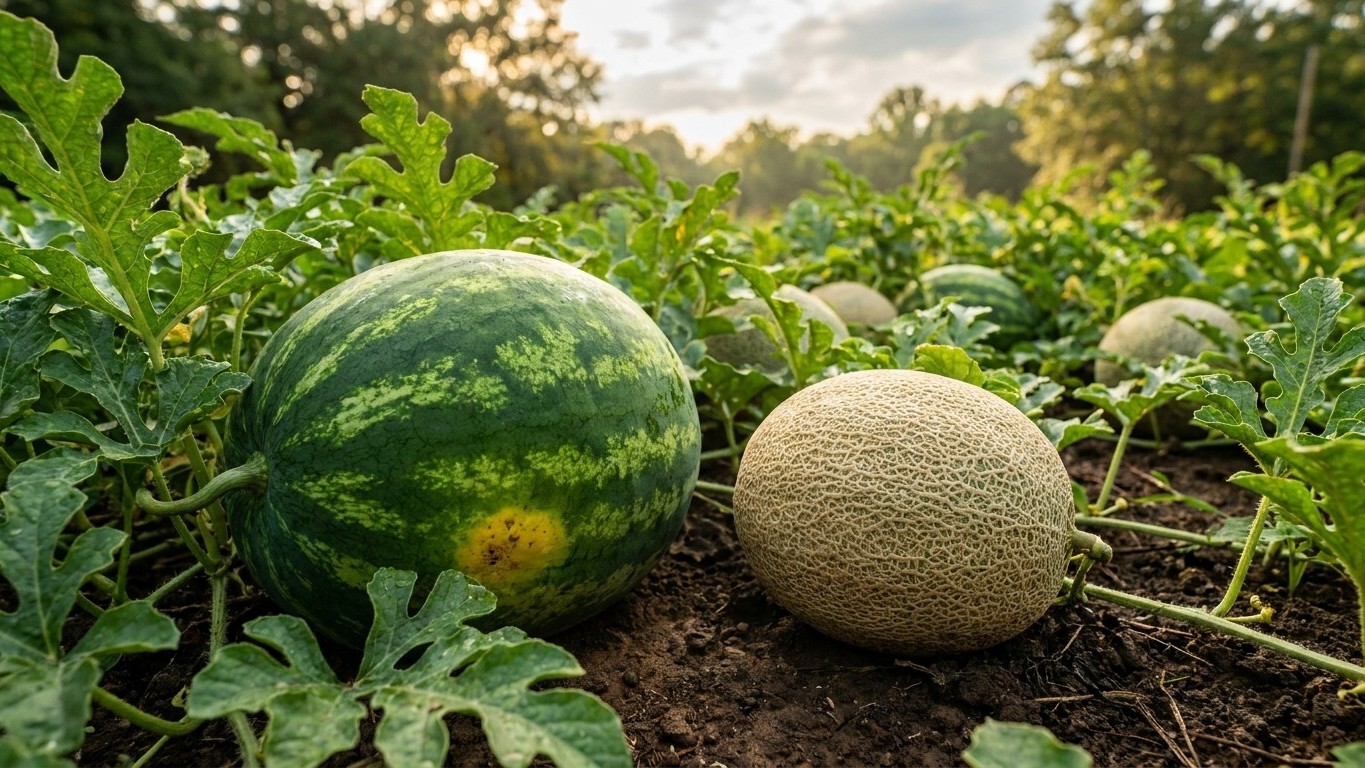

Watermelon and cantaloupe are the two safe bets for a North Carolina garden, especially in the Piedmont around Charlotte. Both finish well within the frost-free window and actually get sweeter under the region’s summer heat. Honeydew and other thin-skinned, low-humidity melons are the riskier pick here, not because of season length, but because of what comes with that heat: rain and stickiness.
The short answer for North Carolina
Start with the calendar. Around Charlotte, the last spring frost lands somewhere between March 23 and April 5, and the first fall frost doesn’t show up until October 30 to November 8. That’s a frost-free stretch of roughly 208 to 230 days, depending on where in that window your own spring and fall land. For melons, that’s a lot of runway. Even the slow, old-fashioned watermelon varieties that take 90 to 100 days from transplant to harvest fit inside that window with weeks to spare, which means a failed first planting can usually be replanted without losing the season.
Heat is the other half of the equation, and North Carolina’s Piedmont has plenty of it: an average of 35 days a year hitting 90°F or higher. Melons are warm-season crops that size up faster and sweeten more reliably as heat accumulates, so this heat load works in your favor for the crops built to handle it. That’s watermelon first, cantaloupe (muskmelon) close behind.
Where the decision gets harder is with melon types that were bred for drier, less humid climates: honeydew, casaba, and some of the French Charentais types. They can technically mature in this season length, but the same conditions that push sugar into a watermelon (heat, plus the rain that follows it) also push fungal disease into a thin-netted melon that wants to ripen dry.
| Melon type | Typical days to maturity | Fits NC’s frost-free window? | Main risk here |
|---|---|---|---|
| Watermelon | 80-100 days | Yes, with margin | Low |
| Cantaloupe / muskmelon | 75-90 days | Yes, with margin | Moderate (fungal, if crowded) |
| Honeydew / Charentais | 85-100 days | Yes, but tighter margin for disease | Higher (humidity) |
The practical takeaway: if you’re picking one melon to plant this year, pick watermelon or cantaloupe. If you want to try honeydew, plan for airflow and disease watching, not just a sunny spot.
What will not work here

North Carolina’s frost-free season isn’t the limiting factor most gardeners assume it is. At 208 to 230 days, it’s long enough to grow almost any melon variety sold in a seed catalog, including the slowest 100-day heirloom watermelons. So the usual northern-garden advice, plant only the fastest varieties or you’ll run out of season, doesn’t really apply in the Piedmont. What defeats melons here is a different combination: heat that spikes water demand, and rainfall that arrives in bursts rather than steady soakings.
Summer rain averages about 12.1 inches across June, July, and August, with July running driest at 3.74 inches. On paper that sounds like enough water. In practice, a lot of that rain falls as a single thunderstorm that runs off a dry, sun-baked bed rather than soaking down to the root zone, especially with 35 days a year pushing past 90°F and pulling moisture back out of the soil through evaporation. A melon watered once a week on a fixed schedule, rain or no rain, will hit an dry stretch during July exactly when the fruit is sizing up, and the result is blossom end rot, cracked rinds, or fruit that stalls out undersized. Watering by feel, checking the soil rather than the calendar, matters more here than in a drier state.
The other failure mode is spacing. Heat plus rainfall means humidity, and humidity is what powdery mildew, downy mildew, and vine-wilting fungal diseases need to spread. Melon vines planted close together the way a seed packet’s minimum spacing allows will shade the soil, trap moisture on the leaves overnight, and stay damp longer after a storm. That’s a minor issue in a dry climate. In the Piedmont’s rainfall and heat combination, it’s often the difference between a healthy vine in August and one that’s collapsed from wilt before the fruit finishes ripening. Wider spacing than the package suggests, and pruning for airflow, are not optional extras here; they’re closer to necessary insurance.
What changes across North Carolina
North Carolina is not one growing climate, and the USDA Plant Hardiness Zone Map (2023 edition, built on 1991-2020 winter minimum temperatures) makes that plain: the state spans zones 5b through 8b. That’s a wider range than most states get, and it means a planting date or variety pick that works fine around Charlotte can be flatly wrong sixty miles in either direction.
The Blue Ridge Mountains to the west sit at the cold end of that range. Higher elevation means a later last frost in spring, often several weeks behind the Piedmont’s March 23 to April 5 window, a shorter run of 90°F-plus days, and cooler nights that slow melon sugar development even in midsummer. A gardener at altitude should lean toward faster-maturing varieties, closer to 75 days than 100, and consider starting transplants indoors rather than direct-seeding, since the soil simply stays cool longer.
The coastal plain runs the other direction: warmer, with an earlier last frost and a longer stretch of hot nights that keep melons growing after Piedmont vines have slowed for the season. Gardeners there have more room to grow the slowest, largest watermelon varieties, and in some years enough season left over to try a second, later planting.
None of this tells you which zone your own yard sits in. What it tells you is that a single state-level answer will undersell the mountains and undersell the coast in opposite directions. The zone map is the tool for narrowing that down to your own county.
Where to check this for your own county
Everything above is built on data from one reference station, Charlotte, standing in for the Piedmont. It’s a reasonable proxy for the middle of the state, but North Carolina’s spread across five USDA zones means a county in the mountains or on the coast is working with a genuinely different set of numbers, not just a slightly adjusted version of these ones.
That’s what a county extension office is for. NC State Extension runs a county-by-county network, and each county center typically publishes its own planting calendar built from local frost data, along with notes on which melon varieties have actually performed in local trial plots, not just which ones are theoretically suited to the region. That local trial history is worth more than any general advice: a variety that struggles with a disease common in one county’s soil may perform fine two counties over.
Search your own county’s extension page for its vegetable planting calendar and any recent melon or cucurbit variety trial results. If your county hasn’t published trial data recently, a neighboring county in the same part of the state (mountains, Piedmont, or coastal plain) is a better substitute than this state-level page, since the two will share more of their actual growing conditions.
The state-level answer is useful for deciding what type of melon to grow and roughly when, not for pinning down your exact planting week. A county recommendation, built from local frost records and local trial results, will always beat a state one. Treat this article as the starting framework, and your county extension office as the fine print.
Checking this against your own garden
None of the dates above account for your specific yard, and your own observations will tell you more than any calendar. Three things are worth watching before you commit seed or transplants to the ground.
Soil warmth by feel is the first. Melons germinate reliably when the soil feels warm and dry to the touch a few inches down, not cool and damp the way it does right after snowmelt or a cold spring rain. If you dig a small hole and the soil still feels chilly in your hand in mid-April, the ground hasn’t caught up to the calendar yet, whatever the average frost date says.
The first flush of male flowers is the second signal. Melon vines produce male flowers before female ones, sometimes by a week or two, and that early bloom is a sign the plant has shifted into reproductive growth. No male flowers yet, even on a vine that looks otherwise healthy, usually means it’s still building leaf mass and isn’t as far along as its size suggests.
The emergence of the first true leaves, the second set that appears after the rounded seed leaves, is the third. Slow or stunted true leaves point to cool soil, thin nutrition, or transplant stress, any of which will push your harvest later than the maturity date on the seed packet promises. Watching these three, rather than counting days on a calendar, is what actually tells you how your own patch of ground compares to the regional averages.