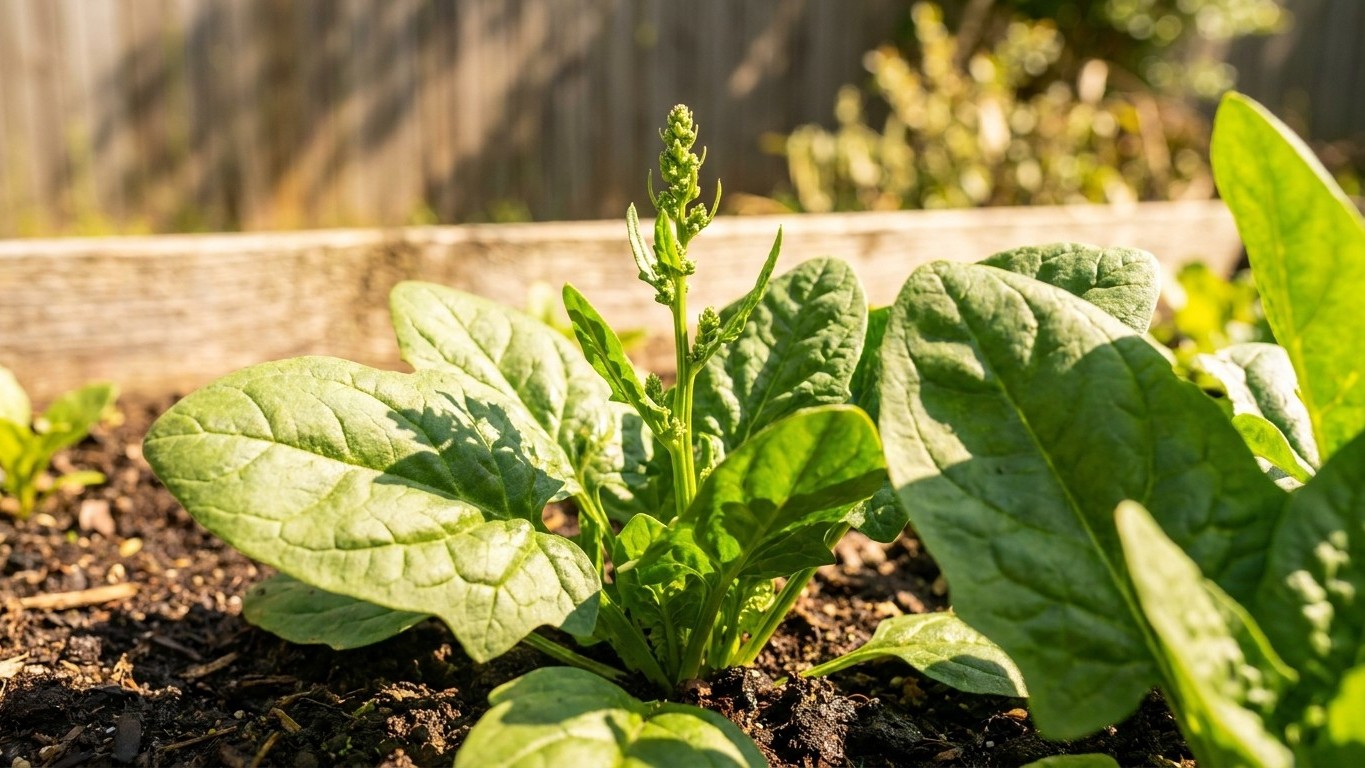

Yes, spinach bolts fast in Nunavut, and heat has almost nothing to do with it. At Rankin Inlet, the reference station for the territory, the longest day of the year holds 19 hours and 41 minutes of daylight. That single figure matters more than any thermometer reading, because spinach reads day length as a signal to flower. The territory logs zero days a year above 90 F, so warmth is barely a factor here. The limit is light, not heat.
The short answer
Start with that daylight number again, because it explains everything else. Nineteen hours and forty-one minutes of light on the longest day is roughly five hours more than a typical mid-latitude garden ever sees in June. Spinach does not need that much light to grow. What it does is respond to it by shifting from leaf production to flowering, sending up a seed stalk and turning the leaves bitter and thin along the way. A cool Arctic summer does not slow that clock down. The plant is not measuring temperature to decide when to bolt. It is measuring hours of daylight, and Nunavut hands it more hours than almost anywhere else spinach gets planted.
Compare that against the heat side of the ledger and the contrast is stark. Rankin Inlet averages 0.0 days a year at or above 90 F. Spinach grows best below 75 F and starts struggling above it, but in a territory where the mercury essentially never approaches 90 F, that ceiling is rarely the thing forcing a bolt. Somewhere further south, a gardener might blame a heat wave for a spinach crop gone to seed. In Nunavut, the heat wave never really shows up. The bolting still happens anyway, on schedule, driven by the sun sitting high in the sky for most of the day rather than by any stretch of warm weather.
So the plain answer is that day length, not heat, sets the limit here. This flips the usual gardening conversation on its head. Most spinach advice south of the border assumes heat is the enemy and day length is a secondary concern. In Nunavut the roles swap. A grower who plans around frost dates and expects a long, cool growing season to be forgiving toward a slow-bolting crop will be surprised when the plants throw seed stalks within weeks of sprouting, well before any heat stress could explain it. The frost-free window matters for survival, but the daylight clock is what actually decides how long the leaves stay worth eating.
How long the spring window really is
Working out a usable spring window in Nunavut means lining up the frost calendar against the daylight calendar, and the two do not agree with each other.
- Sowing date arithmetic. The rule of thumb is to sow spinach two to three weeks before the last spring frost. At Rankin Inlet, the mean last frost falls on June 19, which puts a typical sowing somewhere between late May and the first days of June.
- The frost date is a mean, not a promise. Environment and Climate Change Canada’s normals cover 1981 to 2010, and a mean date means frost arrives later than June 19 in about half of all years. A grower sowing in late May is sometimes gambling on a frost that has not yet finished for the season.
- Daylight is already near its peak. By the time that late-May-to-early-June sowing window opens, the calendar is only weeks from the June solstice, when daylight tops out at 19 hours and 41 minutes. Day length climbs fast at this latitude, so seedlings spend very little of their early life under anything resembling a shorter, non-bolting day.
- Heat does not shorten the window from the other end. With zero days a year reaching 90 F, the 75 F growth ceiling is crossed rarely if at all, so unlike warmer territories, spinach here is not also racing against a heat wave. The window closes because of light, not warmth.
- The practical result is a short harvest, not a short season. The frost-free stretch itself runs for months, but the stretch of leaves worth eating, before flowering stems take over, is likely just a few weeks after emergence, since the plants are already living under near-maximum daylight almost from the start.
The autumn crop, and when the soil lets you sow
A fall planting is supposed to dodge the worst of the daylight problem by growing during shortening days, but Nunavut’s autumn window has its own two gatekeepers: whether the soil is cool enough to let seed germinate, and how soon the first hard frost shuts the whole thing down.
Warm soil, or the lack of it
Utah State University Extension notes that spinach seed germination drops once soil temperature climbs above 80 F, which is the usual reason fall sowings get delayed further south, growers there have to wait for baked summer soil to cool before seed will even sprout. Nunavut mostly sidesteps this problem entirely. With an average of 0.0 days a year above 90 F, soil at Rankin Inlet has little chance of ever reaching that 80 F germination ceiling in the first place. This is one obstacle that barely applies here, in sharp contrast to warmer parts of the country where it is often the single biggest reason a fall spinach crop gets planted late.
The frost that ends the season
The frost that matters instead is the one arriving from the other direction. The mean first fall frost at Rankin Inlet lands on September 13, and Utah State University Extension’s guidance for a fall crop is to sow 50 to 75 days before the target harvest date. Counting back from September 13 puts a sowing window somewhere between late June and late July, roughly June 30 on the early side and July 25 on the later side.
That window sits close enough to the solstice that long days have not really let up yet through most of it, so a “fall” sowing in Nunavut is really more of a very-late-summer sowing still fighting the same daylight pressure that shortened the spring crop. It is also worth treating September 13 as a midpoint rather than a guarantee, since frost arrives later than that date in about half of recorded years, and earlier in the other half. A grower banking on the late end of that range is taking a real risk. As for variety choice, sources commonly name Bloomsdale, Melody, Teton, and Olympia as spinach varieties, but no comparative bolting or maturity data for any of them is published here, so picking among them for a Nunavut garden comes down to trial rather than a documented shortcut.
Common questions
Is it even worth planting spinach in Nunavut given how fast it bolts?
It can still produce a real harvest of tender leaves, just a compressed one. Treating the crop as a quick, repeated planting rather than a season-long bed matches the actual daylight conditions better than expecting weeks of steady growth.
Does the 75 F growth ceiling ever come into play here?
Rarely. With an average of 0.0 days a year reaching 90 F, soil and air temperatures almost never push spinach past its comfort zone on heat alone. The bolting seen locally is driven by day length, not by the plant overheating.
Which spinach variety bolts slowest in a place like this?
Bloomsdale, Melody, Teton, and Olympia are commonly named spinach varieties, but no published data compares their bolting speed or days to maturity, so there is no documented answer to point to for this territory.
Can I rely on June 19 and September 13 as safe planting and harvest dates?
Not as guarantees. Both are mean dates from Environment and Climate Change Canada’s 1981-2010 normals, meaning frost falls later than each date in roughly half of all years, and earlier in the other half. They are useful as a midpoint for planning, not as a fixed calendar.