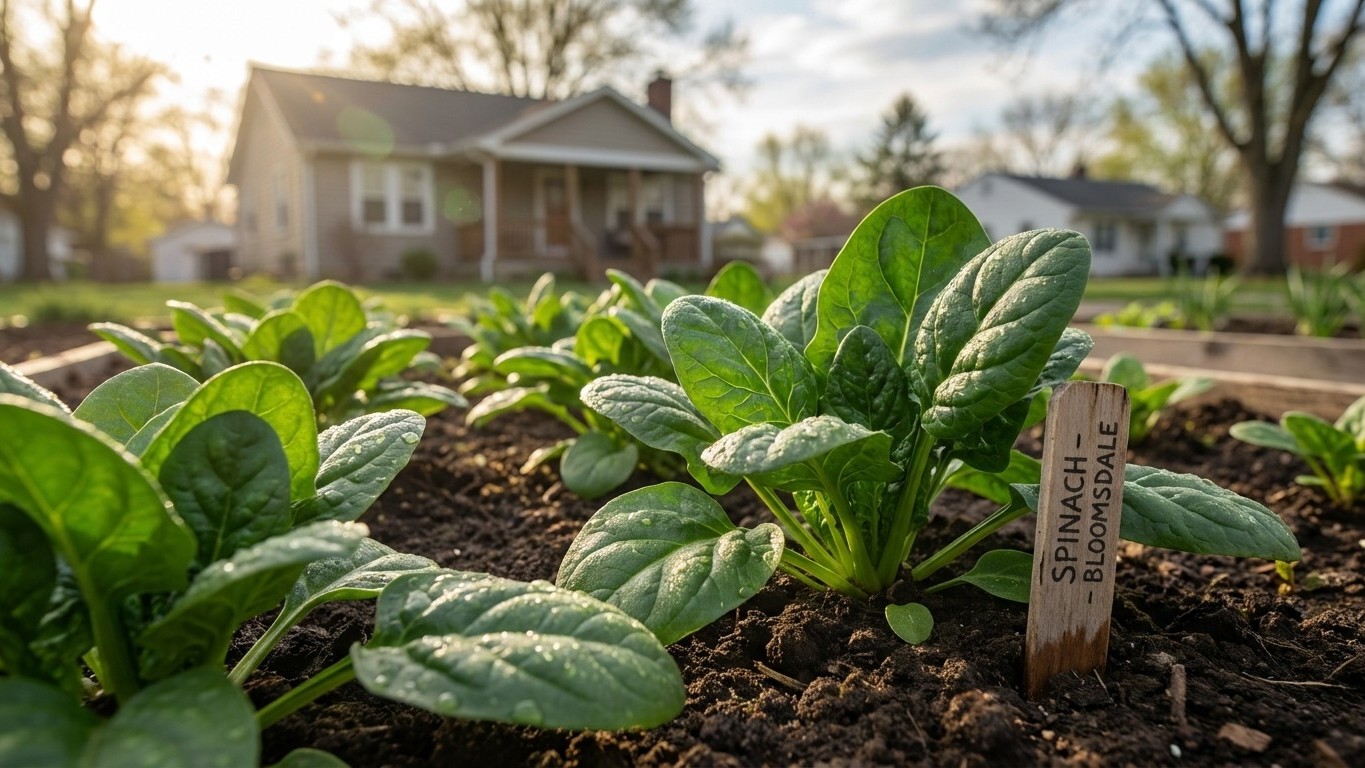

In Nunavut, spinach bolts on the calendar rather than the thermometer. The territory logs 19 hours and 41 minutes of daylight on its longest day, and that alone flips the switch that sends spinach into flower. Heat almost never factors in here; the reference station averages zero days a year above 90 degrees. So the honest answer to Will Spinach Bolt Early in Nunavut?: sometime around the summer solstice, cool season or not, because day length is doing all the work.
The short answer
Spinach flowers, or bolts, in response to two triggers working together: long days and warm temperatures, according to Utah State University Extension. Nunavut supplies plenty of the first and almost none of the second, and that combination flips the usual math gardeners use further south.
In warmer states, gardeners often blame bolting on a heat wave, since long days and high temperatures typically arrive stacked on the calendar together. Split the two apart, and heat all but disappears from the Nunavut version of the problem. The reference weather station for this territory records an average of exactly zero days a year at 90 degrees or hotter. Spinach’s bitterness threshold and growth ceiling both sit at 75 degrees, and the days that actually cross that mark here are rare enough that they barely register in a season.
Daylight is a different story. On the longest day of the year, Nunavut sees 19 hours and 41 minutes of daylight, a span that leaves only a few hours of true darkness at the peak of summer. That number climbs for weeks before the solstice and holds close to its peak for weeks after, so the extended light isn’t a single afternoon spike. It’s most of June and July.
That means the limiting factor for spinach in Nunavut is day length, not heat. A gardener in a hot southern state fights both triggers at once: warm nights push growth past the 75-degree ceiling, and long days pile on top of that. A Nunavut gardener only fights one, but it arrives at a scale most of the country never sees, and it arrives whether the summer feels warm or stays chilly.
This matters for planning because it removes a variable gardeners elsewhere rely on. Down south, a cooler-than-normal June can buy an extra week or two of harvest before bolting kicks in, since heat is part of the trigger. In Nunavut, that trick doesn’t work. A cold, damp June does nothing to slow the push toward the solstice, and the plant reacts to the light regardless of what the thermometer says. The season here runs on sun angle, not degrees, which is exactly why knowing When to Sow Autumn Spinach in Nunavut matters just as much as timing the spring crop.
How long the spring window really is
Figuring out how many usable weeks of spring actually exist here means chaining together three numbers: a frost date, a standard sowing rule, and a daylight curve that’s already sprinting toward its peak.
- Start from the frost date. Environment and Climate Change Canada’s 1981-2010 climate normals put the mean last spring frost at the Rankin Inlet A station on June 19. That’s a mean, not a guarantee. In roughly half the years on record, frost arrived even later, so treat it as the middle of a window rather than a safe cutoff.
- Back up two to three weeks for sowing. Standard spinach guidance calls for seed in the ground two to three weeks ahead of the last frost, which puts a Nunavut sowing date somewhere between roughly May 29 and June 5, weather and soil conditions allowing.
- Watch the daylight ramp, not the thermometer. By the solstice around June 21, daylight is already at its yearly peak of 19 hours and 41 minutes, and that peak was building for weeks beforehand. A crop sown in late May is barely past its first true leaves before the daylight trigger for bolting is fully active.
- Heat stays out of the picture. The 75-degree ceiling that stops good growth further south almost never applies here. The reference station averages zero days a year above 90 degrees, so nothing about temperature is closing this window early.
- Add it up. From a sowing date near the end of May to the point in late June when day length alone pushes the plant toward flowering, Nunavut gardeners get something in the neighborhood of three to four usable weeks of spring spinach before bolting sets in, a short run driven entirely by sun angle rather than by warmth.
That three-to-four-week window is short by almost any standard, and it leaves little room for a slow-germinating batch of seed or a stretch of bad weather that pushes sowing later than planned.
The autumn crop, and when the soil lets you sow
Soil too warm to germinate
Further south, the biggest obstacle to a fall spinach crop is soil that’s still too hot to let seed germinate well; Utah State University Extension notes that germination drops once soil runs above 80 degrees. That obstacle barely applies in Nunavut. With an average of zero days a year reaching 90 degrees in the air, soil temperatures rarely climb anywhere near the germination-blocking range. A Nunavut gardener planning a fall crop isn’t waiting out a heat wave the way a grower in a warmer state would; the ground here stays cool enough to accept seed through most of the growing season.
The frost that ends the season
The obstacle that actually matters sits at the other end of the calendar. Environment and Climate Change Canada’s normals put the mean first fall frost at the Rankin Inlet A station on September 13, and, as with the spring date, that’s a midpoint. In roughly half the years on record, frost came later, and in the other half it came sooner. Utah State University Extension frames fall sowing as a matter of counting backward: put seed in the ground 50 to 75 days before the date you want to harvest. Counting back from September 13 lands a sowing window between roughly June 30 (the 75-day mark, the safer end) and July 25 (the 50-day mark, cutting things much closer to that first frost). Given how unreliable a mean frost date is this far north, leaning toward the earlier end of that window gives more room for a frost that arrives ahead of schedule.
The source publishes no specific days-to-maturity figure for spinach, and none should be invented here; the 50-to-75-day range is planting-to-harvest guidance itself, not a maturity date for any particular variety. Seed catalogs commonly list varieties such as Bloomsdale, Melody, Teton, and Olympia for home gardens, but no comparative data on their timing or cold tolerance appears in the source used for this page.
Checking this against your own county
Every number on this page comes from one station, Rankin Inlet, and Nunavut is too large and too varied for a single station to describe every community. Iqaluit, Cambridge Bay, and the smaller hamlets scattered across the territory each sit under their own microclimate, and a frost date that averages out at one location can run a week or two off at another.
For a starting point beyond this page, Agriculture and Agri-Food Canada, the federal department, publishes gardening and agricultural guidance that applies territory-wide. The territorial department’s own site could not be verified as reachable when this page was checked, so the federal resource is the more dependable link. Local knowledge, from a community greenhouse group or a longtime gardener down the road, will often beat any published normal for pinning down exactly when your own soil warms and your own first frost tends to land.
Common questions
Does a cool Nunavut summer delay spinach bolting?
No. Bolting is triggered by long days as well as by warmth, and day length here reaches 19 hours and 41 minutes regardless of temperature, so a cool summer doesn’t buy extra weeks.
Is heat ever a problem for spinach in Nunavut?
Rarely. The reference station averages zero days a year above 90 degrees, and the 75-degree growth ceiling for spinach is seldom crossed here.
Can I get a fall spinach crop in Nunavut?
Possibly, by counting back 50 to 75 days from the mean first fall frost of September 13, which lands a sowing window between roughly June 30 and July 25. Because that frost date is a mean, not a guarantee, the window is narrow and carries real risk of an early frost cutting it short.
Which spinach varieties should I use?
Bloomsdale, Melody, Teton, and Olympia are commonly available names, but no comparative data on bolt resistance or maturity timing for any of them appears in the source used for this page, so treat variety choice as unverified for Nunavut conditions specifically.