
Ohio’s answer is yes, with a caveat that matters more than the state itself: asparagus doesn’t ask for rich ground or a particular pH, it asks for ground that drains. The soil that represents Ohio does drain well. Whether the specific patch behind a garage or along a fence line does the same thing is a separate question, and one worth settling before a single crown goes in the ground for what could be a decade and a half.
The short answer
Ohio’s representative soil, the Miamian series, is a forest-derived Alfisol, described by USDA as loam to silt: 26 percent sand, 20 percent clay, 53 percent silt, with a surface pH around 6.5 and organic matter near 2.0 percent. USDA classifies it as well drained. That combination, more silt than clay, a moderate structure, no heavy fertility demands, is exactly the profile Utah State University Extension has in mind when it says asparagus will grow in most soils, provided they drain. Nothing about asparagus asks for rich ground or a particular acidity; the source is silent on pH requirements entirely. Drainage is the one non-negotiable.
What drainage actually buys the gardener is simple: asparagus crowns sit underground through winter and through wet spring stretches, and a crown sitting in standing water rots before it ever sends up a spear. A well-drained loam like Miamian sheds excess water through its pore structure rather than holding it around the roots. That’s the mechanism behind why this soil, on paper, supports a bed that’s expected to run for 10 to 15 years without needing to be dug up and relocated.
But a county-level soil series is a starting point, not a verdict on one backyard. Ohio spans hundreds of mapped soil series, and a Miamian designation on a survey map says nothing about the compacted clay a builder left behind a new subdivision, or the low spot at the bottom of a slope where water collects every spring. The only real test is the plot itself: dig down, add water, and watch what happens. Ground that lets water pass through within a reasonable stretch is fine. Ground where water sits for hours, visibly pooled, is not, no matter what the county soil map says.
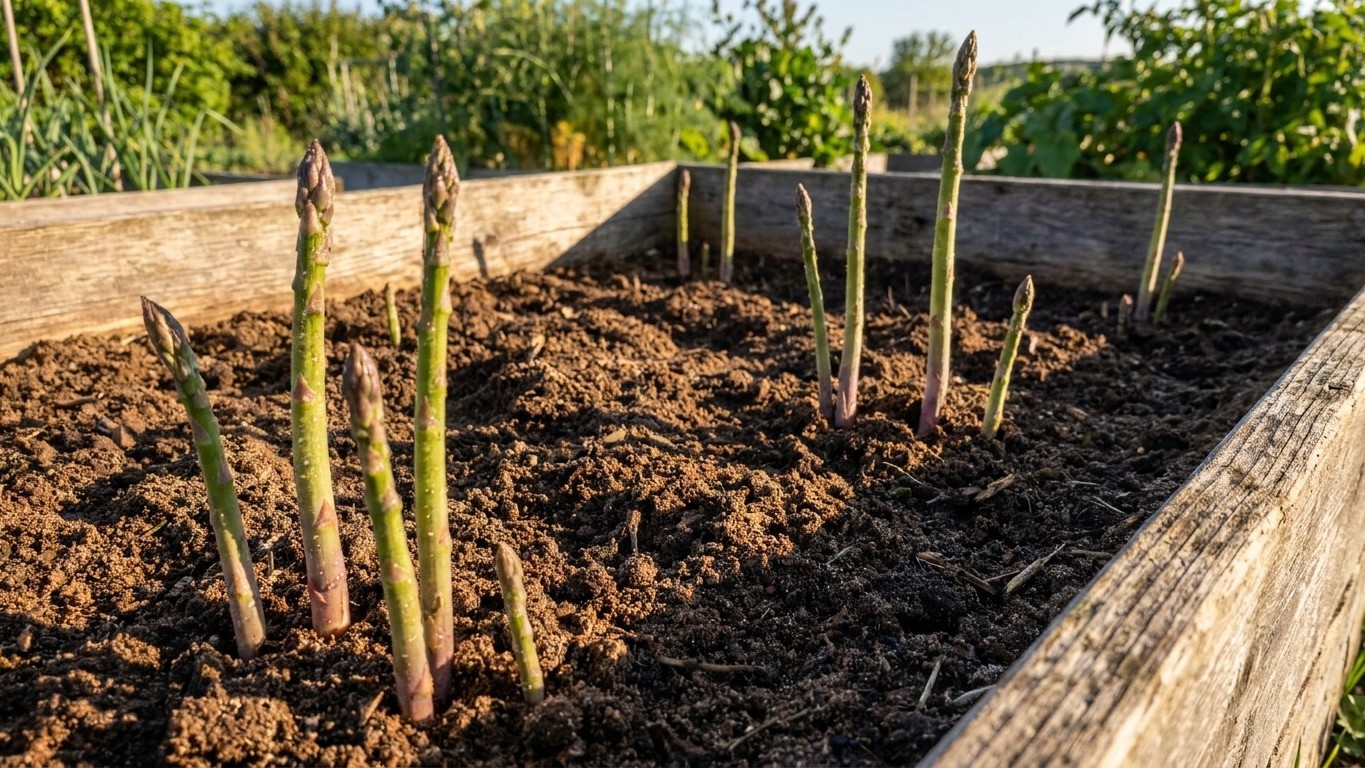
If that test comes back bad, the fix isn’t to abandon asparagus, it’s to change the bed. Raised beds, or a mounded row built up with compost and coarse organic matter, let a gardener create drainage the native ground doesn’t offer. Given that a bed, once planted, isn’t meant to move for a decade or more, that upfront correction is worth far more effort than treating it as an afterthought once crowns are already in the ground.
Will the summer here water it for you?
Utah State University Extension’s watering guidance for a new asparagus bed is specific: 1 to 2 inches every other week for the first two years, tapering to every three weeks once the planting is established. Ohio’s own summer rainfall, drawn from NOAA NCEI’s 1991-2020 normals for the region, comes close to covering that in most months, but not every month, and not without help.
- What the bed asks for: roughly 2 to 4 inches per month during the first two summers (two applications of 1-2 inches), dropping to a lighter, less frequent schedule after that.
- What June and July deliver: the region’s normals show June averaging 4.33 inches and July averaging 4.67 inches, both comfortably above what a young bed needs in a typical month, assuming the rain is spread out rather than falling in one storm.
- Where the gap shows up: August is the driest of the three summer months at 3.74 inches, still close to the lower end of what’s needed, but with less margin for a dry stretch or a heat wave that pushes evaporation up.
- What the numbers don’t capture: normals are an average built from 1991 to 2020, not a forecast, and rain that arrives as a single thunderstorm tends to run off rather than soak into the ground the way a slow, steady rain does. A silt-heavy soil like Miamian holds moisture reasonably well, which helps stretch what falls, but it doesn’t turn a dry August into a wet one.
- What that means for the gardener: a rain gauge on the actual bed, not a regional average, is what decides whether supplemental watering is needed in a given week. In most summers, June and July likely need little help; August is the month to watch, and any stretch without rain for more than a week or two during the first two growing seasons is worth a hose.
When to put the crowns in
Asparagus crowns go into the ground in early spring, set into furrows about 8 inches deep. In Ohio, that window lines up with the tail end of frost risk: Ohio State University Extension’s gardening calendar puts the average last spring frost around May 5 to May 15 for the state’s zone 6a areas. That’s a mean date built from years of records, not a guarantee, so “around” is the operative word, planting a week before or after that stretch is normal, and a late cold snap can still happen even after the average date has passed.
The furrow itself isn’t filled in all at once. Crowns are set at the bottom of that 8-inch trench and covered with only a couple of inches of soil at first. As the season goes on, the furrow is backfilled gradually, roughly 2 inches every other month, rather than mounding all the soil back on day one. That staged approach lets the emerging shoots push through a shallow covering early on, while the trench still has room to be filled in as the plant grows into it over the course of the year.
Crowns are the faster route to a producing bed, since they’re already a year old by the time they go in the ground. Seed is the alternative Utah State University Extension recognizes, and it exists as a legitimate option for gardeners who want to grow their own stock or can’t source crowns locally, but it asks for patience on top of patience: starting from seed adds time before the planting reaches the size and maturity that crowns already have at planting. Either route, the harvest clock doesn’t start early. Nothing is cut in the first year or the second, regardless of whether the bed started from seed or from crowns. Harvest doesn’t begin until the third year, and even then it starts light: about 4 weeks of cutting, building to 6, then 8 weeks in the years that follow, with the actual stopping point each season determined not by a date on the calendar but by the spears themselves. Once most of what’s coming up runs thinner than a pencil, that year’s harvest is over, and the bed is left alone to build strength for the following season.
Common questions
Does Ohio’s soil pH need to be adjusted before planting asparagus?
The source behind this guidance, Utah State University Extension, doesn’t publish a pH requirement for asparagus at all. Ohio’s representative soil sits around 6.5, but since no target pH is specified for the crop, there’s nothing published here to adjust toward.
What happens if a bed is planted in soil that doesn’t drain well?
Crowns sitting in waterlogged ground are prone to rot, which is why drainage, not fertility or pH, is the one condition Utah State University Extension flags as necessary. A raised bed or mounded row is the practical fix where native soil holds water.
Can asparagus survive an Ohio winter once it’s established?
Winter chilling requirements for asparagus aren’t addressed in the sourced guidance, and hardiness zone information shouldn’t be read as a stand-in for a chilling figure that isn’t published.
How soon can spears be harvested after planting crowns?
Not until the third year. The first two seasons are for root establishment only, and the harvest that follows starts at about 4 weeks, then extends to 6 and 8 weeks in later years, ending each season once most spears have thinned to less than pencil width.