
In central Ohio, sow spinach for spring about two to three weeks before the last frost, which falls between May 5 and May 15 in zone 6a, so seed goes in the ground from mid to late April. The fall crop goes in later, once soil temperatures ease off summer’s heat, usually in mid to late August, timed 50 to 75 days ahead of the harvest you’re aiming for before the first fall frost between October 5 and October 15.
The short answer
Fourteen hours and fifty-one minutes of daylight lands on this part of Ohio during the longest day of the year. For spinach, that number works against the gardener, not for it. Long days push the plant to flower, a process called bolting, and once bolting starts, the leaves turn bitter and the harvest is over. That single fact rules out any hope that a mild Ohio summer buys extra growing weeks: even where afternoons stay comfortable, the calendar keeps ticking toward the solstice, and the plant keeps reading the light regardless of how the air feels.
Heat piles on top of daylight rather than replacing it as the limiting factor. Columbus averages 15.3 days a year at 90 F or hotter, a heat load that pushes both soil and air past the point where spinach grows well. The plant’s own ceiling sits at 75 F. Past that mark, growth slows and the same bitterness that comes with bolting starts showing up in the leaf. So the two obstacles arrive together, not one after the other: by the time days are at their longest in Ohio, temperatures are usually running well above 75 F too, closing off the growing window from two directions at once.
That double bind explains why Ohio gardeners grow spinach twice, not once. Spring sowing gets in before the days stretch out and before the heat load builds. Fall sowing waits for the days to shorten again and for the ground to cool off, then rides the plant into a cool, shortening-day stretch that runs up against the first frost of the season, October 5 to October 15 in zone 6a. Summer itself is essentially dead time for this crop here, not because Ohio summers are unusually harsh by national standards, but because spinach has no tolerance for the combination of long daylight and rising heat that summer always brings.
The honest answer to the timing question has two parts, and both matter equally. Day length sets an outer boundary that no amount of watering or afternoon shade can move: spinach bolts once days get long enough, full stop. Heat sets a second boundary, shrinking the usable window from the inside by slowing growth and germination well before the day-length limit even arrives. Gardeners who plant only by frost dates, and ignore day length, are the ones who end up watching spinach shoot to seed under a June sun that still feels mild.
How long the spring window really is
Working out the spring window means stacking three separate pieces of information from Ohio State University Extension and Utah State University Extension against each other, in order.
- Start from the last spring frost. Zone 6a in Ohio runs from May 5 in the milder pockets to May 15 in the cooler ones, per Ohio State University Extension’s Ohio Gardening Calendar. That fifteen-day spread is the anchor for everything that follows.
- Move the sowing date two to three weeks earlier. That puts seed in the ground anywhere from mid-April to the very end of April, depending on which end of the May 5-15 range describes your particular spot.
- Track both ceilings from the sowing date forward. The 75 F growth ceiling and the steadily lengthening day both keep climbing through May, and neither one waits for the other.
- Recognize that the spring harvest window closes well before summer officially arrives. By the time the season’s heaviest heat load builds, Columbus averages 15.3 days a year at 90 F or hotter, mostly concentrated in July and August, spinach sown in April has usually already been through its cool run and is heading toward bolting.
- Add it up. Sowing in mid to late April, growing through a cool May, and losing the crop to bolting sometime around late May to early June leaves a spring window of roughly five to seven weeks. That is not a full spring’s worth of growing by garden standards, but it is enough for one solid harvest before the plant turns.
The autumn crop, and when the soil lets you sow
The fall crop faces a different pair of obstacles than the spring one, and they show up in reverse order: heat comes first, cold comes last.
Soil still too warm to germinate
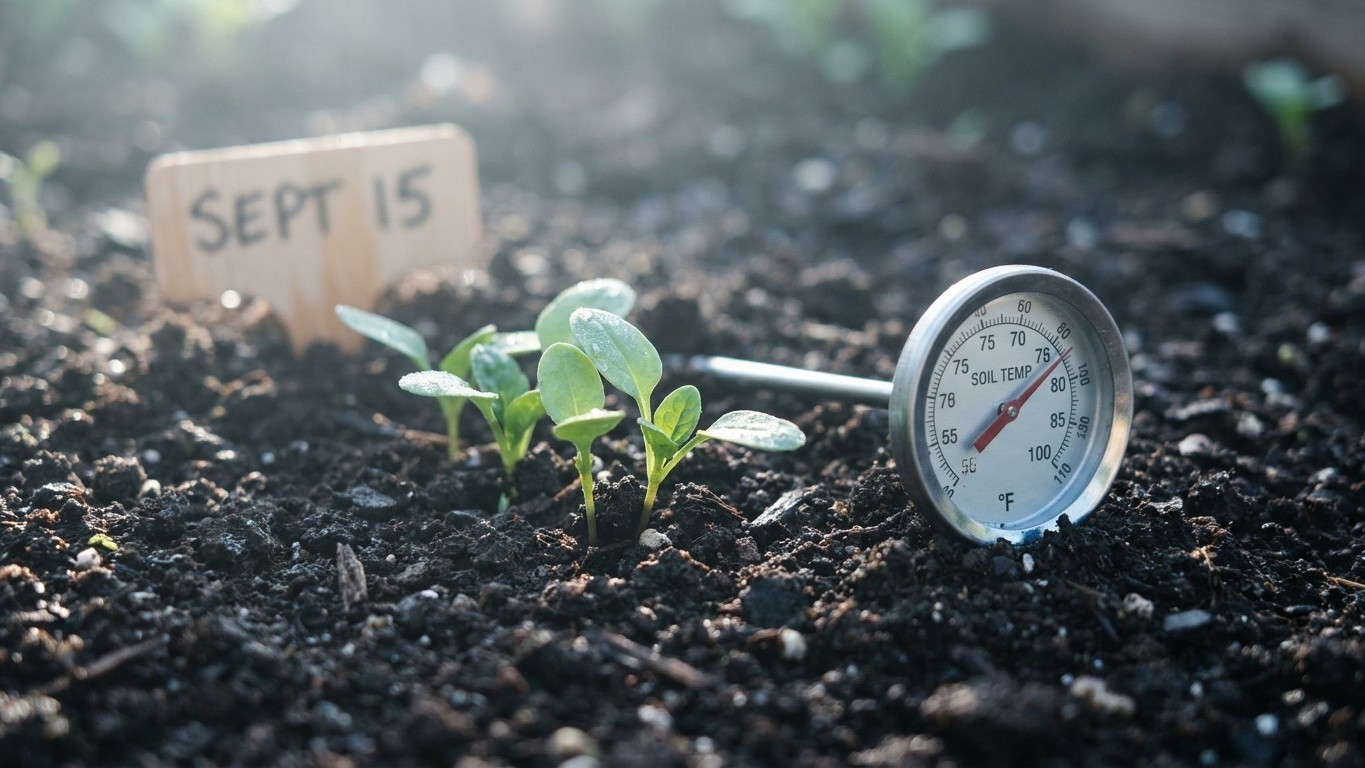
Utah State University Extension is specific on this point: spinach seed germination drops once soil temperature climbs above 80 F. In Ohio, soil holds onto summer’s heat well past the point where the calendar says fall has arrived, and with Columbus averaging 15.3 days a year at 90 F or hotter concentrated through the July and August stretch, the ground simply doesn’t cool fast enough for an early-August sowing to work reliably. Gardeners who drop seed the moment the calendar hits August often see poor or spotty germination, not because the seed was bad, but because the soil hadn’t caught up with the season yet. The practical fix is patience: wait for the soil itself to cool, which in most years means holding off until deeper into August, closer to Labor Day, before trusting seed to the ground.
Racing the first frost
Once soil temperature cooperates, the second obstacle is the calendar running out from the other direction. Utah State University Extension’s guidance for a fall crop is to sow 50 to 75 days before the date you want to harvest. Counting back from Ohio’s first fall frost, October 5 to October 15 in zone 6a, that math lands sowing dates somewhere between late July and late August, depending on exactly which harvest date and which end of the frost window you’re aiming at. But the soil-temperature obstacle described above usually rules out the earlier end of that range, since late July soil is still well above the 80 F germination threshold in most Ohio gardens. In practice, that pushes real sowing toward the back half of the 50-to-75-day math, closer to mid or late August, with harvest crowding right up against the first frost date itself.
Four spinach varieties come up often in Ohio garden planning: Bloomsdale, Melody, Teton, and Olympia. No days-to-maturity figures or performance data for any of these are published in the sources behind this guide, so none are claimed here. What is established is the timing framework itself: soil cool enough to germinate, and a sowing date counted back 50 to 75 days from a realistic harvest before the first frost.
Common questions
Can spinach be sown in Ohio in the middle of summer? No. Both obstacles are working against it at once during peak summer: day length is at or near its longest, which pushes the plant toward bolting, and soil temperature is well above the 80 F point where germination starts to fail. Summer is the one stretch of the year this crop can’t use here.
Why does a mild Ohio summer not extend the spinach season? Because bolting is triggered by day length as much as by heat. Even in a cooler-than-usual summer, the days still reach 14 hours and 51 minutes at their longest, and that light exposure alone is enough to push the plant toward flowering regardless of the temperature.
How many spinach harvests can an Ohio garden realistically get in a year? Two: one from a spring sowing timed two to three weeks before the last frost, and one from a fall sowing timed once the soil has cooled below 80 F, counted 50 to 75 days back from a target harvest before the first fall frost.
What actually stops the fall spinach crop, heat or frost? Both, but at opposite ends of the sowing window. Warm soil blocks germination if you sow too early, and the first fall frost, October 5 to October 15 in zone 6a, sets the outer limit on how late a sowing can still mature into a usable harvest.