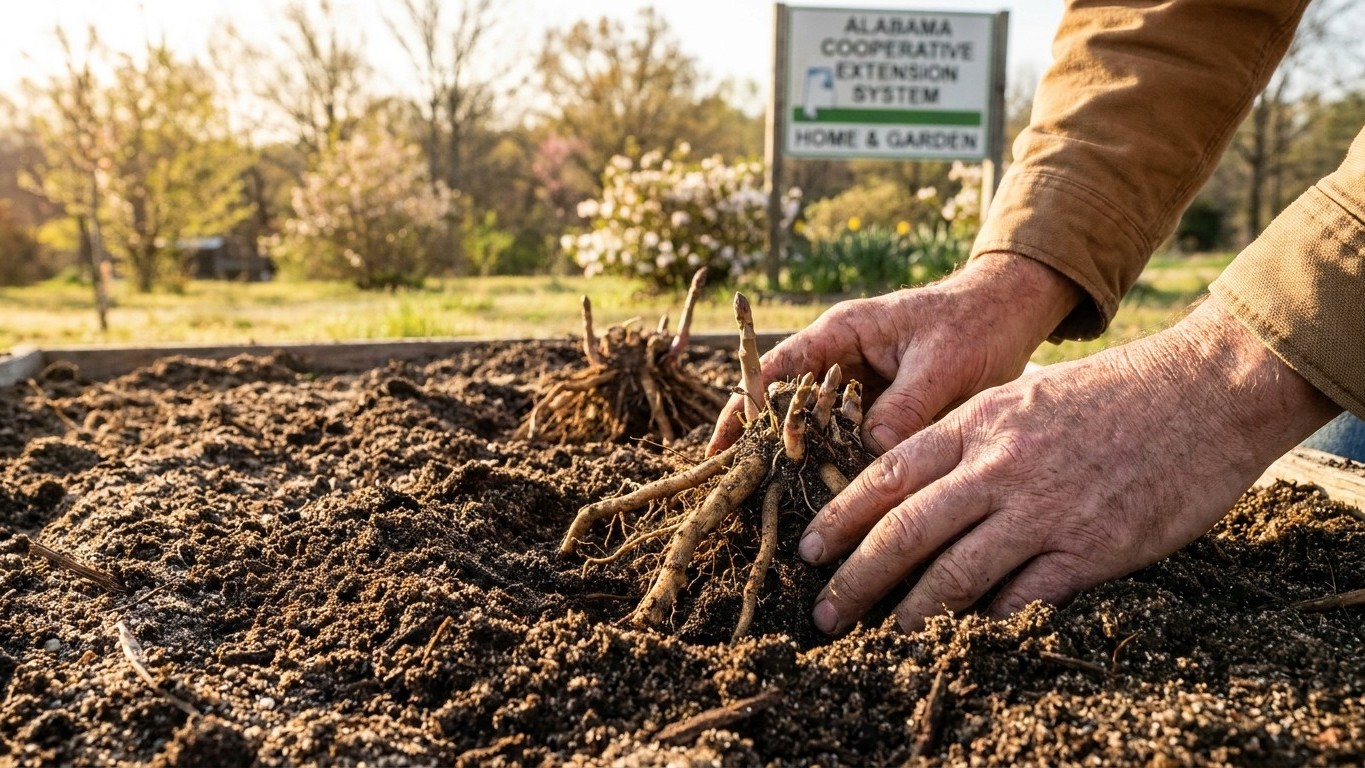

Plant asparagus crowns in Wisconsin in early spring, as soon as the ground can be worked and before the season really warms, roughly the same stretch of weeks the state marks as its average last frost. That’s a window, not a fixed date, and it opens onto a bed that will occupy the same patch of ground for a decade or more once the crowns go in.
The short answer
Asparagus is a plant you choose ground for once and live with for a long time. A bed produces for 10 to 15 years, according to Utah State University Extension, which means the spot picked this spring is the spot you’re stuck with through the next decade or more of gardening seasons, moves, kids growing up, maybe a kitchen remodel. The source’s soil requirement for the crop is short and unambiguous: most soils will do, provided they are well drained. That single word, drained, is the whole test.
Wisconsin’s official state soil, the Antigo series, gives a useful read on what a lot of the state’s ground tends to do. It’s an Alfisol, a forest-derived soil of moderate fertility, running loam to silt (about 20 percent sand, 10 percent clay, 70 percent silt), with a surface pH near 5.5 and roughly 3.0 percent organic matter. The Soil Survey Geographic Database classes it as well drained. For a fifteen-year asparagus bed, that’s good news in principle: a silt loam with decent structure generally sheds excess water rather than sitting in it, and it holds nutrients well enough to feed a long-lived planting without constant amendment.
The catch is that the Antigo series describes a representative soil the state has chosen to stand for Wisconsin, not the dirt in any one backyard. The state spans hundreds of mapped soil series, and a garden near a river bottom, on old hill country, or on ground a builder graded and filled a few years back can behave nothing like the state soil on paper. A bed set into heavy, slow-draining clay, or into low ground that holds water after a storm, is a bed that will struggle no matter how well the surrounding region drains on average.
The fix, if a plot turns out to hold water, isn’t complicated: raise it. A mounded or raised bed, built up 8 to 12 inches above grade with soil worked in for structure, moves excess water off the crowns and out of the root zone, which is the one condition this crop actually asks for. Given the length of the commitment, a soil test and a look at how the spot drains after a heavy rain are worth the hour before the crowns go in, not after.
Will the summer here water it for you?
Newly set asparagus needs 1 to 2 inches of water every other week for its first two years, tapering to about once every three weeks once the bed is established, per Utah State University Extension. Wisconsin’s summer, on its own, delivers a fair amount of water, but not always on that schedule. Here’s how the numbers line up against a reference station’s 1991-2020 climate normals.
- What the bed asks for in year one and two. At 1 to 2 inches every other week across a 13-week summer, an establishing bed wants somewhere in the range of 6 to 13 inches of water across June, July and August, delivered on a fairly even schedule.
- What the region typically supplies. The reference station’s normals put summer rainfall at about 11.4 inches across June, July and August combined (34.6 inches for the year), broken down as 4.38 inches in June, 3.4 in July, and 3.65 in August. On paper, that’s inside the range the young bed wants.
- Where the schedule breaks down. July is the driest of the three months, and Wisconsin summer rain tends to arrive as thunderstorms rather than steady soaking rain. A single downpour that drops an inch in twenty minutes runs off a lot faster than it soaks into a silt loam, so the total on a rain gauge can look adequate while the root zone still dries out between storms, especially in a hot stretch.
- What that means for watering in the first two summers. Treat the region’s rainfall as a baseline, not a guarantee, and keep a rain gauge on the bed itself. In a normal July, expect to top off with supplemental water during any run of a week or more without measurable rain, particularly on sandier ground that drains fast and holds little reserve.
- What changes after year two. Once the bed shifts to roughly every three weeks, the demand drops enough that most established Wisconsin summers cover it without much intervention, barring an unusually dry stretch. A soil that runs closer to the clay end, holding moisture longer, needs even less supplemental attention at that stage.
When to put the crowns in
Crowns go into the ground in early spring, and in Wisconsin that means working around the state’s average last spring frost, which falls somewhere between April 16 and April 29 depending on location, per NOAA’s 1991-2020 climate normals for the reference station. That’s an average across three decades of data, not a promise for any single spring, so treat it as a general window to plan around rather than a date circled on the calendar. Asparagus crowns are dormant and reasonably tolerant of cool soil, which is why growers commonly get them into the ground while the season is still cool, rather than waiting for all frost risk to pass entirely.
The planting method itself matters as much as the timing. Crowns go into furrows dug about 8 inches deep, set in place, and then covered gradually rather than buried all at once: backfill the furrow in stages across the season, adding roughly 2 inches of soil every other month as the new shoots grow, until the trench is level with the surrounding bed. That gradual fill gives the emerging spears room to push upward without being smothered early.
Seed is the other route into a bed, and it’s the slower one. Starting asparagus from seed pushes the harvestable stage out further, since the plants need an extra season of growth before they reach crown size, compared with starting from a nursery crown that’s already a year or two along. For a gardener aiming for the earliest possible harvest, crowns planted in that early-spring window are the faster path; seed suits a grower planning further ahead or wanting more control over which plants make the final bed.
Variety choice at planting time comes down mostly to plant sex, which is the one distinction Utah State University Extension publishes. Jersey Giant and Jersey Knight are all-male types; UC 157 F1 and Purple Passion include both male and female plants. No flavor or yield comparison between them is published by that source, so the decision at this stage is really about sex composition in the bed, not taste or output.
| Variety | Sex type |
|---|---|
| Jersey Giant | All-male |
| Jersey Knight | All-male |
| UC 157 F1 | Male/female |
| Purple Passion | Male/female |
Whichever variety goes in, the calendar afterward is fixed and worth knowing before the first spear even shows: no harvest at all in year one or two. Cutting starts in year three, and even then it’s limited, roughly 4 weeks of harvest that first cutting year, extending to about 6 weeks the year after, and up to 8 weeks in following years. The signal to stop cutting for the season isn’t a date on the calendar; it’s the spears themselves. When most of what’s coming up runs thinner than a pencil, harvest ends for that year, regardless of how many weeks have passed, so the crown can put its energy into building fern growth for next season instead.
Common questions
Can asparagus crowns be planted later in spring if the ground is still wet in April?
Yes, within reason. The early-spring window described here is a general target tied to the region’s average last frost, not a hard cutoff. If a plot is too saturated to work in late April, waiting a couple of weeks for it to dry out is better than working wet soil, which can compact it and work against the drainage the crop needs for the long run.
Does Wisconsin’s soil need extra lime or amendment before planting asparagus?
The source used here is silent on the ideal pH for asparagus, and the state soil’s own surface pH (about 5.5) is a regional reference point, not a reading for any specific garden. A soil test on the actual planting site is the way to know whether pH needs adjusting, rather than assuming the state soil figure applies.
How long before an asparagus bed in Wisconsin actually produces a full harvest?
Three years minimum before any cutting begins, then a gradually expanding harvest window: about 4 weeks in year three, 6 weeks in year four, and up to 8 weeks in following years, per Utah State University Extension. There’s no shortcut published for compressing that timeline.
What happens if the planting site turns out to have poor drainage after all?
Given a bed’s 10 to 15 year lifespan, a poorly draining site is worth correcting before crowns go in rather than working around later. Building a raised or mounded bed, several inches above the surrounding grade, is the straightforward fix mentioned by the extension source’s general guidance on soil suitability for this crop.