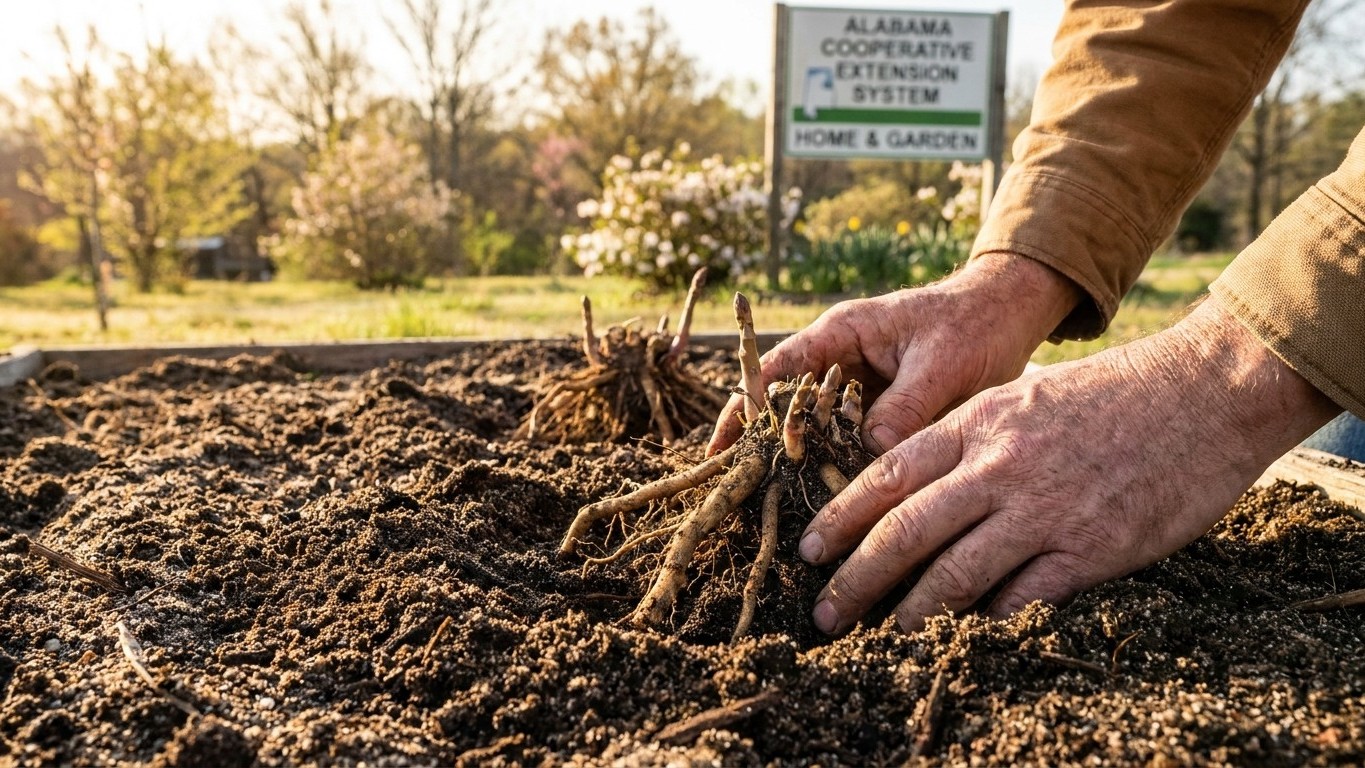

Plant Asparagus Crowns in Wyoming around early spring, timed to the tail end of the frost window that runs from about May 7 to May 18 across the state’s mid-elevation ground. That’s the short version. The longer one involves a bed that will sit in the same spot for 10 to 15 years, a soil that has to drain well from day one, and a harvest you won’t touch until the third year after planting.
The short answer
Ten to fifteen years. That’s how long an Asparagus Bed stays put once the crowns go in, and it’s the number that should shape every decision before a single root touches soil. Utah State University Extension, the reference point for home asparagus culture in this region, lists exactly one requirement for the ground itself: it has to drain. Not “prefers to drain.” Has to. Everything else about the plant (its long life, its slow start, its stubborn refusal to be moved) makes that single condition non-negotiable.
So what does Wyoming’s ground actually do? The soil USDA records as representative of the state is the Forkwood series, an Aridisol, the dry-climate soil family typical of the Mountain West. Its surface horizon runs loam to silt, about 42 percent sand, 20 percent clay, and 38 percent silt, with organic matter around 1.5 percent and a surface pH near 7.2, close to neutral. USDA lists it as well drained. That combination, a soil carrying nearly as much sand as silt and comparatively little clay, tends to shed water rather than hold it, which is the direction an Asparagus Bed wants.
That’s a state-level average, not a verdict on any one backyard. Wyoming spans river bottoms, hillsides, and plenty of ground a builder has scraped, filled, or compacted, and any of those can behave nothing like the mapped series. The only honest way to know a specific plot is a soil test or a simple homemade check: dig a hole about a foot deep, fill it with water, and see whether it’s gone within a few hours or still sitting there the next morning. Standing water is the disqualifying answer, and here it doesn’t call for giving up on asparagus. It calls for a raised bed, or working generous organic matter into the top foot of soil before the crowns ever go in. Given the 1.5 percent organic matter typical of Forkwood surface soil, adding compost also helps a bed that starts on the lean side.
Once the site passes that test, planting itself is straightforward. Crowns go into furrows about 8 inches deep, spaced along the row, and the furrow is not filled in all at once. It gets backfilled gradually, about 2 inches of soil added every other month across the first year, letting the emerging shoots push through as the trench slowly closes. Gardeners choosing a variety will find the available options split by sex rather than by flavor or yield: Jersey Giant and Jersey Knight are all-male, while UC 157 F1 and Purple Passion are male and female. USU Extension publishes no ranking among them for taste or productivity, so the choice comes down to preference rather than performance data.
Will the summer here water it for you?
Not on its own. An asparagus bed wants 1 to 2 inches of water every other week for its first two years, tapering to about every three weeks once established. Wyoming’s summer rainfall doesn’t come close to covering that on its own, and the gap is worth spelling out month by month.
- June: normal rainfall runs about 2.16 inches for the month, close to a single one of those every-other-week doses but arriving as scattered storms rather than steady soaking, so some of it runs off instead of reaching the root zone.
- July: normal rainfall drops slightly to 2.11 inches, while heat climbs and evaporation with it, meaning the same amount of rain does less for the bed than it did in June.
- August: this is the driest summer month at 1.52 inches, well under half of what an actively growing first- or second-year bed asks for across that stretch.
- Across the season: the three months together add up to about 5.8 inches, against a 10-week span of establishment watering that, at 1 to 2 inches every other week, could call for anywhere from roughly 5 to 10 inches depending on the year.
- The takeaway: a new bed in its first two summers needs supplemental watering most weeks, not just in dry stretches, and an established bed on its every-three-week schedule still needs the gaps filled during Wyoming’s driest weeks in August.
None of this accounts for soil or elevation on a given lot. A sandy, well-drained surface like the state’s representative Forkwood soil lets rain move through fast, which is good for avoiding rot but means the ground dries out again quickly too. A rain gauge staked into the actual bed, checked weekly through the growing season, is the only way to know how much of that 1-to-2-inch target nature is covering and how much falls to a hose.
When to put the crowns in
Early spring is the planting window, and in Wyoming that means working around a last frost date that falls somewhere between May 7 and May 18 across much of the state’s mid-elevation ground. That’s an average drawn from three decades of records at a reference weather station, not a guarantee for any specific week, so “around” is the operative word rather than a fixed date on the calendar. Crowns can go into the ground before that window closes, since the plant is dormant and tolerant of cool soil, but the soil needs to be workable, not frozen or waterlogged, which in practice often pushes actual planting into the weeks just ahead of or right around that mid-May mark at higher elevations.
Frost risk doesn’t vanish the moment that date passes, either. At elevations around 6,000 feet, which cover a large share of Wyoming’s populated valleys, frost is possible in any month of the year, and the growing season itself runs only about 130 frost-free days. That’s short enough that gardeners here treat season extension (row cover, cold frames, timing tricks) as standard practice rather than an optional extra, especially for a plant whose first true harvest is still two years away.
Seed is the alternative route, though it’s a slower one. Starting asparagus from seed means growing seedlings for a season before they’re large enough to set out as young plants, effectively adding a year onto the timeline compared with putting purchased crowns straight into the furrow. For a plant that already asks for patience, most home gardeners choose crowns for exactly that reason: it shaves a year off an already long wait.
That wait is worth stating plainly, because it’s the part most often softened in casual advice. There’s no harvest at all in the first two years. In year three, the bed can be cut for about 4 weeks. The following year stretches to about 6 weeks, and the year after that to about 8. Each season, the cutting stops not on a fixed date but on a signal from the plant itself: once most of the spears coming up are thinner than a pencil, harvest ends for the year, and the plant is left to grow fern and rebuild its root reserves for the next season.
The Moon calendar is a separate, older custom: see when to plant asparagus by the moon, written as tradition rather than fact.
Common questions
Can asparagus grow in heavy clay soil in Wyoming?
Not well, and not for fifteen years without help. Asparagus crowns need soil that drains, and clay-heavy ground holds water around the roots long enough to cause rot. If a plot fails a simple drainage test (water still sitting in a test hole after several hours), the fix is a raised bed or working substantial organic matter into the topsoil before planting, not planting anyway and hoping for the best.
How long before you can harvest asparagus after planting crowns?
Two full years pass with no harvest at all. The first cutting comes in year three, and even then it’s limited to about 4 weeks, followed by roughly 6 weeks in year four and about 8 weeks in year five and beyond, with each season’s cutting ending once most emerging spears run thinner than a pencil.
Should you plant asparagus from crowns or seed in Wyoming?
Crowns are the faster route and what most home gardeners use, since seed-grown asparagus needs a full season as seedlings before it’s ready to go into the garden, effectively adding a year to an already long timeline before the first harvest.
Which asparagus variety grows best in Wyoming?
That comparison isn’t published. Utah State University Extension names four commonly available varieties by sex only: Jersey Giant and Jersey Knight are all-male, while UC 157 F1 and Purple Passion produce both male and female plants. No ranking for flavor, yield, or regional performance accompanies those names, so the choice comes down to what’s available and personal preference rather than documented performance.