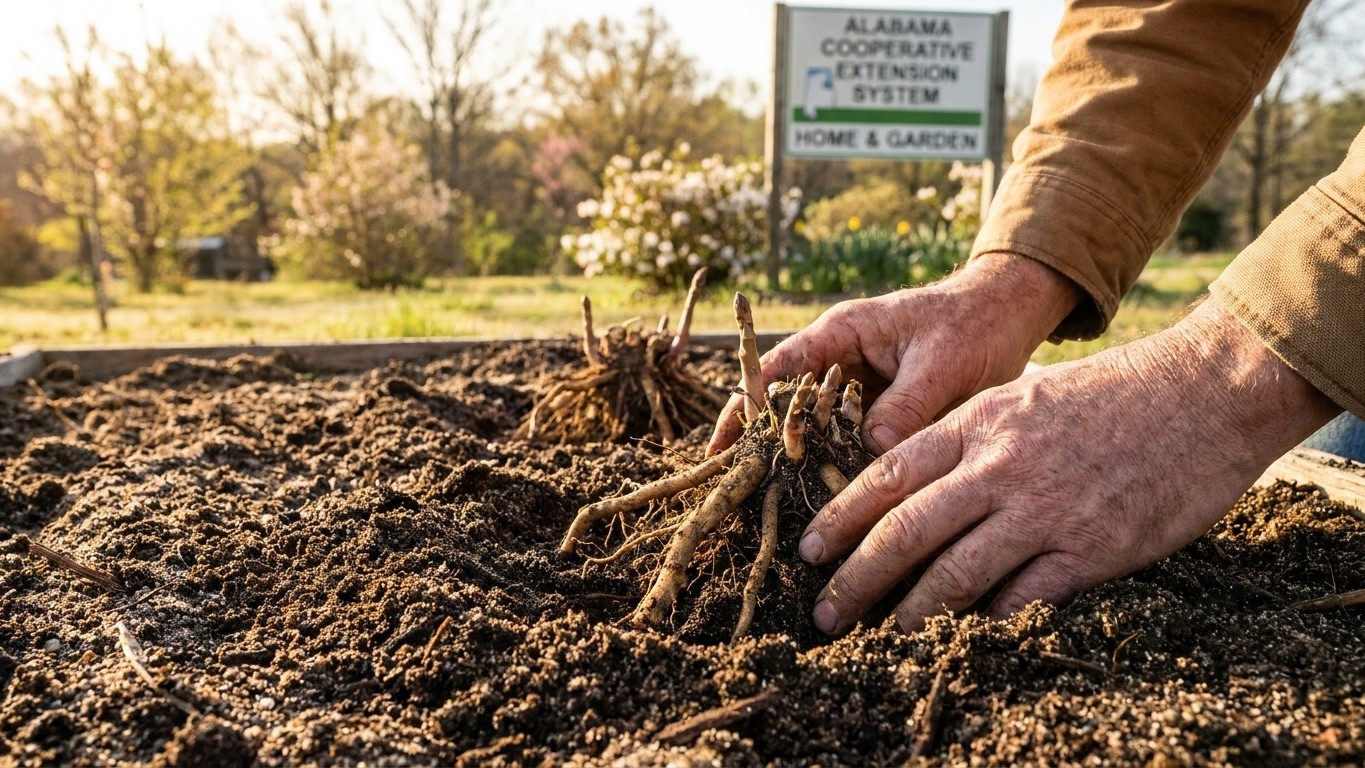

Around early June is when asparagus crowns go into the ground in Yukon, timed to the territory’s average last spring frost. That single planting date, though, is the easy part. Asparagus is not a plant you tuck in for one season and rotate out next year: once those crowns settle into a bed, they stay there for 10 to 15 years, which makes the soil underneath them a far bigger question than the calendar.
The short answer
Asparagus has exactly one soil demand that matters, and it isn’t about fertility or pH: it needs to drain. A bed that sits wet through spring rots crowns before they ever send up a spear, and there’s no fixing that once the roots are three years into an eight-foot spread underground. So before anything else, the question for a Yukon gardener is whether the ground drains well enough to carry a planting for a decade or more.
The dominant soil across the territory’s mapped agricultural land is a Brunisol, a young soil where the layers are still sorting themselves out, typically found on coarser or more recently deposited material. It runs loam to silt in texture (roughly 47 percent sand, 38 percent silt, 15 percent clay), with a median surface pH near neutral at 6.8 and organic matter around 12 percent, which is a healthy amount of decomposed material for holding nutrients. The catch is drainage: this dominant profile is classed as imperfectly drained, meaning water moves through it slower than asparagus would prefer.
That figure describes the territory in general, not any one backyard. River-bottom ground, muskeg, and any lot a builder has cut or filled will behave nothing like the median soil the survey captured, and the pH number above is a regional midpoint, not a reading from a specific garden. A soil test is still the only way to know what’s actually under a given plot.
If a bed sits heavy and slow to drain, the practical fix in Yukon is the same one gardeners use anywhere with imperfect drainage: build up rather than dig down. A raised bed or a mounded row lifts the crowns above the saturation line and gives excess water somewhere to go besides sitting against the roots. Trying to amend a naturally slow-draining plot in place, year after year, is a losing argument against fifteen years of wet springs.
Once the bed is planted and drains properly, patience becomes the second cost of asparagus. There is no harvest at all in year one or two. The first cutting comes in year three, and even then it’s limited to about four weeks of picking. Year four stretches to roughly six weeks, and mature beds after that can be harvested for about eight weeks each spring. The signal to stop cutting for the season isn’t a date on a calendar, it’s the spears themselves: once most of what’s coming up is thinner than a pencil, harvest ends and the plant is left to grow ferns that rebuild the root system for next year.
Will the summer here water it for you?
An established asparagus bed wants 1 to 2 inches of water every other week for its first two years, then eases to roughly every three weeks once the roots are deep and settled. Whitehorse’s climate normals put summer rainfall at about 4.2 inches total across June, July, and August, with June, the planting month, running driest at 1.28 inches, then July at 1.5 inches and August at 1.41 inches.
- Compare the totals. A young bed’s first two summers need roughly 4 to 8 inches spread across June through August if watered on the every-other-week schedule from planting on. Whitehorse’s summer normal of about 4.2 inches falls short of that on its own, especially in a dry June.
- Look at the driest stretch first. June is both the lightest rainfall month and the planting month, so new crowns are getting established during the least generous part of the summer. That’s the window where supplemental watering matters most.
- Plan to add water, not skip it. Given the gap between what a young bed needs and what June through August typically deliver, a Yukon gardener should expect to run a hose or drip line through most of the growing season for the first two years, rather than counting on rainfall to cover it.
- Ease off, but don’t stop, in later years. Once the bed matures and shifts to a watering need every three weeks, the territory’s summer rainfall still won’t reliably hit that mark every cycle, so an occasional deep watering during a dry stretch is worth keeping in the routine even on an established planting.
- Use a rain gauge, not the normal. These are 1981-2010 averages for the Whitehorse A station, not a forecast and not a reading from any particular yard. A slope, a windbreak, or simple year-to-year variation can push actual rainfall well above or below the normal, so tracking what actually falls on the bed is what settles the watering schedule.
When to put the crowns in
Crowns go into the ground in early spring, planted into furrows about 8 inches deep. In Yukon, that timing lines up with the average last spring frost recorded at Whitehorse, which falls around June 5. That date is a mean, not a guarantee, and in roughly half of all years the last frost lands later than that average, so treat it as the middle of a window rather than a safe green light to dig.
The furrow itself isn’t filled in all at once. Crowns are set in the trench and covered with just enough soil to start them, then the rest of the furrow is backfilled gradually over the course of the year, adding about 2 inches of soil back in every other month as the spears grow. That gradual fill is part of how the root system establishes itself at the right depth rather than being buried too deep too soon.
Seed is the alternative route, and it simply moves the clock back. Starting asparagus from seed adds an extra year to the process before the planting reaches the crown stage that most home gardeners buy directly, so in a territory where the growing season is already short, crowns are the more practical starting point for most people rather than seed started indoors.
On variety, the published record from Utah State University Extension only goes as far as naming plant sex, not performance. Four varieties are identified this way: Jersey Giant and Jersey Knight are all-male selections, while UC 157 F1 and Purple Passion are male and female mixes. No flavor comparison, yield figure, or reason to prefer one over another is part of that source, so the choice among them isn’t settled by anything published here.
| Variety | Plant type |
|---|---|
| Jersey Giant | All-male |
| Jersey Knight | All-male |
| UC 157 F1 | Male/female |
| Purple Passion | Male/female |
One thing worth flagging plainly: nothing in the record used here covers a winter chilling requirement for asparagus, and nothing covers soil pH as a planting condition. Yukon’s cold winters aren’t a documented obstacle in this source, but they aren’t confirmed as fine either. It simply isn’t addressed, so it shouldn’t be assumed one way or the other.
Common questions
Can I harvest any spears in the first two years?
No. The first harvest doesn’t happen until year three, and taking spears earlier weakens the root system the plant needs to build before it can support cutting.
How do I know when to stop harvesting each spring?
Stop once most of the spears coming up are thinner than a pencil. That’s the signal the plant needs, not a fixed week count, to switch back into growing ferns instead of spears.
Does my soil need a specific pH for asparagus?
That isn’t specified in the source used for this article. The region’s median surface pH runs near neutral at 6.8, but that’s a soil survey figure, not a planting requirement, and a test of the actual bed is the only way to know the number that matters.
What if my planting site doesn’t drain well?
Raise it. A mounded or raised bed lifts the crowns above standing water, which matters far more here than it would with an annual crop, since a poorly drained asparagus bed is a problem that lasts as long as the planting does.