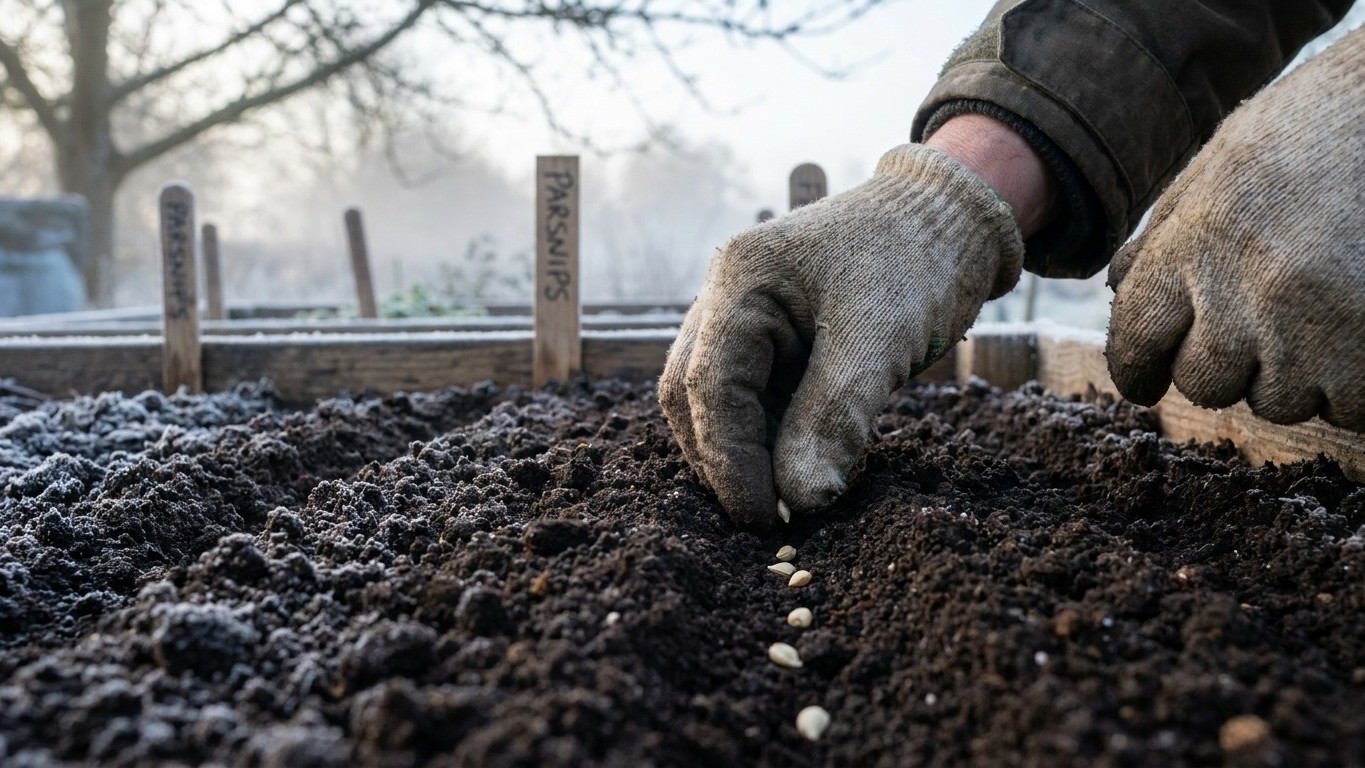

Sow parsnips in Yukon in mid to late May, about two to three weeks ahead of the average last spring frost on June 5. That timing gives the crop its best shot at reaching harvest size before the short growing season closes, and it lines up seeding with soil that’s finally workable after breakup. The catch is the window itself: it’s tight, and the numbers below explain why timing here leaves little room for error.
The short answer
Start with the question that actually decides how this crop turns out here: does Yukon deliver several frosty weeks, or just a cold snap and then mud? The answer is unambiguous. The mean daily minimum of the coldest month at Whitehorse runs -2.6°F, according to Environment and Climate Change Canada’s 1981-2010 climate normals. That’s not a record low or a average for the month. It’s the typical overnight low across the coldest stretch of winter, and it tells you this is a territory built for deep, sustained cold rather than a mild dip that barely touches the ground.
That number matters for one reason above all others: parsnips don’t get sweet from a comfortable hardiness zone rating. They get sweet from actual frost exposure, the kind that converts stored starch into sugar over several cold weeks, as documented by Utah State University Extension. A territory could sit in a zone that sounds harsh on paper and still fail to deliver real frost depth. Yukon doesn’t have that problem. With a coldest-month mean minimum well below zero, any parsnip left in the ground here after the first fall frost is going to get more cold exposure than the crop technically needs to sweeten. This is not a place where roots merely grow and stay starchy and bland. If a gardener manages to get parsnips to a decent size before the ground locks up, the flavor payoff is close to guaranteed.
The harder question isn’t whether Yukon gets cold enough. It’s whether the growing season is long enough to get a root to harvestable size before that cold arrives in earnest. Parsnips need 100 to 120 days from seeding, and they’re sown directly in place, not transplanted. That detail matters more here than almost anywhere else on this site, because Yukon’s frost-free window, bounded by a mean last frost of June 5 and a mean first fall frost of August 25, is short by national standards. The sweetening isn’t in question. The sizing is.
Does the season fit?
Lay out the arithmetic step by step, because in Yukon it’s the whole ballgame.
- The average last spring frost falls on June 5. Recommended practice is to sow parsnips two to three weeks before that date, which puts a realistic seeding window around May 15 to May 22.
- Seeding that early asks a lot of Yukon soil, which is often still cold and slow to dry after breakup. Germination itself takes 14 to 21 days under good conditions, so a gardener who sows May 19 shouldn’t expect to see seedlings before roughly the first week of June, and shouldn’t panic and re-sow bare soil in the meantime.
- From that same May 19 sowing date to the average first fall frost on August 25 is about 98 days.
- Parsnips need 100 to 120 days from seeding to maturity. Ninety-eight days falls short of even the low end of that range, by roughly two to twenty-two days depending on the variety and the growing conditions of a given year.
- The frost dates themselves are averages, not guarantees. In one year out of two, the last spring frost arrives later than June 5, and the first fall frost can arrive earlier than August 25 just as often. A gardener banking on the mean dates is playing the season’s midpoint, not its safe edge.
- The takeaway: the Yukon window fits parsnips tightly, not comfortably. A slightly late spring or an early fall frost can push the crop out of the 100-day minimum entirely.
None of this means the crop is doomed. It means the margin for delay, whether from cold soil, a late sowing, or a slow germination stretch, is thin. Every week lost at the front end of the season is a week the roots don’t get at the back end, and in Yukon there isn’t a week to spare.
What goes wrong here
- Forked roots from heavy or stony ground. Parsnips push a long taproot straight down, and any compacted layer, rock, or clumped clay splits it into forks. Yukon gardens with heavy or rocky soil need it double dug to a good depth before sowing, working in coarse sand or well-rotted organic matter so the root has a clear, loose path downward.
- Forked roots from overwatering. This is a separate cause from heavy soil, and the two get confused often. Too much water, especially in a garden already sitting in cool, damp northern soil, encourages shallow, branching root growth instead of one clean taproot. Water deeply but less frequently, and let the top inch of soil dry between waterings once seedlings are established.
- The season runs out before roots size up. With only about 98 days between a realistic sowing date and the average first fall frost, a slow spring or a late sowing can leave roots undersized. Sow at the earliest workable date within the recommended window, and consider that in a short year, smaller roots are still usable even if they haven’t hit full size.
- Ground freezes hard before harvest. Yukon’s cold sets in fast once it starts, and a coldest-month mean minimum near -2.6°F means the soil can lock up solid. A heavy mulch layer applied in early fall keeps ground workable longer, letting roots take on more of that sweetening frost exposure before the gardener has to dig them out ahead of a full freeze.
Common questions
Is there enough time to hit 120 days in Yukon?
Not comfortably. A mid-to-late May sowing leaves roughly 98 days before the average first fall frost, which covers the low end of the 100-120 day range only in a favorable year. Gardeners aiming for the full 120 days should expect to fall short most years and plan for a shorter-season harvest instead.
Why haven’t my parsnip seeds sprouted yet?
Give it time before assuming failure. Parsnip germination takes 14 to 21 days even under decent conditions, and cool northern soil can push that toward the longer end. Digging up and re-sowing too early is a common mistake that wastes seed and time the season doesn’t have to spare.
Will parsnips actually get sweet in Yukon, or just grow?
They’ll sweeten. The coldest-month mean minimum of -2.6°F confirms Yukon delivers far more than the several frosty weeks parsnips need to convert stored starch to sugar. The real challenge here isn’t cold exposure, it’s getting the roots to a decent size before that cold arrives.
What soil works best for parsnips in a Yukon garden?
Deep, sandy soil is the ideal starting point, since it lets the taproot run straight down without resistance. Heavy garden soil, common in many Yukon plots, should be double dug before sowing rather than left as is, since the state of the soil is a starting point for planning, not a guarantee of how the crop will turn out.
The Moon calendar is a separate, older custom: see when to plant parsnips by the moon, written as tradition rather than fact.