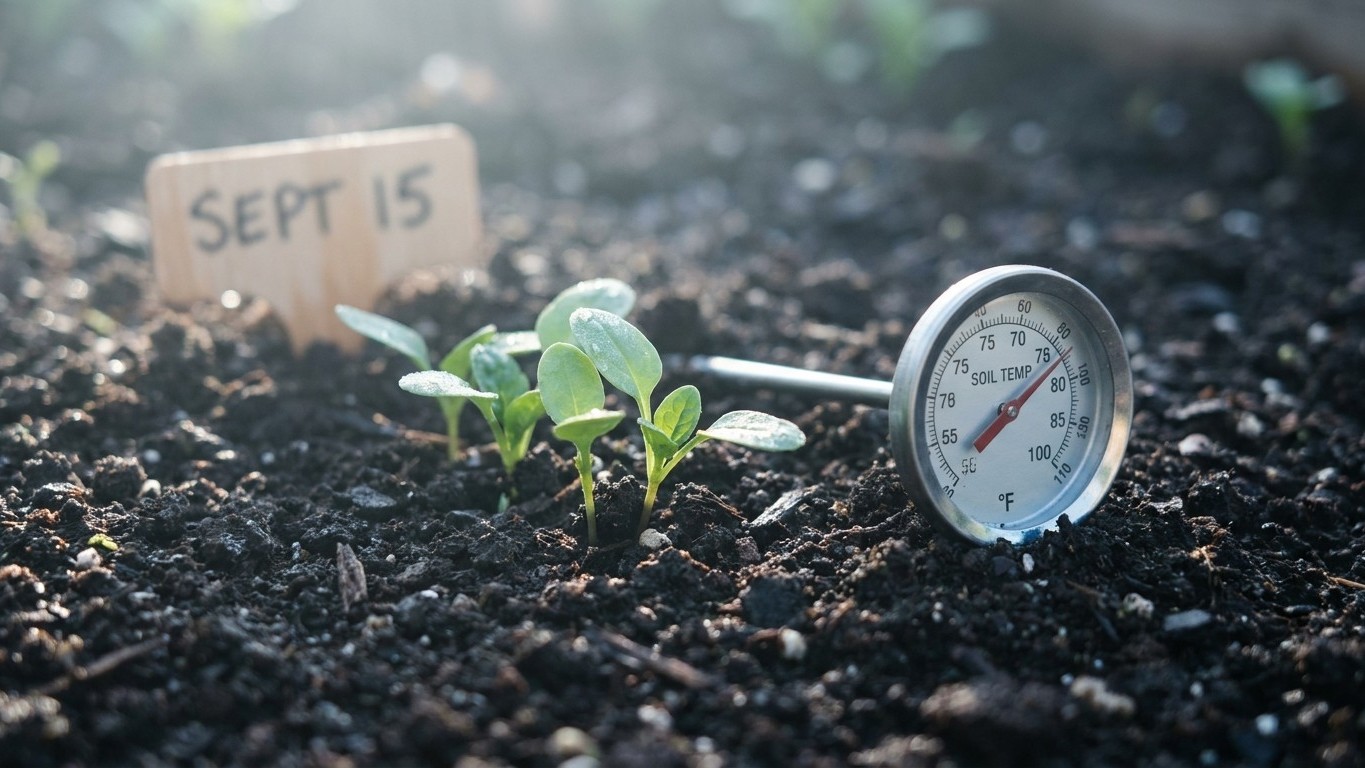

In the Yukon, the realistic window for sowing autumn spinach runs from roughly mid-June to early July, counting back 50 to 75 days from a harvest you’d like to bring in before the first fall frost, which falls on average August 25. That’s a tight target, and it sits right in the middle of the territory’s longest, brightest days, which is exactly the complication worth understanding before you open a seed packet.
The short answer
Whitehorse gets 18 hours and 45 minutes of daylight on the longest day of the year. That number matters more than any thermometer reading you’ll find in a Yukon garden, because spinach bolts under long days as much as it does under warm ones. A cool northern summer does not buy extra growing weeks here the way it might for a crop that only cares about heat. Once daylight stretches past a certain point, spinach starts pushing up a flower stalk no matter how mild the air feels.
Here’s what makes the Yukon an unusual case: heat almost never enters the equation. The reference station records an average of 0.0 days a year reaching 90 F. That’s not a typo or a rounding error, it’s a flat zero. Spinach grows best where temperatures stay under 75 F, and in the Yukon that ceiling is barely ever tested from the outside. So the limiting factor for spinach here isn’t heat stress at all. It’s day length.
This is a genuinely different problem than a gardener in a hot southern state faces. A grower in Texas or Arizona battles soil that cooks past the point where spinach seed will even germinate. A Yukon grower doesn’t have that fight, at least not from air temperature. What a Yukon grower fights instead is the calendar itself, because the sun barely sets in June and early July, and that light alone is enough to flip spinach into reproductive mode and send it to seed before the leaves ever bulk up.
The practical result is that spring-sown spinach in the Yukon has a short runway. You get a window before the days become punishingly long, and then bolting risk climbs fast regardless of how comfortable the temperature feels on your skin. Autumn sowing has to thread a different needle: you want to get plants in the ground early enough to mature before frost, but sowing too early means sowing straight into the same long-day stretch that undoes spring plantings. There’s no way around addressing day length directly, because in this territory it’s doing more work than the thermometer ever will.
How long the spring window really is
Working out the spring window means lining up three things: the general rule of sowing 2 to 3 weeks before the last frost, the mean last spring frost date for this region, and the point at which day length starts working against the crop. Here’s how that plays out step by step.
- The mean last spring frost at the Whitehorse A station is June 5. That’s an average, not a guarantee, so in roughly half of all years frost arrives later than that date.
- Sowing 2 to 3 weeks before that average date puts seed in the ground somewhere around mid-to-late May, assuming soil is workable and not still frozen solid.
- From that sowing point, spinach has only a handful of weeks before the days lengthen toward the June solstice peak of 18 hours 45 minutes, when bolting pressure from day length alone becomes hard to outrun.
- Because heat is a non-issue here (zero days a year above 90 F), the 75 F growth ceiling is rarely breached from the air temperature side, which removes one obstacle other regions deal with, but it does nothing to slow the day-length clock.
- Add it up and the usable spring window is short, likely just a few weeks between soil being workable in May and the long-day bolting pressure that builds through June. It’s a narrow slot, not a lazy monthlong opportunity.
This is worth sitting with for a moment, because it reframes what “cool climate” actually means for this crop. A cool Yukon summer sounds like ideal spinach territory on paper. But the day-length trigger doesn’t care whether the air is 55 F or 85 F. It fires on light, and the Yukon has more of that in June than almost anywhere in the country. The mean last frost date of June 5 also carries a real caveat: since it’s a midpoint from the 1981-2010 Canadian Climate Normals, treat it as the center of a range rather than a line you can plant right up against. A grower who sows on May 20 in a year when frost lingers into mid-June is taking on real risk, and there’s no way to know in advance which kind of year it will be.
The autumn crop, and when the soil lets you sow
Fall spinach in the Yukon has to clear two separate hurdles before it ever reaches the plate: soil that’s warm enough to slow germination, and a frost that arrives and ends the growing season outright. Neither hurdle behaves quite the way it would somewhere with a longer, hotter summer, and that’s worth breaking apart.
Soil still too warm to germinate
Utah State University Extension notes that spinach seed germination drops off once soil temperature climbs above 80 F. In much of the country, that’s the single biggest obstacle to a fall planting, because gardeners have to wait out the peak of summer before soil cools enough for seed to sprout reliably. In the Yukon, this obstacle is real but muted. With an average of zero days a year reaching 90 F in the air, soil rarely bakes to that 80 F mark the way it does in warmer states, though direct summer sun on bare soil during 18-plus-hour days can still push surface temperatures higher than the air reading alone would suggest. The takeaway for a Yukon gardener is that soil heat is a secondary concern here, not the primary one, but it’s not something to dismiss outright if you’re sowing into dark, uncovered ground at the height of summer light.
The frost that ends the season
The bigger constraint in the Yukon is simply how early the first fall frost tends to land. The mean date at the Whitehorse A station is August 25, and just like the spring figure, that’s a midpoint, not a promise; in about half of all years frost shows up earlier than that. Utah State University Extension’s guidance for a fall spinach crop is to sow 50 to 75 days before the date you want to harvest, and no days-to-maturity figure beyond that is published for the crop. Working backward from a harvest target of roughly August 20, a few days ahead of the mean frost date, a 50-day plan points to sowing around July 1, while a 75-day plan points to sowing closer to June 6. That places the entire realistic sowing window for a fall crop somewhere between early June and early July, which happens to overlap heavily with the same long-day stretch that pressures spring-sown spinach into bolting. It’s a narrow overlap and there’s no clean way to escape it in this latitude.
Four spinach varieties are commonly named in extension guidance: Bloomsdale, Melody, Teton, and Olympia. No days-to-maturity, cold tolerance, or bolt-resistance data for any of these specific varieties appears in the source used here, so nothing further can be said about how they’d perform against the Yukon’s particular day-length and frost pressures without guessing.
Common questions
Does a cooler Yukon summer mean spinach can be sown later than in warmer states?
Not really. Since bolting is triggered by long days as well as heat, and the Yukon’s 18 hours 45 minutes of summer daylight is extreme, the day-length trigger arrives regardless of how mild the temperature stays. Cooler air doesn’t cancel out the light.
Is heat ever a real problem for spinach in the Yukon?
Rarely. The reference station averages 0.0 days a year at 90 F or above, so the 75 F growth ceiling is seldom challenged by air temperature alone. Day length remains the dominant constraint, not heat.
How reliable are the June 5 and August 25 frost dates?
They’re mean dates from Environment and Climate Change Canada’s 1981-2010 Climate Normals for the Whitehorse A station, meaning frost falls later than each date in roughly half of all years. Treat them as the center of a window, not a safe cutoff, and expect northern or upland parts of the territory to run behind the Whitehorse figures.
What’s the actual sowing window for a fall spinach crop in the Yukon?
Counting back 50 to 75 days from a harvest target near the mean frost date of August 25 points to sowing somewhere between early June and early July, a stretch that unfortunately overlaps with the territory’s longest-day period.