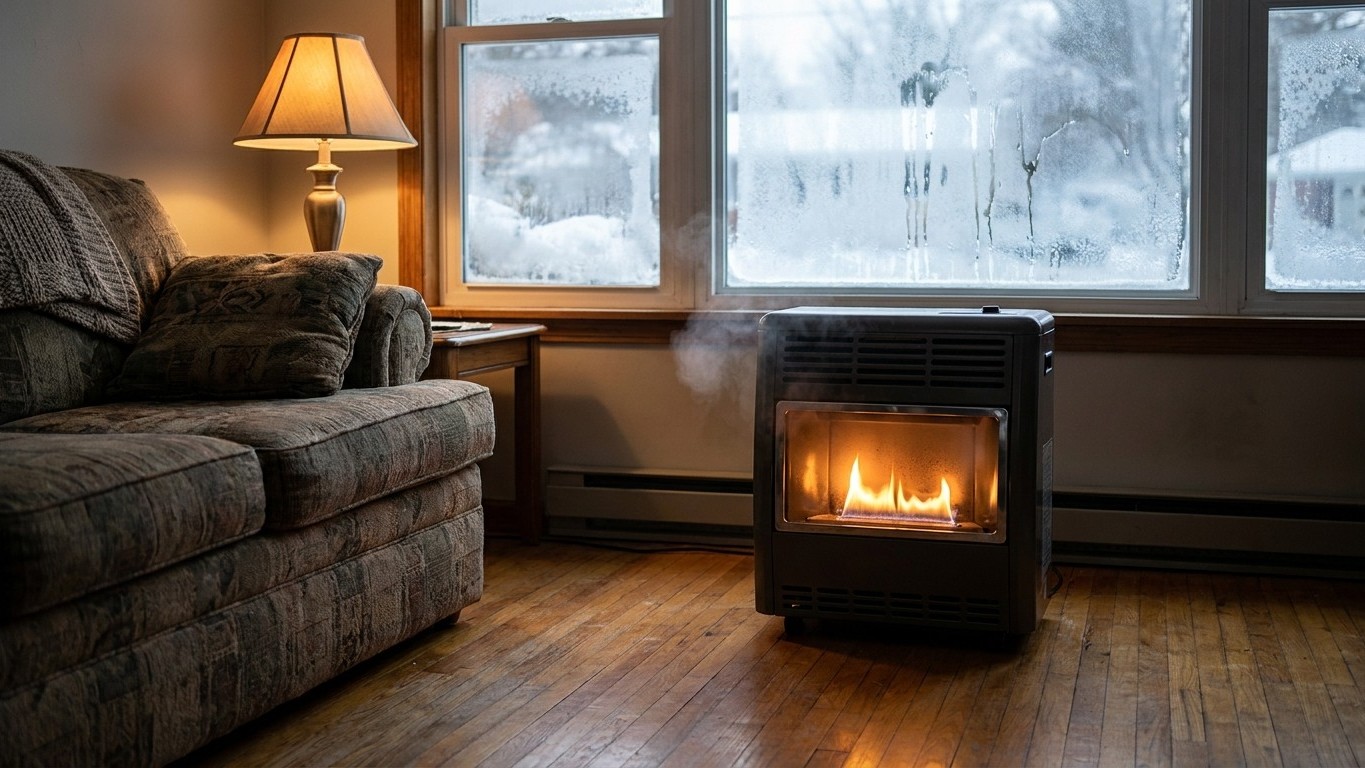

Bringing a kerosene or propane heater indoors changes the math on heating a room. Electricity in, heat out – that’s the entire transaction with a plug-in space heater. A fuel-burning heater adds combustion to that transaction, and combustion is never a closed loop. It uses the room’s air, it produces exhaust the room’s air must absorb or vent, and it demands a level of attention an electric unit simply doesn’t ask for.
A different class of appliance
Every guide on this site that covers electric space heaters starts from one assumption: nothing is being burned. Flip on a plug-in heater and a resistive coil converts electricity to heat, full stop. There’s no flame, no exhaust, no fuel tank to refill. A kerosene or propane heater breaks that assumption entirely, because the heat comes from a flame burning inside the same room where people are sitting, sleeping, or watching television.
That single difference cascades into three consequences an electric heater never produces. The flame consumes oxygen from the room’s air, meaning the air in a closed space is slowly being used up rather than simply warmed. The flame also produces combustion byproducts, carbon monoxide chief among them, which have nowhere to go unless the room lets them go somewhere. And combustion releases water vapor as a normal part of burning fuel, which is one reason a room heated by a kerosene unit can feel damp or develop condensation on cold windows in a way an electrically heated room does not.
None of this makes these heaters illegal or, used correctly, unreasonably dangerous. They’re legal to own and operate in the overwhelming majority of U.S. jurisdictions, and they remain genuinely useful when the power goes out and an electric heater becomes a paperweight. What changes is the list of conditions the appliance requires to run the way it’s supposed to: a specific fuel grade, an alarm that can detect what the human nose cannot, and airflow that a homeowner has to supply on purpose rather than something the heater handles for itself.
| Feature | Electric heater | Kerosene heater | Propane heater |
|---|---|---|---|
| Consumes room oxygen | No | Yes | Yes |
| Produces carbon monoxide | No | Yes | Yes |
| Releases water vapor | No | Yes | Yes |
| Requires fresh-air ventilation | No | Yes | Yes |
| Requires specific fuel grade | No | Yes | No (standard propane) |
A reader who came to this page from an electric-heater guide can use that table as a quick gut check: if the appliance in question burns nothing, most of what follows on this page doesn’t apply. If it burns fuel, all of it does.
Carbon monoxide, and the alarm
Carbon monoxide is colorless and odorless. That sentence carries more weight than it looks like it should, because it means a person in a room with a leaking flue or a poorly tuned burner gets no warning from their own senses. No smell tips them off. No visible haze signals trouble. The only reliable early warning comes from a working carbon monoxide alarm, and that’s true regardless of how carefully the heater is maintained or how experienced the operator is. Care reduces the chance of a problem. It does not replace the alarm’s job of catching the problem if one occurs anyway.
Every fuel-burning heater on this site’s coverage produces carbon monoxide as a byproduct of combustion. That includes kerosene heaters, propane heaters, and any other appliance that burns fuel to make heat. Electric space heaters do not, because there’s no combustion happening inside them at all. A household running only electric heaters doesn’t need to treat carbon monoxide as a risk from that appliance, though a CO alarm remains sound practice in any home with a furnace, water heater, fireplace, or attached garage.
The U.S. Fire Administration and the U.S. Consumer Product Safety Commission both treat any fuel-burning heating appliance as a carbon monoxide source, without exception for size or portability. A tabletop kerosene heater running in a den is, on this specific point, in the same category as a furnace in the basement. Both burn fuel, both produce CO, both require detection that doesn’t depend on a person noticing anything unusual.
This site’s furnace carbon monoxide page covers alarm placement and maintenance in the depth the topic deserves. That material applies just as directly to a kerosene or propane space heater as it does to a furnace, since the gas itself doesn’t care what appliance produced it. What matters here is narrower and simpler: if the heater burns fuel, the room needs a working alarm, and that requirement doesn’t loosen because the appliance is small, portable, or only running for a few hours in the evening.
The fuel, and the mistake that kills
Portable kerosene heaters are built around one specific fuel: water-clear 1-K grade kerosene. That clarity isn’t cosmetic. It reflects a lower sulfur content and fewer additives than the 2-K grade or dyed kerosene sometimes sold for other purposes, like off-road diesel equivalents or heating oil. Run a portable heater on the wrong grade and the wick fouls faster, the flame burns less cleanly, and the heater pushes more contaminants into the exact room it’s supposed to be warming. The appliance’s manual is the actual authority here, since specifications vary by model, but the underlying principle holds across the category: the heater was engineered around a specific fuel, and departing from it degrades performance and indoor air quality together.
Fuel grade is a design problem, though. The mistake that actually kills people is a different one, and it needs to be named without hedging: gasoline, diesel, camp fuel, and lamp oil are not backup options for a kerosene heater. They are not lower-quality substitutes that just burn a little dirtier. Putting gasoline into a kerosene heater isn’t a performance issue at all, it’s a fire risk, because gasoline vapor ignites at conditions the heater’s wick and combustion chamber were never built to contain. This single substitution error shows up again and again in fire investigation reports, usually from someone who ran out of kerosene, had a gas can in the garage, and assumed one flammable liquid was close enough to another. It isn’t.
Refueling is where a lot of that risk concentrates in practice, so the routine matters as much as the fuel itself. Refuel outdoors, not in the room where the heater lives. Refuel a cold unit, never one that’s still warm from recent use. And never refuel a heater that’s running, a rule that sounds obvious stated plainly but gets skipped constantly by people trying to keep a flame going through a cold night without a gap in warmth. The few minutes it takes to let a heater cool, carry the fuel container outside, and refill it properly are the few minutes that keep a fuel-handling task from turning into a fuel-handling accident.
Ventilation is a requirement, not a precaution
This is the part of the instructions most people are tempted to skip, and it’s worth explaining why skipping it defeats the entire point of the heater. A kerosene or propane heater burning indoors needs a supply of fresh air, which in a modern, well-sealed house usually means deliberately cracking a window. That feels backward. The whole reason for running the heater is to keep the room warm, and opening a window seems like undoing the work before it’s done.
It isn’t, because the heat in that room comes from the fuel burning, not from how airtight the room happens to be. Sealing every gap doesn’t make the heater produce more warmth; it just traps the combustion byproducts alongside the heat, letting carbon monoxide and depleted oxygen build up in the same enclosed space the flame is trying to warm. The opened window isn’t fighting the heater’s job. It’s the cost of doing that job with combustion instead of electricity, and it’s a cost a plug-in heater never charges because it never burns anything in the first place.
The U.S. Fire Administration’s guidance on keeping heat sources clear of anything flammable doesn’t single out furnaces or fireplaces and leave space heaters out of it. The agency states plainly: “Keep anything that can burn at least 3 feet from all heat sources including fireplaces, wood stoves, radiators, space heaters or candles.” That list groups a portable kerosene or propane heater with exactly the appliances a homeowner already treats with caution, and the clearance applies the same way, regardless of how small or temporary the heater feels.
A burning heater also isn’t something to walk away from, ever. The Fire Administration’s instruction is direct: “Turn space heaters off when leaving the room or going to bed.” Both halves of that sentence matter on their own. Leaving the room for ten minutes to answer the door counts. Going to bed with the heater still running counts too, and it’s the scenario behind a disproportionate share of the fatal fires tied to this appliance category. The agency’s 2017-2019 report on portable heater fires found an estimated annual average of 1,100 fires, 65 deaths, 150 injuries, and $51 million in property loss, and inside that data sits the contrast that matters most: portable heaters caused about 3% of home heating fires but accounted for about 41% of fatal home heating fires. Rare as an ignition source. Wildly overrepresented among the fires that kill someone. Both numbers describe the same appliance, and neither one alone tells the real story.
Two other pieces of the agency’s guidance round out the picture, and both apply beyond kerosene and propane heaters specifically. “Never use an oven to heat your home” addresses a related but separate temptation during a cold snap or power outage. And “maintain heating equipment and chimneys by having them cleaned and inspected each year by a professional” is a reminder that upkeep isn’t a one-time purchase decision, it’s an annual task that keeps every fuel-burning appliance in the house, portable or fixed, working the way it was designed to.
Common questions
Can I run a kerosene heater in a fully closed room overnight?
No. The Fire Administration’s guidance to turn space heaters off when leaving the room or going to bed applies directly here, and a closed room with no fresh air supply is exactly the condition that lets carbon monoxide and depleted oxygen accumulate around a sleeping person.
What happens if I put the wrong kerosene grade in my heater?
The heater is designed for water-clear 1-K kerosene. Dyed or 2-K grade fuel carries more sulfur and additives, which fouls the wick and increases what the heater releases into the room. Check the appliance’s own manual, since it’s the authority on that specific model’s requirements.
Is it ever acceptable to use gasoline if I run out of kerosene?
No, under any circumstance. Gasoline, diesel, camp fuel, and lamp oil are not substitutes for kerosene in a kerosene heater. This is a fire risk, not a performance downgrade, and it’s named as the single most dangerous error associated with this appliance.
Do electric space heaters need a carbon monoxide alarm too?
An electric heater burns nothing, so it produces no carbon monoxide on its own. A CO alarm is still sound practice in most homes because of other fuel-burning appliances like furnaces or water heaters, but the electric heater itself isn’t the source in that case.