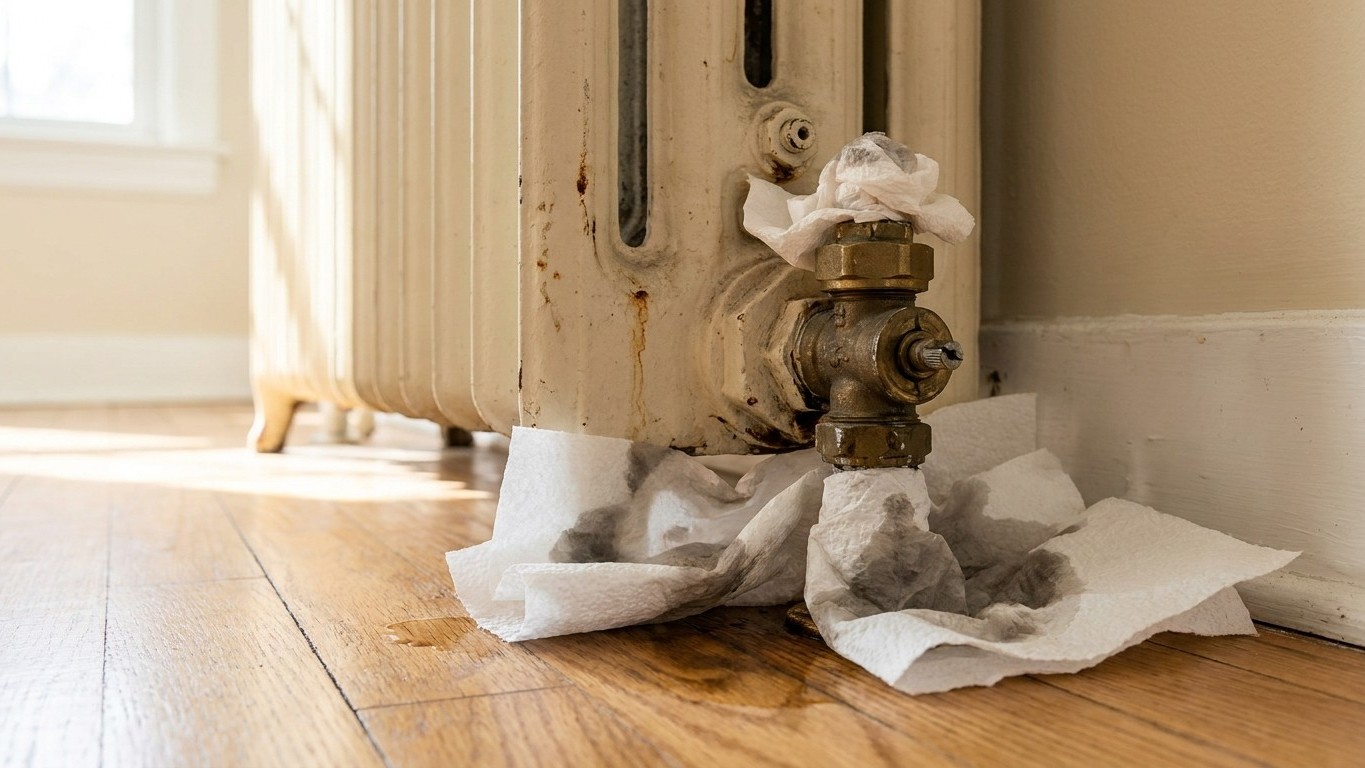

Water pooling under a radiator almost always comes from one of four spots: the pipe union where the valve meets the radiator, the valve spindle itself, a crack or corroded patch in the radiator’s body, or a bleed point that isn’t sealing anymore. Which one it is changes what you do next and how urgent it is. A radiator is not a heating system on its own, it’s the object a boiler pushes hot water or steam into, and that distinction matters before you touch anything, because a steam radiator has no bleed key and shouldn’t be opened like a hot-water one.
Find the source before doing anything
A wet patch on the floor tells you almost nothing on its own. Water travels along pipe insulation, runs down the back of a radiator, and lands three feet from where it actually started. Before you decide anything is wrong with the radiator body, or worse, start tightening things at random, the job is to dry everything off completely and watch where the water reappears.
Wipe down the whole unit and the floor beneath it, then slide a few sheets of dry paper towel or a folded paper napkin under each of the likely points: under the union nut where the valve connects to the radiator, under the valve body itself, along the bottom seam and any visible seams or joints on the radiator’s face, and under the bleed point at the top (on systems that have one). Let the heating run through a normal cycle, then come back and check which piece of paper is wet first. That’s your answer, and it’s a better answer than anything you’ll get from staring at a puddle.
The four places worth checking
Every leak on a radiator traces back to one of four points, and naming them up front saves a lot of guessing:
- The valve union: the threaded joint where the valve connects to the radiator tapping.
- The valve spindle: the part that turns when you adjust the valve open or closed.
- The radiator body: the metal panels, seams, and welds of the radiator itself.
- The air vent or bleed point: the small square-headed valve at the top used to release trapped air.
One safety point applies regardless of which of the four it turns out to be. If the leak is anywhere near an electrical outlet, a Baseboard Heater control, or above a light fitting on the floor below, switch off power to that circuit before you do any further inspection. Water and live wiring don’t need to be touching yet to be a problem, and a slow drip has a way of finding the one outlet in the room.
What each location means
Once you know which point is wet, the next question is what that actually means for the radiator and for how much time you have. A union leak and a body leak are not the same kind of problem, and treating them the same way wastes effort at best and makes things worse at worst.
| Location | Usual cause | Gets worse over time? | Within reach for a homeowner? |
|---|---|---|---|
| Valve union | Loose nut, worn washer, or a joint that was never fully tightened | Often stays steady until touched, but can worsen with vibration or thermal cycling | Yes, usually a wrench and a new washer |
| Valve spindle (when turning the valve) | Worn gland packing around the spindle | Tends to worsen gradually with each use of the valve | Yes, gland can often be tightened or repacked |
| Radiator body | Internal corrosion or a pinhole from age | Worsens, sometimes slowly, sometimes suddenly | No, this is a replacement issue, not a repair |
| Bleed point (weeping) | Bleed valve not fully seated, or a worn seal inside it | Usually stays minor but rarely fixes itself | Yes, often just needs re-seating or a new valve |
The spindle leak is worth understanding
A valve that only weeps when you actually turn it, rather than sitting there dripping at all times, is telling you something specific: the gland (the packing that seals around the moving spindle) has worn down. This is the most fixable of the four problems, because on most valves the gland nut can be tightened a partial turn to compress fresh packing against the spindle, or the packing itself can be replaced. It’s mechanical wear on a part designed to be serviced, not a sign that the radiator or the valve is failing structurally.
Holding it until it can be fixed
Not every leak gets fixed the moment it’s found. Sometimes it’s evening, sometimes the part isn’t on hand, and the honest answer is that the leak needs to be managed for a day or two rather than solved on the spot.
- Contain it. Put a shallow tray or towel under the leak point and check it periodically rather than leaving it unattended overnight.
- Close the valves at both ends, if they’ll close. Most hot-water radiators have a valve on each side, one adjustable, one a lockshield that needs a wrench or pliers to turn. Closing both isolates the radiator from the rest of the system and stops the leak at its source while it stays cold.
- Know what to do if they won’t close. A valve seized open, or a lockshield that’s been painted over and won’t budge, means the leak keeps flowing until the whole zone or system is shut down at the boiler or a nearby isolation point. Don’t force a seized valve, a rounded-off spindle is a harder problem than the leak you started with.
One caution applies specifically to steam systems: closing valves on a radiator that runs on steam is not the same act as closing valves on a hot-water radiator, and it should not be improvised by someone unfamiliar with how that particular system is piped. Steam systems often rely on specific valves staying open for the system to vent and balance correctly, and closing the wrong one can cause pressure problems elsewhere in the loop. If in doubt, shut down at the boiler rather than guessing at a radiator valve.
It’s also worth being plain about the body leak case. A leak from the body of a cast-iron radiator, as opposed to a union or a spindle, is usually the end of that radiator rather than something to patch. Internal corrosion that’s worked its way through the metal doesn’t get better, and it doesn’t stay at pinhole size. Sealants poured into a heating system to chase a slow leak are a real option in some situations, but they’re a decision that affects the whole system, not just the one radiator, since the same sealant circulates through every pipe, valve, and pump the water touches. That’s a call worth making with full information, not a quick fix to grab off a shelf.
Why it started now
The question underneath all of this is usually simple: why now, why this radiator, why the first cold week of the year? The answer has less to do with bad luck and more to do with what the system has been doing, or not doing, all summer.
A radiator that’s been cold and motionless for months has joints that have settled into one position. Turning the heat back on doesn’t just warm the room, it heats the metal itself, and metal expands when it’s heated. A union or gland that was holding perfectly well at rest is suddenly being asked to hold while the pipe and the radiator both grow slightly and shift against each other. A joint that was marginal all along, a washer that was already a little compressed, a gland that was already a little worn, picks this exact moment to show it.
That means the start of the heating season isn’t an unlucky time for a leak to appear, it’s the predictable time. The system is doing the one thing it hasn’t done in months: moving, heating, expanding. A short check before the season gets fully underway catches most of these before they turn into an evening spent with a tray and a towel.
- Run the heat for a full cycle on a day when you’re home to watch it.
- Check each radiator’s union, spindle, and base for dampness while it’s warm.
- Bleed hot-water radiators that have cold spots at the top, using the bleed key made for that valve.
- Note any valve that’s stiff or won’t fully close, and deal with it before it’s the only thing standing between you and a shut-off system.
Common questions
Is a leaking radiator an emergency?
Not usually, if it’s a slow drip you can contain and the valves close normally. It becomes urgent if water is near an electrical outlet or fitting, if the leak is fast and won’t slow when valves are closed, or if it’s coming from the body of the radiator and getting worse by the hour.
Can I just tighten the leaking joint myself?
A union nut can often be snugged with a wrench while the system is cold, and a spindle gland can sometimes be tightened a partial turn. Both are reasonable first steps. A leak from the radiator’s body isn’t something tightening will fix, since it’s coming through the metal itself rather than a joint.
Why does my radiator only leak when I turn the valve?
That pattern points to the spindle gland, the packing that seals around the moving part of the valve. It only weeps under the movement and pressure of being turned, which is why it can go unnoticed for a long time between adjustments.
Does a leaking radiator mean I need a new boiler?
No. The radiator and its valves are separate parts of the loop from the boiler itself. A leak at a union, spindle, or bleed point is local to that radiator and has no bearing on the boiler’s condition.