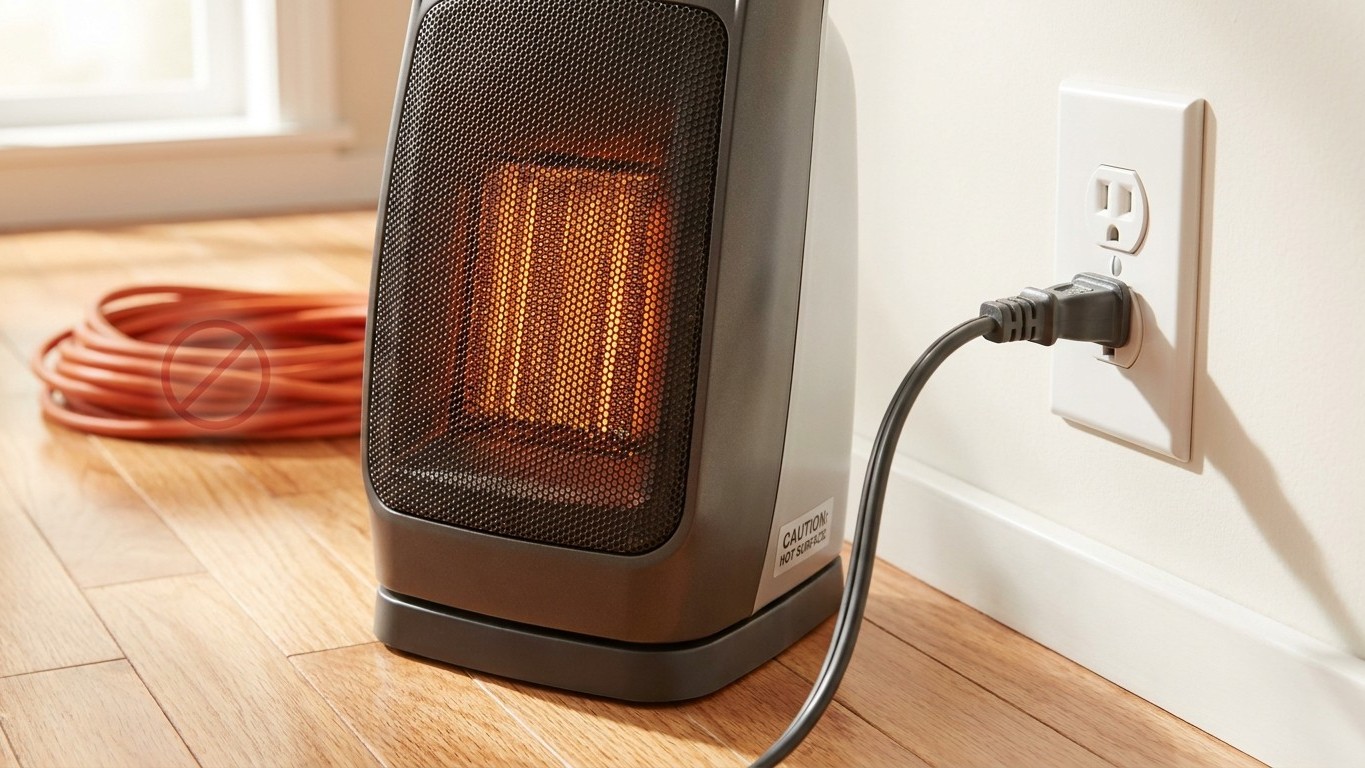

No. A space heater should run straight from a wall outlet, plugged in directly, with nothing in between. Extension cords aren’t built to carry the steady, high-amperage draw a resistive heater pulls for hours at a stretch, and that mismatch is exactly what turns a $20 accessory into a fire risk. The U.S. Fire Administration’s own guidance treats portable heaters as a distinct hazard category, and the numbers behind that guidance are worth understanding before the next cold snap.
Where the heat actually appears

A space heater is, electrically speaking, a very simple appliance. It has no motor to spare current, no compressor cycling on and off. It’s a resistive load, meaning almost all the electricity it pulls gets converted directly into heat, and it does that continuously for as long as it’s running. On a cold night, that can mean hours of near-maximum draw on a single household circuit, not a quick burst like a hair dryer or a toaster.
An extension cord introduces resistance into that circuit. Every cord has some, but a cord that’s long, thin-gauge or simply worn adds more than a direct connection would. And resistance doesn’t disappear, it converts electrical energy into heat, following the same basic physics as the heating element inside the space heater itself. The difference is where that heat shows up.
Inside a well-made heater, the heating element is designed to get hot and to dissipate that heat safely, with housing, spacing and shutoffs built around that expectation. A plug, a wall socket or a splice inside an extension cord was never designed to run hot. So when a cord and connector are pushed past what they can comfortably carry, the excess heat concentrates at the weakest points in the circuit: the prongs where they meet the socket contacts, the connection points inside a spliced or coiled cord, the plastic housing around the plug itself.
That’s the mechanical reason a failure connected to a space heater and extension cord rarely looks like the heater failing. The heater keeps blowing warm air right up until something goes wrong. What actually happens is a plug that’s warm to the touch, a wall socket with a faint plastic smell, a discolored outlet cover, or in the worst case, arcing at a loose connection that ignites nearby material. The heater is doing exactly what it’s designed to do. The problem is happening a few feet away, at the connection carrying its power.
This is also why the danger doesn’t announce itself the first time. A cord can carry a marginal load for an evening, or a week, without any visible sign. Heat builds gradually with repeated use, degrading insulation and loosening connections a little more each time, until a particular cold night finally pushes things past the point where the plastic holds. That delay is part of what makes the habit feel safe long after it’s stopped being safe.
What to look for, and what it means
Nobody needs a multimeter to catch this early. The warning signs are things a person can notice with a hand and a nose, usually within the first hour a heater is running through a cord. What matters is treating any one of them as a stop signal, not something to monitor.
- A plug that feels warm or hot. Touch the plug where it meets the outlet or the cord, not the heater’s own casing. Any warmth beyond mild is a sign the connection is carrying more current than it can dissipate comfortably.
- A discolored or darkened socket face. Yellowing, browning or a slightly melted look around the outlet or the plug’s prongs means heat has already been building there, possibly over multiple uses.
- A smell of hot plastic. This is one of the least ambiguous signs available. Insulation and plastic housings give off a distinct odor well before they visibly fail.
- A cord that’s warm along its length, not just at the ends. This points to resistance building inside the cord itself, often at a coiled section or an internal joint.
- A breaker that trips when the heater runs. This means the circuit is being asked to carry more than it’s rated for, whether or not a cord is involved.
Any of these means the same thing: unplug the heater immediately and stop using that particular combination of cord and outlet. Don’t reset a tripped breaker and try again to “see if it happens twice.” Don’t keep using a warm cord because the heater is still blowing warm air. The heater’s output tells you nothing about the condition of the connection feeding it.
What these signs don’t do is tell you exactly what’s wrong or how serious it is. A darkened outlet could mean a single overloaded evening, or it could mean a wiring problem behind the wall that’s been building for months. That distinction matters, and it’s not one to guess at. If an outlet shows discoloration, if a breaker trips repeatedly on a circuit that seems to have nothing else drawing power, or if a plug is hot even when nothing but the heater is plugged in, it’s time to call a licensed electrician rather than simply switching outlets and hoping the next one behaves differently.
Power strips, surge protectors and multi-outlet taps
A lot of people reach for a power strip instead of an extension cord, assuming it’s a safer middle ground. It isn’t automatically, and the reason comes down to what each device is actually built to do.
A power strip is a set of outlets with its own internal wiring, contacts and, in many cases, its own circuit breaker or fuse designed to cut power if the load gets too high. But that internal protection is almost always sized around the expected load of the devices it’s meant to serve: lamps, chargers, a router, a television. None of those pull anywhere near What a Space Heater pulls, continuously, for hours. Plugging a heater into a power strip built for electronics asks it to do a job it was never rated for.
A surge protector is a different device entirely, even though it often looks identical to a power strip and gets used the same way. Its job is to absorb a brief spike in voltage, the kind caused by a lightning strike or a grid fluctuation, and shunt that spike away from whatever’s plugged in. It is not built to carry a sustained heavy load at all; its protective components are designed around momentary events, not hours of continuous high current. Running a space heater through a surge protector is the worst combination on this list, because the device’s entire design purpose has nothing to do with carrying steady current safely.
| Device | Designed for | Safe for a space heater? |
|---|---|---|
| Extension cord | Temporary extension of reach for light or intermittent loads | No |
| Power strip (basic) | Multiple low-draw electronics plugged into one outlet | No |
| Surge protector | Absorbing brief voltage spikes, not sustained current | No |
| Direct wall outlet | Continuous, direct-rated household load | Yes |
The takeaway isn’t that some brand or model of power strip is fine while others aren’t. It’s that none of these accessories were built with a sustained resistive heating load in mind, and a heater doesn’t care what the packaging on the strip promised. The only connection built for that job is the wall outlet itself.
What to do when the socket is in the wrong place
None of this is much comfort to someone whose only outlet is across the room from where the cold actually is. That’s a real problem, and “just don’t use a cord” isn’t a complete answer to it.
The most direct fix is to move the heater, not the power. Most portable heaters are light enough to sit right next to whichever outlet is available, even if that means heating a slightly different spot in the room than originally planned. A heater a few feet from where someone is sitting still does its job; a heater plugged in through a cord stretched across the floor is a tripping hazard on top of the electrical one.
If the outlet-equipped area genuinely isn’t usable, for example a garage or a workshop with only one accessible plug far from where the heat is needed, the better move is often to reconsider the room entirely rather than force a connection. A smaller, better-insulated space near an existing outlet will heat more efficiently anyway, and that’s true regardless of the electrical question.
For a space that’s used regularly and just doesn’t have enough outlets, having an electrician add a properly rated outlet where it’s actually needed solves the problem permanently, rather than working around it every winter. This is a modest job in most homes and removes the temptation to reach for a cord entirely.
Some households are better served by a different category of appliance altogether: a heater designed to be permanently wired into a circuit, sized and installed by an electrician for the specific space, rather than a portable unit moved from room to room. That’s a bigger step, but for a space heated every day through an entire season, it can be worth the upfront work.
Whatever the setup, the U.S. Fire Administration’s core habits still apply. “Keep anything that can burn at least 3 feet from all heat sources including fireplaces, wood stoves, radiators, space heaters or candles.” “Turn space heaters off when leaving the room or going to bed.” And for anyone tempted to warm a room a different way when the outlet situation feels impossible: “Never use an oven to heat your home.” The agency also recommends people “maintain heating equipment and chimneys by having them cleaned and inspected each year by a professional,” a habit that applies to permanent heating systems as much as portable ones.
The scale of the risk is worth keeping in view. The U.S. Fire Administration’s 2017-2019 report on portable heater fires found an estimated annual average of 1,100 fires, 65 deaths, 150 injuries and $51 million in property loss tied to portable heaters in residential buildings. Portable heaters accounted for about 3% of home heating fires overall, but about 41% of fatal home heating fires. They’re rare as a cause of fire and badly over-represented as a cause of death, which is exactly the kind of gap that a warm plug or a hot socket in the middle of the night can turn deadly.
Common questions
Can I use a heavy-duty extension cord instead of a regular one?
A better-built cord may hold up longer than a thin one, but the underlying issue is the connection points, not just the wire itself. The wall outlet remains the only connection designed for a heater’s continuous draw.
Is it safe if the heater has a built-in shutoff or tip-over switch?
Those features protect against the heater falling over or overheating internally. They do nothing to protect the plug, cord or socket carrying its power, which is where cord-related failures happen.
What if the extension cord feels cool to the touch after an hour?
A cool cord is a good sign in the moment, but heat can build gradually over repeated uses as connections loosen or insulation degrades. A single check isn’t a guarantee for every future use.
Are ceramic heaters safer to run on a cord than the older coil types?
The heating technology inside the unit doesn’t change what the cord and outlet have to carry. Both types draw a similar continuous load, and the electrical risk sits at the connection, not inside the heater.