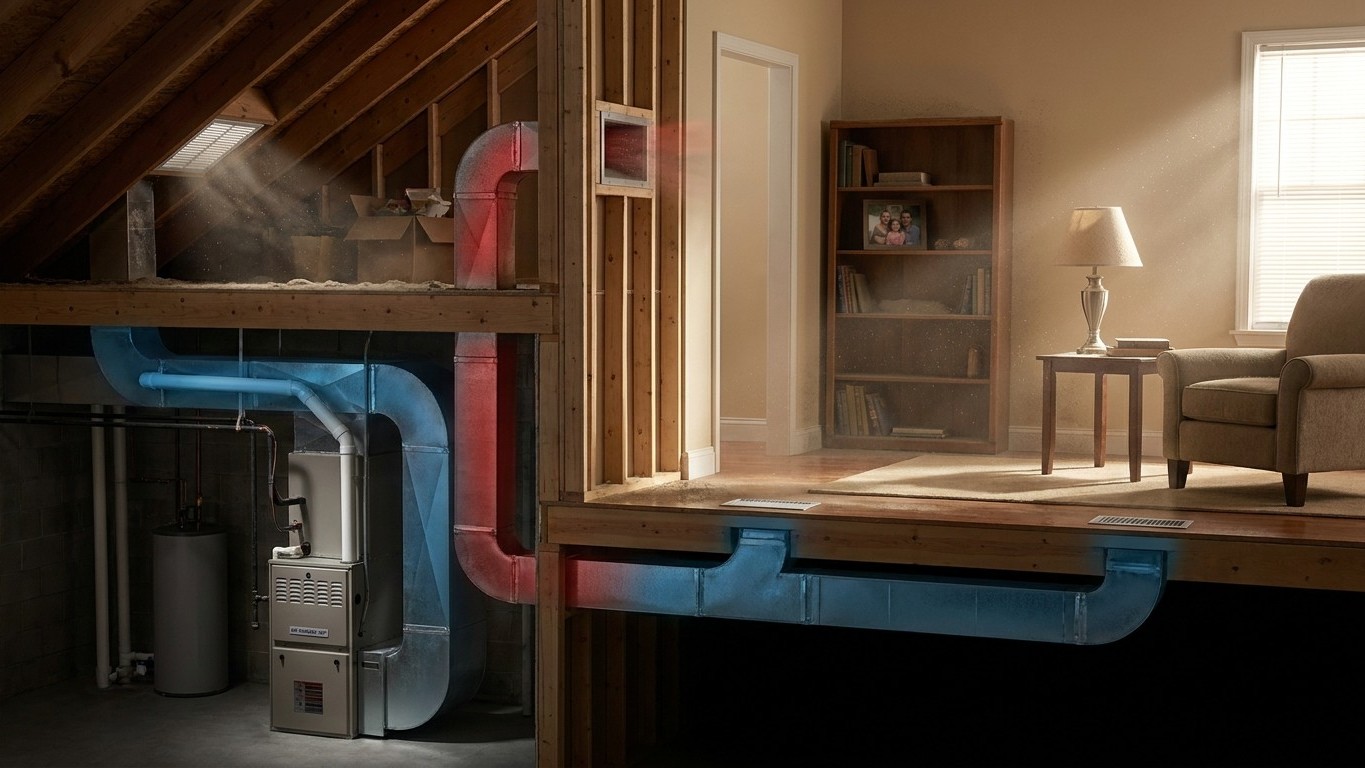

A dusty house that keeps getting dusty a few days after you clean is rarely a cleaning problem. In a forced-air system (furnace, central air conditioner, or heat pump with a blower and ducts), dust that reappears fast usually means the ducts are pulling air in from somewhere they shouldn’t, or the filter isn’t catching what passes it. If your home runs on radiators, hydronic baseboard, or mini-splits, none of this applies to you: those systems don’t use ducts at all.
The half of the system nobody thinks about
Every forced-air system has two sides, and they behave in opposite ways. The supply side is the half that pushes conditioned air out to your rooms through the registers you can see and feel. It runs under positive pressure. A leak there pushes air out into a wall cavity or attic before it reaches you, which wastes energy and leaves rooms uneven, but it doesn’t bring anything new into the house.
The return side does the opposite job. It’s the half that pulls air back toward the furnace or air handler to be filtered, heated or cooled, and recirculated. It runs under negative pressure, which means a leak on this side doesn’t lose air, it gains it. Air gets sucked in from wherever the leak happens to be, whether that’s an attic, a crawlspace, a wall cavity, or a garage, and that air travels straight into the return duct and out through your registers.
This is the part almost nobody explains when they talk about dust. People assume all duct leaks are the same kind of problem, a waste of energy, and stop there. But a return leak is a delivery mechanism. It doesn’t just cost you money the way a supply leak does. It actively brings outside air, attic insulation particles, crawlspace moisture, or garage fumes into your living space, and it does it every single time the blower runs.
That distinction matters because it changes where you look. If a house feels dusty no matter how often it gets vacuumed, the fix usually isn’t a stronger filter or more frequent cleaning. It’s finding where the return side of the duct system is pulling in air it was never supposed to touch. According to the U.S. ENERGY STAR program, “in a typical house, however, about 20 to 30 percent of the air that moves through the duct system is lost due to leaks, holes, and poorly connected ducts.” Some of that loss happens on the supply side. A meaningful share of it happens on the return side, and that’s the share that shows up as dust on your furniture rather than as a higher energy bill.
Where the air is coming from
Return leaks tend to cluster in a handful of predictable spots, mostly because those are the places builders take shortcuts to save material or labor. Knowing the usual suspects makes them easier to spot without opening up walls.
| Leak location | What it brings into the house | How to recognize it |
|---|---|---|
| Return duct running through an attic | Attic dust, insulation fibers, and air at whatever extreme temperature the attic has reached | Dust buildup near the attic access hatch; rooms feel dustier right after very hot or very cold weather |
| Return grille or duct located in the garage | Whatever is in the garage air at that moment: vehicle exhaust, gasoline or solvent vapors, dust, chemical residue | A faint chemical or exhaust smell inside the house, especially after the car has run or after using garage stored products |
| Panned floor joist used as a return duct | Crawlspace or basement air, along with moisture and any mold spores present down there | A musty smell that seems to come from the floor registers rather than the air itself |
| Unsealed platform under the furnace or air handler | Basement or crawlspace air pulled through gaps in the cabinet base | A visible ring of dust or grime around the base of the equipment |
| Filter slot that doesn’t close properly | Room air that bypasses the filter, plus whatever is behind the slot if there’s a gap to the outside | Dust visible right at the frame of the return grille itself |
A return leaking in a garage draws whatever is in the garage into the house, plainly and without exception. That’s not a worst-case scenario, it’s how negative pressure works. If a return duct or grille sits in or near a garage, treat it as a priority to check, since a garage is one of the few spots in a home where the air genuinely isn’t safe to recirculate at will.
The panned joist return deserves a second look too, because it’s common in older homes and it’s rarely obvious. Builders used to save on ductwork by turning the space between floor joists into a return air pathway, sealed (in theory) with a strip of sheet metal along the bottom. Over decades, that metal strip loosens, the mastic or tape holding it dries out, and the “duct” starts pulling in whatever is on the other side, usually a crawlspace or unfinished basement.
The filter that the air walks around
Even a perfectly sealed duct system can produce a dusty house if the air finds a way around the filter instead of through it. This is the single most common cause of dust complaints, and it’s also the cheapest one to fix, since it usually doesn’t require touching any ductwork at all.
It happens for a few simple reasons: a filter that’s slightly smaller than its slot, a return slot with no rigid cover or door to hold the filter flush, or a gap along one edge of the filter frame where the cardboard doesn’t quite meet the metal. Air always takes the path of least resistance. If squeezing through a clean filter takes more effort than slipping through a quarter-inch gap at the edge, the air chooses the gap, and the filter does essentially nothing for the air that skips it.
ENERGY STAR is direct about how often this component needs attention: “Inspect, clean, or change air filters once a month in your central air conditioner, furnace, and/or heat pump.” That’s monthly, for all three types of equipment, not just during the months you happen to notice dust.
How to check for bypass
- Pull the filter and measure the actual opening of the slot with a tape measure, rather than trusting the size printed on the old filter, since slots are sometimes slightly out of standard dimensions.
- Look for a rigid door or cover over the return slot. If the filter is just resting in an open frame with nothing holding it snug, that’s an open invitation for air to slip past the edges.
- With the system running, run a hand slowly around the perimeter of the filter frame and feel for air movement at the edges, which shouldn’t be there if the fit is tight.
- Check the clean side of the filter, the side facing the blower. If that side is dusty too, air is bypassing the filter media entirely rather than passing through it.
- With the system off, open the blower compartment and look at the fan wheel and housing. Dust buildup in there is air that skipped the filter completely on its way to the equipment.
- Confirm the filter still seats flush in its frame. A denser filter that’s slightly warped or doesn’t sit fully flat creates its own gap, even in a system with no other problems.
What actually reduces it
The order matters here, because fixing things out of sequence wastes effort and sometimes creates a new problem while solving an old one.
- Close the filter bypass first. It’s the cheapest fix, it takes minutes, and there’s no point sealing ducts if unfiltered air is still slipping past the filter itself.
- Seal the return side next. This is where dust actually enters the system, so accessible joints, seams, and connections on return ducts and plenums get priority over anything on the supply side.
- Seal the supply side after that. It won’t reduce dust much, but it recovers lost conditioned air and evens out comfort between rooms, which is worth doing once the return side is handled.
- Only then consider a denser filter. A better filter is a reasonable last step once the leaks and gaps are addressed, not a substitute for fixing them.
Fitting a much denser filter into a system that wasn’t designed for one restricts airflow, and that creates a different problem entirely. Registers start blowing weaker than before, rooms farthest from the equipment stop getting enough air, and the system runs longer to reach the same temperature. In more severe cases, restricted airflow can cause the cooling coil to ice over or push a furnace’s heat exchanger to run hotter than it should. A denser filter isn’t automatically better if the system’s blower and duct sizing were never built to pull air through it.
DIY work reasonably stops at accessible duct sealing, meaning joints and seams you can reach in an attic, basement, or crawlspace without cutting into finished walls or ceilings. Return ducts hidden behind drywall, panned joist returns buried under flooring, and any diagnosis that requires a blower door or duct leakage test belong to a professional, since guessing at sealing work you can’t see or verify tends to waste time without fixing the actual leak.
Common questions
Does a new filter really stop dust if the ducts are leaking?
Not on its own. A filter only catches what passes through the return grille and into the duct. If a return leak is pulling attic or crawlspace air in downstream of where the filter sits, or if air is bypassing the filter frame entirely, a new filter changes nothing about that source. The leak has to be sealed for the filter to do its job.
Can duct cleaning fix a dusty house?
The U.S. Environmental Protection Agency addressed this directly in 1997, and its position hasn’t been shown to have changed since. The EPA’s own summary states that duct cleaning has never been shown to actually prevent health problems, and it has also never been shown to be harmful, since research on the subject remains limited either way. Duct cleaning may remove visible debris from inside the ducts, but it does nothing to seal a leak that keeps pulling in new dust after the cleaning is done.
How do I know if my return is in the attic or garage?
Follow the return duct or grille from the room back toward the equipment, or check the equipment’s installation label if visible. In many homes, a large central return grille sits in a hallway ceiling or wall and its duct run passes through an attic on the way to the furnace or air handler. A garage-adjacent return usually has a grille either in the garage itself or on the wall shared with the house.
Is dust from ducts a health problem?
It depends heavily on what the duct is pulling in, and that’s exactly why the source matters more than the dust itself. Insulation fibers, attic debris, and ordinary household dust are a nuisance. Garage air carrying vehicle exhaust or chemical vapors is a different category of concern. Rather than trying to judge severity from symptoms alone, sealing the leak removes the question entirely.