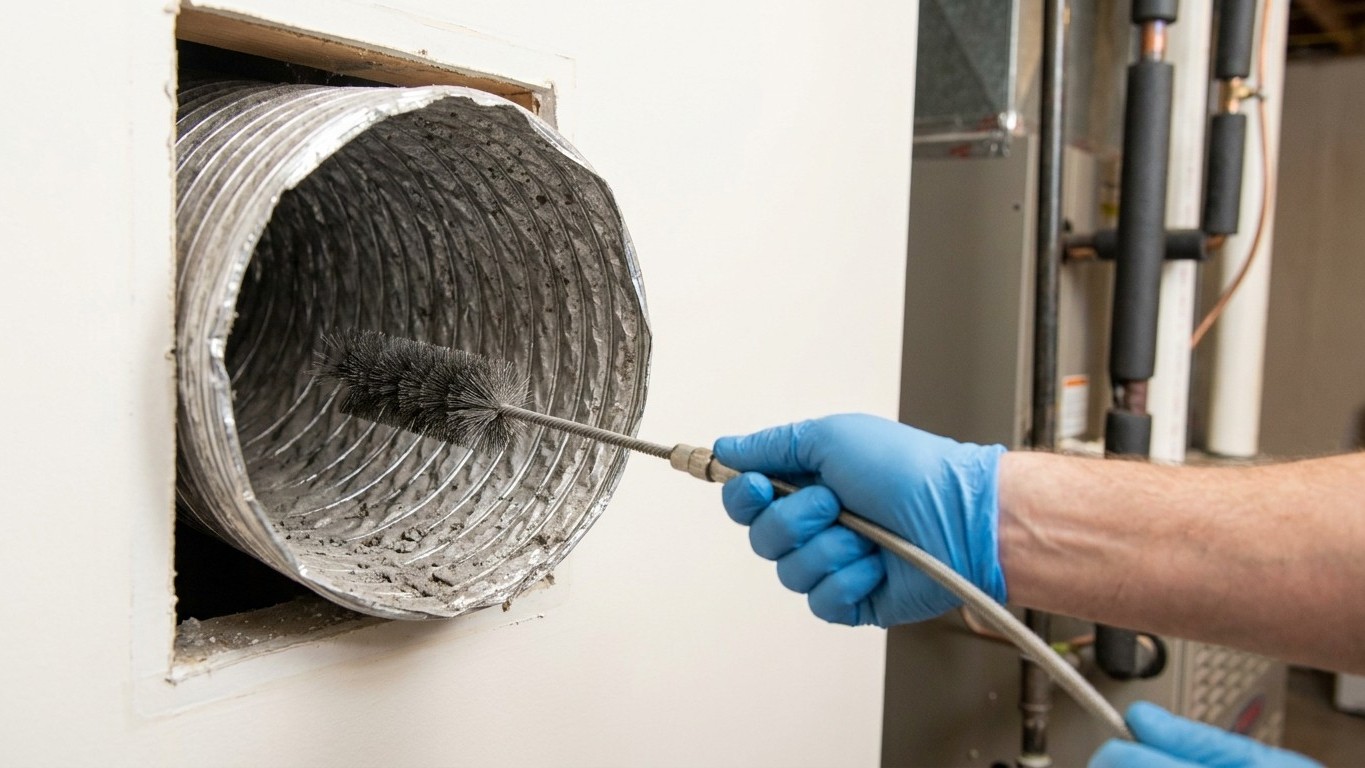

Duct cleaning is worth it in a handful of specific situations, not as routine upkeep. That’s the position the federal government has held since it first studied the question, and it applies only to forced-air systems, the ones with a furnace or air handler pushing air through metal or flex ductwork. Radiators, hot-water baseboard, and mini-splits don’t have ducts, so this whole conversation doesn’t apply to them. For everyone else, the answer depends less on opinion and more on what’s actually inside the ductwork right now.
There is a published position, and it is careful
The U.S. Environmental Protection Agency put its findings in writing back in October 1997, in a document numbered EPA 402-K-97-002, and the wording has held up because it was deliberately cautious rather than sweeping. The most quoted line from that document reads: “Duct cleaning has never been shown to actually prevent health problems.” No study, at the time or since, has connected a cleaned duct system to fewer allergy flare-ups, fewer respiratory complaints, or measurably cleaner indoor air for the average household.
That sentence gets repeated a lot, usually to argue that duct cleaning is a waste of money across the board. But the same 1997 document also states the opposite risk doesn’t hold up either: provided the work is done properly, no evidence suggests that duct cleaning is detrimental. A page that quotes only the skeptical half of that finding is doing exactly what the EPA warned readers to watch for in the industry itself, presenting a partial picture as if it were the whole one.
Put those two findings together and the EPA’s actual guidance becomes: “EPA does not recommend that air ducts be cleaned except on an as-needed basis because of the continuing uncertainty about the benefits of duct cleaning under most circumstances.” That’s a narrower statement than “don’t bother” and a narrower statement than “do it every few years.” It hinges entirely on the phrase “as-needed,” which sounds vague until you see what the same document means by it.
That phrase isn’t a dodge. The EPA names three specific triggers, and knowing them turns a fuzzy recommendation into a checklist you can run through in your own basement or attic in about ten minutes.
The three conditions that do justify it
The 1997 guidance ties “as-needed” to three concrete situations, not to a calendar interval. If none of the three apply to your system, the EPA’s own position is that cleaning wouldn’t be expected to change much. If one does apply, cleaning stops being optional and becomes a fix for a real problem.
| Condition | How to check it yourself |
|---|---|
| Substantial visible mold growth inside hard-surface ducts or on other parts of the heating and cooling system | Remove a supply or return register, shine a flashlight a couple feet into the duct, and take a phone photo. Look for fuzzy or discolored patches, not just dust film. |
| Ducts infested with vermin (rodents or insects living inside the system) | Look for droppings, nesting material, or shredded insulation near registers, in the plenum, or where ducts run through the attic or crawlspace. |
| Ducts clogged with excessive dust and debris, or particles actually blowing into the home from the supply registers | Turn the system on, hold a dark cloth or paper towel a few inches from a supply register for a minute, and check what settles on it. |
The mold column deserves a second look before anyone calls a contractor. Most of a duct system is hidden behind drywall, above ceilings, or buried in insulation, so a technician who tells you there’s mold in there is making a claim you generally can’t verify without their equipment. It’s reasonable, and normal, to ask them to show you on camera before agreeing to any work. It’s also worth remembering that plenty of things that look like mold from a flashlight and ten feet away, mineral staining, old adhesive residue, dust caked with condensation, are not actually mold at all.
The other detail that gets skipped in duct cleaning pitches: cleaning removes what’s already there, but it does nothing about what put it there. A moisture problem that grew mold once will grow it again unless the moisture source gets fixed. A gap in the ductwork that let rodents in will let the next batch in too. Cleaning treats the symptom, not the cause, so any conversation about cleaning should include a second conversation about why the condition happened in the first place.
A dusty register is not a contaminated duct
Here’s the mix-up that drives a lot of unnecessary spending: a dusty-looking return register gets read as proof the whole duct system is dirty. It usually isn’t. Return grates are where the system pulls air from the house, and household air carries dust, pet hair, and fabric fibers. That dust naturally collects on the grate itself because it’s the first surface the air passes through. A dusty register is normal wear, not a diagnosis, and it’s fixed with a vacuum attachment or by pulling the grate and washing it in the sink, not with a full-system cleaning contract.
The efficiency argument is the other pitch worth examining closely, because it mixes two different parts of the system. The EPA’s language on this is precise: “Some research also suggests that cleaning dirty cooling coils, fans and heat exchangers can improve the efficiency of heating and cooling systems. However, little evidence exists to indicate that simply cleaning the duct system will increase your system’s efficiency.” The efficiency gains that research supports come from cleaning the equipment, the coils, blower fan, and heat exchanger inside the furnace or air handler cabinet. That’s a different job than duct cleaning, and it’s one worth separating out when you’re getting quotes, since some technicians bundle the two under one label.
The maintenance step that actually keeps dirt out of both the ducts and the equipment is the least glamorous one: the filter. ENERGY STAR’s guidance is specific and easy to follow: “Inspect, clean, or change air filters once a month in your central air conditioner, furnace, and/or heat pump.” Once a month, across all three types of equipment, not once a season. A filter that’s overdue lets more dust past it and into the ductwork and coils, which is a big part of what eventually creates the buildup a cleaning company gets called out to remove.
If someone is selling you the work
Duct cleaning is one of the more heavily marketed home services, and it’s also one where the EPA has been unusually blunt about how to spot a weak sales pitch. On health claims specifically, the guidance says: “Do not hire duct cleaners who make sweeping claims about the health benefits of duct cleaning, such claims are unsubstantiated.” Any pitch built around asthma, allergies, or general “clean air for your family” language, without pointing to one of the three conditions above, is leaning on a claim the agency itself says isn’t backed by evidence.
The other line matters because of a phrase homeowners hear constantly and usually take at face value: “EPA neither establishes duct cleaning standards nor certifies, endorses, or approves duct cleaning companies.” There’s no such thing as an “EPA-certified” duct cleaner. If that phrase comes up in a sales call, it’s worth asking exactly what certification they mean, because it isn’t coming from the federal government.
A short list to run through before signing anything:
- Ask them to show you the mold, debris, or vermin evidence that justifies the job, ideally with a camera or borescope, not just a verbal claim.
- Ask whether the quote covers the whole system, coils, fans, and heat exchanger, or only the ductwork itself, since those are different jobs with different expected results.
- Ask what will be done about the underlying cause, whether that’s a moisture source, a sealing gap, or an access point for pests, not just the visible deposit.
- Get more than one estimate in writing before agreeing to anything.
No price range is worth repeating here. The 1997 EPA document does print one, but it’s stated in 1997 dollars, and a number that old would mislead more than it would help. A written estimate from a local provider, compared against at least one other, is what actually settles the cost question today.
Common questions
Does duct cleaning help with allergies?
The EPA’s own research found no evidence that duct cleaning prevents health problems, including allergy symptoms, in typical homes. It may make sense if visible mold or heavy debris is confirmed inside the ducts, but as a general allergy remedy it isn’t supported by the data the agency reviewed.
How often should ducts be cleaned?
There’s no recommended interval. The EPA’s guidance is “as-needed,” tied to one of three conditions: visible mold, vermin infestation, or heavy dust and debris actually blowing into the home. A system with none of those issues doesn’t have a clock running on it.
Can I clean my own ducts?
Registers and the first foot or two of visible ductwork are fair game for a vacuum and a damp cloth. Anything deeper, especially near the furnace, coils, or in sealed sections, calls for a professional with the right equipment, partly because improperly done cleaning can loosen debris or damage flex duct rather than remove it.
Does a new HVAC system need duct cleaning first?
Not automatically. New equipment doesn’t retroactively make old ductwork dirty. It’s worth inspecting the existing ducts for the same three conditions, mold, vermin, or heavy debris, before assuming a swap in equipment requires a duct cleaning add-on.