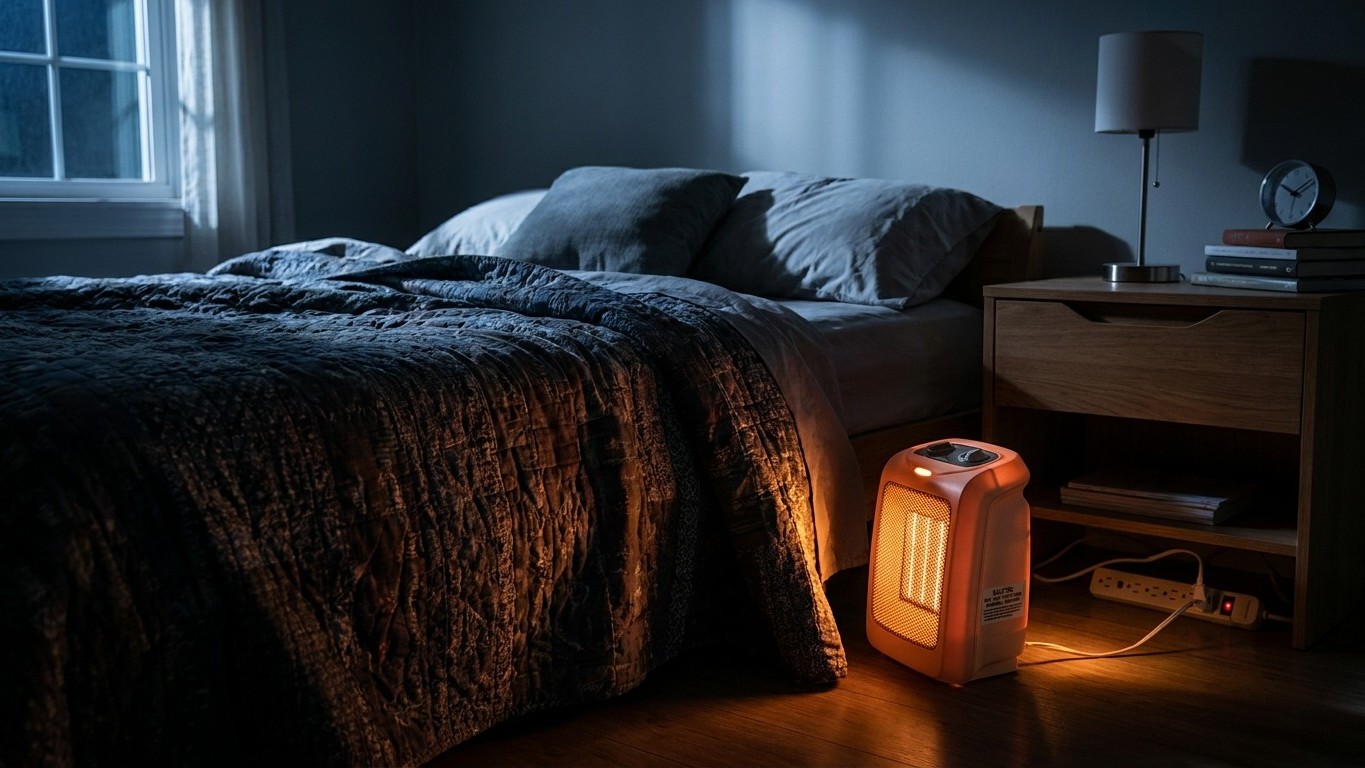

Space heater safety comes down to three habits: keep anything flammable at least three feet away, plug the unit straight into a wall outlet rather than an extension cord, and shut it off whenever you leave the room or go to sleep. Fire investigators keep circling back to the same handful of failure points, and the data below explains why those three habits carry so much weight.
Rare among fires, common among deaths
Here’s the contrast that should reframe how you think about that little heater in the corner. The U.S. Fire Administration’s 2017-2019 report on portable heater fires found that these units account for roughly 3% of home heating fires, but around 41% of the fatal ones. Read that twice. A portable heater almost never starts the fire. When it does, the odds that someone dies in it jump dramatically compared to fires started by furnaces, fireplaces, or central heating systems.
The same report put a yearly average on the damage: an estimated 1,100 fires, 65 deaths, 150 injuries, and $51 million in property loss tied to portable heaters in residential buildings. Sixty-five deaths a year from an appliance that starts only 3% of heating fires is not a small number when you consider how few heating fires it actually causes. Something about the way these fires unfold is different from a chimney fire or a furnace malfunction.
Part of the explanation is location. A furnace fire usually starts in a basement or utility closet, spaces people don’t sleep in and can often detect early. A portable heater, by contrast, sits in a bedroom, a home office, a garage workshop, or a living room, running for hours in a space someone occupies, often overnight. When ignition happens, it happens close to the person, close to bedding, close to whatever they were using the heater to warm.
Timing matters too. Furnace fires tend to happen during the day, when a household is awake and mobile. Portable heater fires cluster around evening and overnight hours, precisely when a slow-burning fire has the most time to grow before anyone notices. A fire that ignites at 2 a.m. next to a bed gives smoke and heat a head start that a daytime fire in an unoccupied basement never gets.
None of this means a space heater is a dangerous appliance to own. Tens of millions of them run every winter without incident. But the 3%-versus-41% split is the single fact worth carrying into every other decision about where you place one, what’s near it, and whether you leave it running when you’re not in the room. Rare causes with disproportionate death tolls are exactly the kind of risk that responds to a few consistent habits rather than luck.
The three-foot rule, and what it applies to
The U.S. Fire Administration states it plainly: “Keep anything that can burn at least 3 feet from all heat sources including fireplaces, wood stoves, radiators, space heaters or candles.” Notice what’s doing the work in that sentence. It isn’t really about the heater. It’s about everything else in the room that can catch fire, and it groups space heaters with fireplaces, wood stoves, and radiators, four very different heat sources treated the same way because the mechanism of ignition is identical: something flammable gets too close, too long, to something hot.
That framing matters because it’s easy to think a modern electric heater with a cool-touch housing is exempt from this kind of caution. It isn’t. The exterior housing may not scorch a hand, but the heating element or the airflow directly in front of the unit reaches temperatures well above the ignition point of ordinary household materials. A curtain that brushes against a heater on a breeze from an HVAC vent doesn’t need direct contact for long, sustained heat exposure to matter.
What actually sits inside that three-foot circle
Walk around a room with a heater running and look at hip height and below, since that’s where most portable units sit. Common culprits include:
- Bedding, comforters, or a dangling blanket edge near a nightstand heater
- Curtains or drapes that move with airflow from the heater’s fan
- Upholstered furniture, especially recliners positioned close for warmth
- Laundry set out to dry on a rack or draped over a chair
- Stacks of paper, mail, or cardboard boxes in a home office or garage
- Rug edges or bath mats that can curl toward the heat source
The three-foot radius isn’t an arbitrary number pulled from a safety pamphlet. It’s a practical buffer that accounts for how heat radiates and how airflow from a fan-forced heater can push warm air further than the unit’s housing suggests. Measuring it out loud in a room, three long steps from the heater in every direction, takes about ten seconds and is worth doing before the heater runs unattended for the first time in a new spot.
Where it plugs in
Most portable resistive heaters draw close to the full capacity of a standard 15-amp household circuit when running on their highest setting. That single fact explains most of the wiring advice you’ll see attached to these appliances, and it’s worth understanding the reasoning rather than just following a rule handed down without context.
Electricity moving through any conductor generates some heat as a byproduct of resistance. A well-built appliance cord is sized to carry that load with a negligible temperature rise. An extension cord, especially a long one or one built with thinner gauge wire meant for lamps and small electronics, adds resistance the heater’s own cord was never designed to push current through. That extra resistance doesn’t disappear. It shows up as heat, and it tends to concentrate at connection points: the plug where the cord meets the outlet, the coupling where an extension cord joins another cord, or a power strip’s internal contacts.
This is why power strips and multi-outlet adapters are a particularly poor match for space heaters, even when the strip is rated for a high wattage on paper. A power strip built for a lamp, a phone charger, and a router splits its rated capacity across several plugs used lightly and intermittently. A space heater asks for sustained, near-continuous draw on its own, and sharing that circuit with other appliances, a hair dryer, a window AC unit, a toaster, pushes the total load toward or past what the circuit and its connections were built to handle over time.
A longer treatment of what makes an extension cord safe or unsafe for a heater, including cord gauge and the difference between indoor and outdoor rated cords, is covered in this site’s guide to extension cords and space heaters. The short version worth remembering here: plug the heater directly into a wall outlet whenever possible, avoid running it through anything else, and if a breaker trips repeatedly, an outlet feels warm to the touch, or a room seems to be on an overloaded circuit already, that’s a signal to call an electrician rather than to reach for a heavier-duty extension cord as a workaround.
Leaving the room, and going to bed
The U.S. Fire Administration’s guidance here is short and easy to skim past: “Turn space heaters off when leaving the room or going to bed.” Both halves matter equally. Leaving the room means the heater keeps running unsupervised even if you’re only gone for twenty minutes to start dinner. Going to bed means it keeps running through the hours when the 2017-2019 data shows fatal fires cluster, overnight, when a household is least able to detect and respond to a problem early.
This single behavior, more than any feature built into the heater itself, is what separates the households in that 3% of fires from the households represented in the 41% of deaths. A heater that’s off can’t ignite anything. A heater left running next to a bed, in a room nobody’s watching, has hours to interact with whatever eventually drifts too close to it, a blanket that slides off during sleep, a pet that knocks over a nearby object, a curtain caught by a draft.
What safety features do, and don’t do
Newer heaters commonly include a tip-over switch, which cuts power the moment the unit is knocked or tilted past a certain angle, and an overheat cutout, which shuts the heater down if internal temperatures climb beyond a safe threshold, often because airflow is blocked or the unit has been running for an extended period. Both are genuinely useful engineering responses to real failure modes, and neither should be dismissed.
But it’s worth being precise about what they actually prevent. A tip-over switch stops the heater from running while lying on its side against a rug or curtain. It does nothing to prevent a fire from bedding placed too close while the heater sits upright as intended. An overheat cutout protects against internal component failure. It doesn’t sense that a blanket has draped over the front grille, restricting airflow just enough to raise surface temperatures without triggering the internal cutoff. These features reduce certain risks. They don’t substitute for turning the unit off before you’re no longer there to watch it.
Common questions
Is it safe to run a space heater overnight while sleeping?
The U.S. Fire Administration’s guidance is to turn heaters off when going to bed, not to run them through the night. Overnight hours are also when the 2017-2019 fire data shows fatal incidents cluster most heavily, which is a strong reason to treat that recommendation as more than boilerplate advice.
Do newer heaters with tip-over switches remove the need for the three-foot rule?
No. A tip-over switch responds to the heater being knocked over, not to flammable material sitting too close while the unit runs upright as designed. The three-foot clearance addresses a separate failure mode that safety switches don’t cover.
Can I use a power strip if it’s rated for a high wattage?
A power strip’s wattage rating is generally intended for several lighter, intermittent loads, not one sustained near-continuous draw from a heater. Plugging directly into a wall outlet avoids the added resistance and heat buildup that can occur at power strip connection points.
Why does the U.S. Fire Administration also mention never using an oven to heat a home?
It’s part of the same broader guidance on safe heating practices, alongside annual professional inspection of heating equipment and chimneys. An oven isn’t designed for sustained space heating and lacks the safety features, ventilation, and shutoff mechanisms built into equipment meant for that purpose.