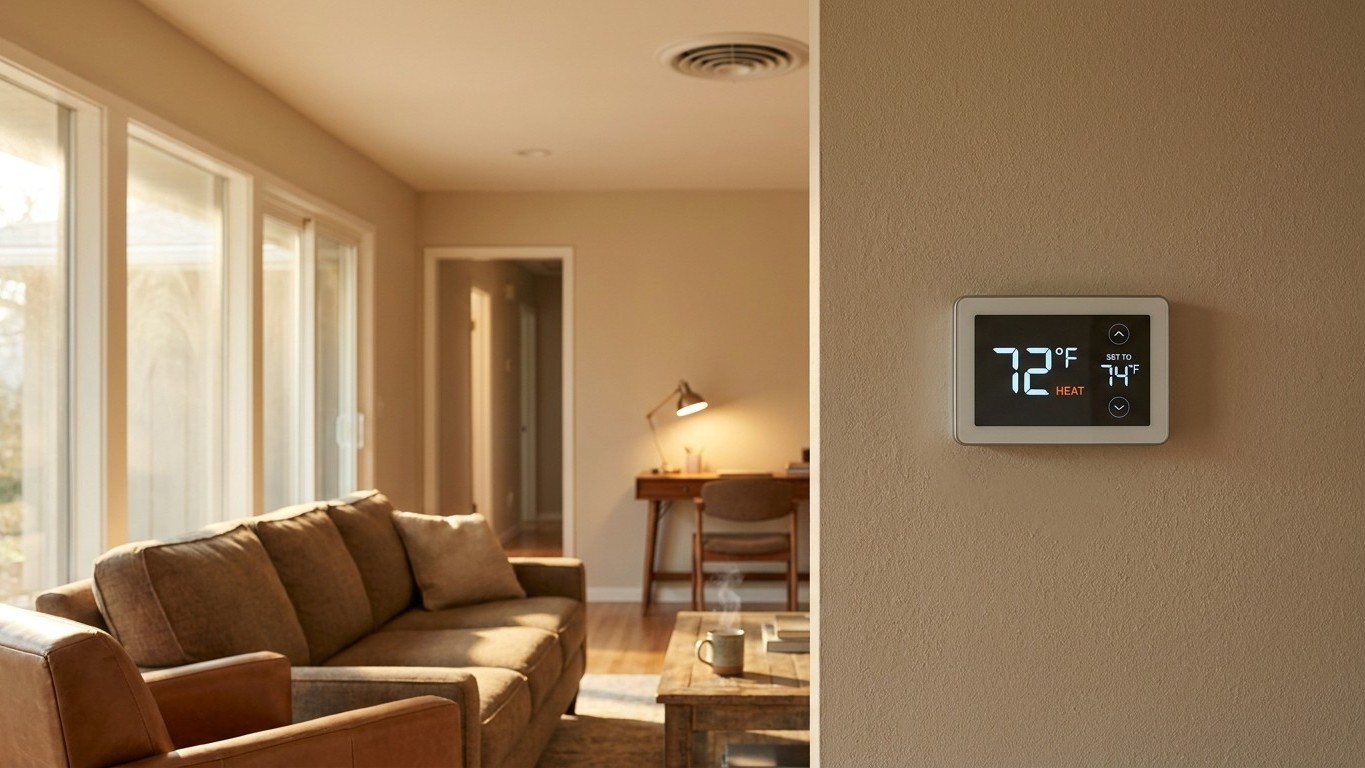

The best spot for a Thermostat is an interior wall, at roughly chest height, in a room the household actually spends time in, away from windows, vents, lamps, and doorways. That single decision affects every room’s comfort more than the model of Thermostat you buy. But “interior wall” only gets you started. What actually happens on that wall, hour by hour, is where the placement either works or quietly sabotages the whole system.
It controls the house from one point
A thermostat doesn’t measure your house. It measures a few cubic inches of air around one sensor, on one wall, in one room. Every other room gets whatever temperature that sensor decides is correct, whether or not it matches what’s actually happening down the hall or upstairs.
That’s the whole problem with placement, and it’s why there’s rarely a perfect answer, only a least-bad one. A living room with a big window facing south behaves nothing like a bedroom on the north side of the house. A finished basement holds heat differently than a bonus room over a garage. The thermostat can’t know any of that. It just reacts to the air touching its sensor and tells the furnace or the AC to run or stop based on that one reading.
This is why two houses with identical equipment and identical settings can feel completely different to live in. One has a thermostat mounted where the air genuinely represents the living space. The other has one stuck in a spot that runs a few degrees warmer or cooler than the rooms people actually use, and the whole system spends its life compensating for a lie it doesn’t know it’s being told.
The goal of placement, then, isn’t finding a magic wall. It’s finding the spot whose temperature swings track the occupied rooms as closely as possible, so the thermostat’s one data point is a reasonably honest stand-in for the rest of the house. Everything else, including where a homeowner should never put one, follows from that single idea.
The places that guarantee trouble
Some locations don’t just make placement slightly worse. They actively feed the thermostat false information in a consistent, predictable direction. Knowing which way each mistake leans is more useful than a generic warning, because it explains the symptom a homeowner is actually seeing, like a house that never quite gets warm or a system that seems to run in short, frustrated bursts.
Reading the errors correctly
| Location | What the sensor reads | Resulting problem |
|---|---|---|
| Exterior wall | Colder than the room in winter, hotter in summer | Overheats or overcools the house trying to correct for a reading that isn’t representative |
| Direct sunlight | Artificially warm, sometimes by a wide margin | System underheats the rest of the house because the thermostat thinks the job is already done |
| Above a radiator or supply vent | Warms up almost instantly whenever heat runs | Short cycling: the furnace shuts off before the rest of the room has actually warmed |
| Kitchen | Warm reading from cooking, appliances, and the oven | Rest of the house runs cold while the thermostat thinks it’s satisfied |
| Hallway by the front door | Cold drafts every time the door opens | Furnace overcompensates, overheating rooms away from the entry |
| Unheated stairwell | Reads the temperature of a transitional space, not a living space | Chronic mismatch between what the thermostat sees and what people feel in the rooms they use |
| Behind a door that’s usually open | Blocked airflow, delayed and muted readings | Sluggish response; the system reacts to yesterday’s temperature, not today’s |
Notice the pattern. Every one of these spots pushes the thermostat’s reading in one direction, and the house gets pushed the opposite way to compensate. A sun-drenched thermostat makes the rest of the home cold. A drafty one makes the rest of the home too warm. None of these locations are subtle mistakes; they’re the ones inspectors and HVAC technicians flag first when a homeowner complains about uneven temperatures room to room.
If an existing thermostat sits in one of these spots and moving it isn’t practical, that’s exactly the situation a remote sensor was built to solve, which is covered further down.
What a good spot looks like
Flip the bad list around and a workable answer emerges. An interior wall, not touching the outside, avoids the temperature swings that come with weather and sun exposure. A room the household actually occupies, meaning a living room, a family room, a main hallway that isn’t next to the front door, gives the thermostat air that resembles daily life rather than an edge case like a laundry room or a mudroom.
Chest height comes up constantly in HVAC guidance, and it’s not an arbitrary number. Warm air rises and cool air sinks, so a room stratifies into layers: cooler near the floor, warmer near the ceiling, and a middle band that roughly matches what a person standing or sitting actually feels. A thermostat mounted too low reads the cool layer and can overheat a room trying to chase a temperature nobody at head height is experiencing. One mounted too high does the reverse, catching warm air that’s already risen out of reach and telling the system to back off too soon. Chest height puts the sensor in the same air people are breathing, which is the entire point of measuring temperature in the first place.
Free air movement matters as much as the wall itself
A thermostat needs air to actually reach it. Furniture pushed up against the wall, curtains that fall across it, or a shelf mounted just above it can all trap a pocket of still air that doesn’t reflect the room. The same goes for placement near a supply register: even a foot or two of separation can be enough for a blast of conditioned air to hit the sensor directly and shut the system off early, the same short-cycling problem an above-vent location causes.
None of this happens in a vacuum, though. Existing wiring is often the deciding factor, since running new low-voltage cable through finished walls is a real cost and a real hassle. The realistic choice most homeowners face isn’t “perfect wall versus flawed wall.” It’s choosing between two or three imperfect walls that already have a cable behind them, and picking the one that breaks the fewest rules above. An interior wall with slightly awkward furniture nearby still beats an exterior wall with a clear line of sight.
When the answer is a second sensor
Sometimes there’s no wall in the house that solves the problem, because the room that actually matters isn’t anywhere near where the thermostat lives. A bedroom at the far end of a long hallway, a bonus room over an unheated garage, a finished basement two floors below the thermostat’s wall: these rooms can run several degrees off from whatever the main thermostat reads, and no amount of clever placement on the original wall fixes that, because the thermostat simply isn’t in that room.
This is where remote sensors have become the practical workaround rather than tearing into walls or rerouting wiring. A remote sensor is a separate temperature sensor placed in the room that actually needs attention, communicating back to the main thermostat. Instead of relying on one wall’s reading, the system can factor in a second location entirely, so a bedroom that’s chronically too warm or too cold at night finally gets represented in the decision instead of being ignored.
How the averaging actually behaves
Most systems that support multiple sensors let a homeowner choose how they’re weighted: temperature can be based on one sensor at certain times of day, blended as an average across two or more sensors, or prioritized toward whichever room the household cares about most in that moment. An average doesn’t mean the system splits the difference and calls it good; it means the far bedroom’s reading now genuinely pulls the furnace’s decision toward that room’s actual condition, rather than the furnace running blind based only on the hallway wall.
It’s worth being honest about the limits here. A remote sensor doesn’t insulate an addition better, it doesn’t fix a duct that’s undersized for a bonus room, and it doesn’t warm up a room faster than the equipment physically can. What it does is stop the thermostat from being confidently wrong about a room it was never actually measuring. A genuinely underheated space, one with a real airflow or insulation problem, still needs that problem solved at the source; a sensor just makes sure the thermostat knows the problem exists instead of declaring the house comfortable because one hallway wall happens to feel fine.
Common questions
Can a thermostat go on any interior wall in the house?
Not quite. It should still avoid direct sun through a nearby window, drafts from an adjacent exterior door, and any spot near a supply vent, radiator, or appliance that runs its own heat. An interior wall is the starting filter, not the whole answer.
Does thermostat height really matter that much?
Yes, because warm and cool air separate into layers in a room. A thermostat mounted too close to the floor or ceiling reads air that doesn’t match what a person standing in the room actually feels, which can cause the system to overshoot or undershoot the comfort level people notice.
Is it worth moving an old thermostat to a better wall?
Sometimes, but always shut off power at the breaker before opening anything, and take a photo of how the wires connect to the old terminals before disconnecting them. If the existing wiring doesn’t reach the ideal wall, a remote sensor is often a simpler fix than running new low-voltage cable through a finished wall.
What if the whole house has only one thermostat and multiple problem rooms?
This is exactly the situation multi-sensor systems were built for. Rather than trying to find one wall that represents an entire multi-story house, additional sensors let the system weigh readings from several rooms at once, instead of leaving distant rooms to run however hot or cold the ductwork happens to leave them.