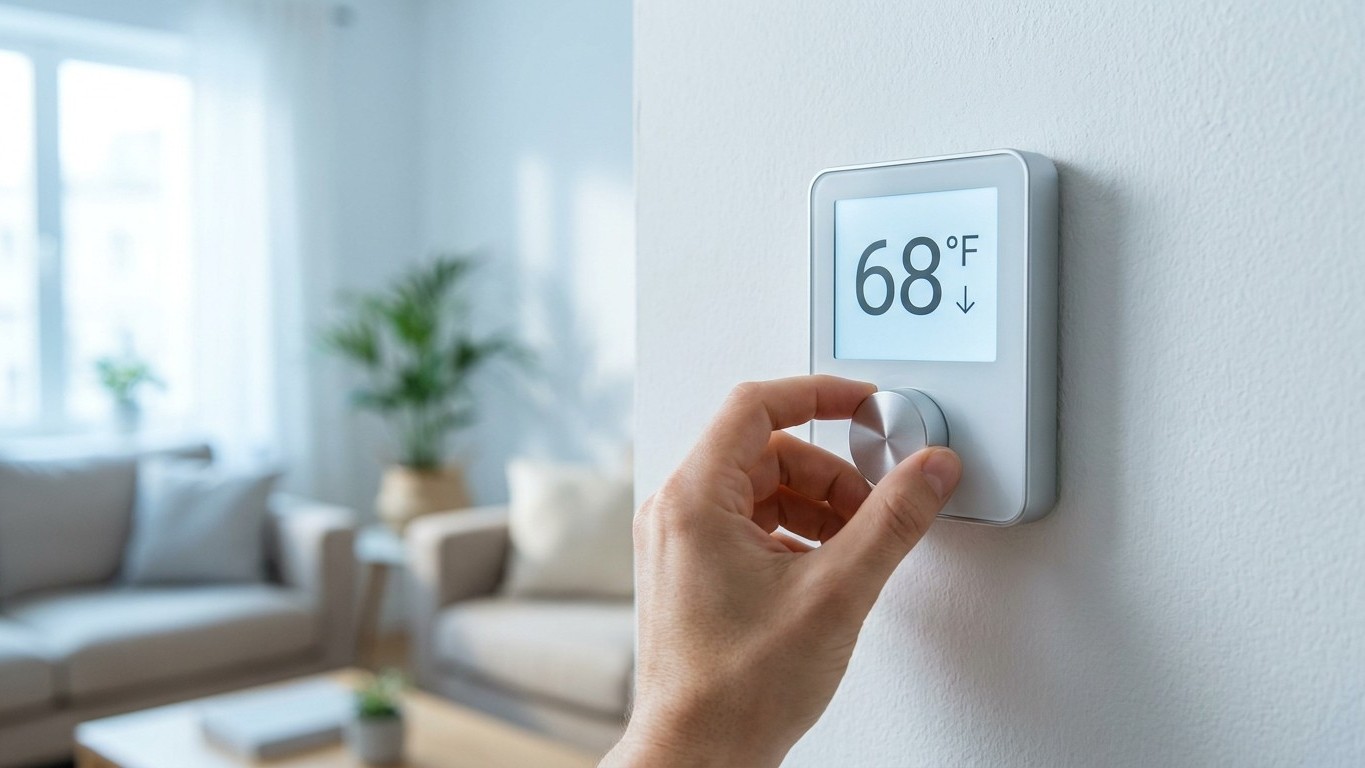

Yes, turning the thermostat down saves money, and the savings are real enough that the Department of Energy puts a number on them. But the number is smaller and more specific than most people assume, and it applies to average homes with average systems. Some houses actually cost more to run this way. The difference between the two comes down to what’s heating your home and how quickly it responds when you ask more of it.
The claim that it costs more to reheat
Someone in your life has probably said it with total confidence: leave the heat where you want it, because letting the house cool down just means the furnace has to work harder later to catch up, wiping out anything you saved. It sounds reasonable. It’s also the single most repeated piece of thermostat advice in America, passed down from parents, landlords, and that one uncle who used to work in HVAC. The claim deserves a fair hearing before it gets knocked down, because it isn’t stupid. It’s just wrong about how heat actually moves.
A house loses heat at a rate that depends on the difference between the indoor and outdoor temperature. That’s the whole mechanism. A house held at 70 F when it’s 30 F outside is losing heat faster, every single hour, than a house allowed to drift down to 62 F during that same stretch. When you bring that cooler house back up to 70 F, you’re paying to replace exactly the heat it lost while it sat cool, not some inflated penalty on top of it.
Here’s where the confusion creeps in. Recovery does involve the furnace or heat pump running hard, often at full output, for a stretch of time. That looks and sounds like the system is working overtime. It is. But running hard for a shorter burst doesn’t automatically cost more than running gently for hours on end. Total energy used is close to what physics predicts: a house that spent fewer hours at a lower temperature difference did less overall work, even if some of that work got compressed into a busier window at the end.
Where the folk wisdom picks up a grain of truth is in what happens during that recovery period, which systems handle it well and which ones don’t. That’s a real distinction, and it’s the subject worth understanding before you decide how far to push your own thermostat back.
What the measured figure actually says
The Department of Energy states it this way: “You can save as much as 10% a year on heating and cooling by simply turning your thermostat back 7-10 F for 8 hours a day from its normal setting.” That sentence gets repeated online, but almost always with pieces missing, and the missing pieces change what it means for your own bill.
Start with what it isn’t. It is not 10% per degree of setback, and treating it that way is one of the most common errors floating around. Setting your thermostat back 1 F does not save 1%, and setting it back 20 F does not save 20%. The 10% figure attaches to a specific setback range, 7 to 10 degrees, held for a specific duration, 8 hours a day. Push past that range and the savings don’t scale up in a straight line; they level off, partly because of the recovery dynamics covered in the next section.
What “a year” and “heating and cooling” actually cover
The figure is annual, not a one-night estimate. It reflects the cumulative effect of doing this setback consistently, day after day, across a heating season, or a cooling season when the same logic applies in reverse with air conditioning. A single skipped night of setback won’t show up on your bill in any way you could measure. The habit is what produces the number.
It also covers heating and cooling together, as one combined savings estimate, not two separate 10% figures that stack. If your climate leans heavily toward one or the other, your real-world result will lean that way too, and the 10% is best read as a ballpark for a typical mixed climate rather than a guarantee for any specific address.
To see what fraction of your bill this touches at all, ENERGY STAR offers the scale: “For the average American household, almost half of the annual energy bill goes to heating and cooling – that’s more than $900 a year.” That’s an average across American households, not a prediction of your own utility bill, but it does frame the size of the pie that a thermostat setback is taking a slice out of.
The houses where the belief is true
The reheating myth didn’t come from nowhere. In a handful of common setups, running through a deep setback really can cost more than holding steady, and it’s worth knowing whether your home is one of them before you commit to an aggressive schedule.
| System | What happens on recovery | What to do instead |
|---|---|---|
| Heat pump with electric backup | A large setback triggers backup resistance heat strips to catch up fast, and that backup heat is far more expensive per unit than the heat pump’s normal compressor operation | Use a smaller setback, or a heat pump thermostat mode designed to avoid triggering backup heat during recovery |
| Steam or hot-water (radiator) heat | The system’s mass, cast iron radiators, water in pipes, takes a long time to heat up, so a deep setback can leave the house cold for hours during recovery | Use a shallower setback and start the recovery cycle earlier, giving the slow-responding system more lead time |
| Poorly insulated or leaky house | The house loses heat so quickly that it effectively arrives at “setback temperature” within minutes of the thermostat change, meaning almost no time is actually spent saving before recovery has to start | Address insulation and air sealing first; a setback schedule works better once the house holds temperature longer |
Notice the pattern. In every one of these cases, the problem isn’t that setbacks are a bad idea in principle. It’s that a specific piece of equipment or a specific building envelope turns the recovery period into an expensive event, either by switching to a costlier heat source or by giving the system so little runway that the setback barely happens before it’s over. Homeowners who’ve lived through one of these situations, watching the backup heat strips kick on with an audible click, or waiting an hour for a cast-iron radiator to feel warm again, generalize the experience to “setbacks don’t work,” when the more accurate lesson is “this setback, on this system, doesn’t work.”
A smart or learning thermostat can help here, since many are built to recognize a heat pump’s recovery behavior and ramp up gradually instead of triggering backup heat. If your system falls into one of these categories, that’s a more useful next step than abandoning setbacks entirely.
How far back, and for how long
Once you know what kind of system you’re working with, the question becomes practical: what setback actually fits your house. There’s no universal number here, and any source that hands you a specific temperature as a rule is guessing. What works is testing your own house, in order.
- Start shallow. A 4 to 5 degree setback is a reasonable first test, small enough to avoid triggering backup heat or long recovery periods on most systems.
- Hold that setback for the actual hours the house is empty or everyone is asleep, not an arbitrary block of time that doesn’t match your schedule.
- Time the recovery. Note how long it takes the house to climb back to a comfortable temperature once the setback period ends and the thermostat calls for the higher setting.
- Deepen the setback only if that recovery time fits comfortably inside the window you actually have before someone needs the house warm again. If recovery eats into your morning or your evening, it’s too deep.
- Stop increasing the setback at the point where the house is still cold when people walk in the door. That’s the ceiling for your specific home, and pushing past it trades comfort for savings you likely won’t feel anyway once backup heat or slow recovery enters the picture.
This sequence matters more than any single number, because it lets the house tell you its own limits instead of borrowing a figure that was never calculated for your insulation, your climate, or your equipment.
Common questions
Does turning the thermostat down at night save more than turning it down during the day?
The savings depend on how many hours the setback runs and how large the indoor-outdoor temperature difference is during those hours, not specifically on whether it’s day or night. A nighttime setback tends to work well because it lines up with hours nobody needs the house at full temperature anyway.
Is there a point where turning the thermostat down stops saving money?
Practically, yes, once the setback is deep enough to trigger backup heat on a heat pump or force a long, energy-intensive recovery on a slow system like steam heat. At that point the recovery cost can offset or exceed what was saved during the setback period.
Does the same 10% savings apply to air conditioning in summer?
The Department of Energy’s figure covers heating and cooling together as a combined annual estimate, using a warmer setback while away in summer rather than a cooler one. It isn’t a separate 10% on top of the heating savings.
Do smart thermostats change how much a setback saves?
A smart thermostat doesn’t change the physics, but it can automate the setback schedule reliably and, on some heat pump systems, manage recovery in a way that avoids triggering expensive backup heat, which is where a lot of the real-world savings get lost or gained.