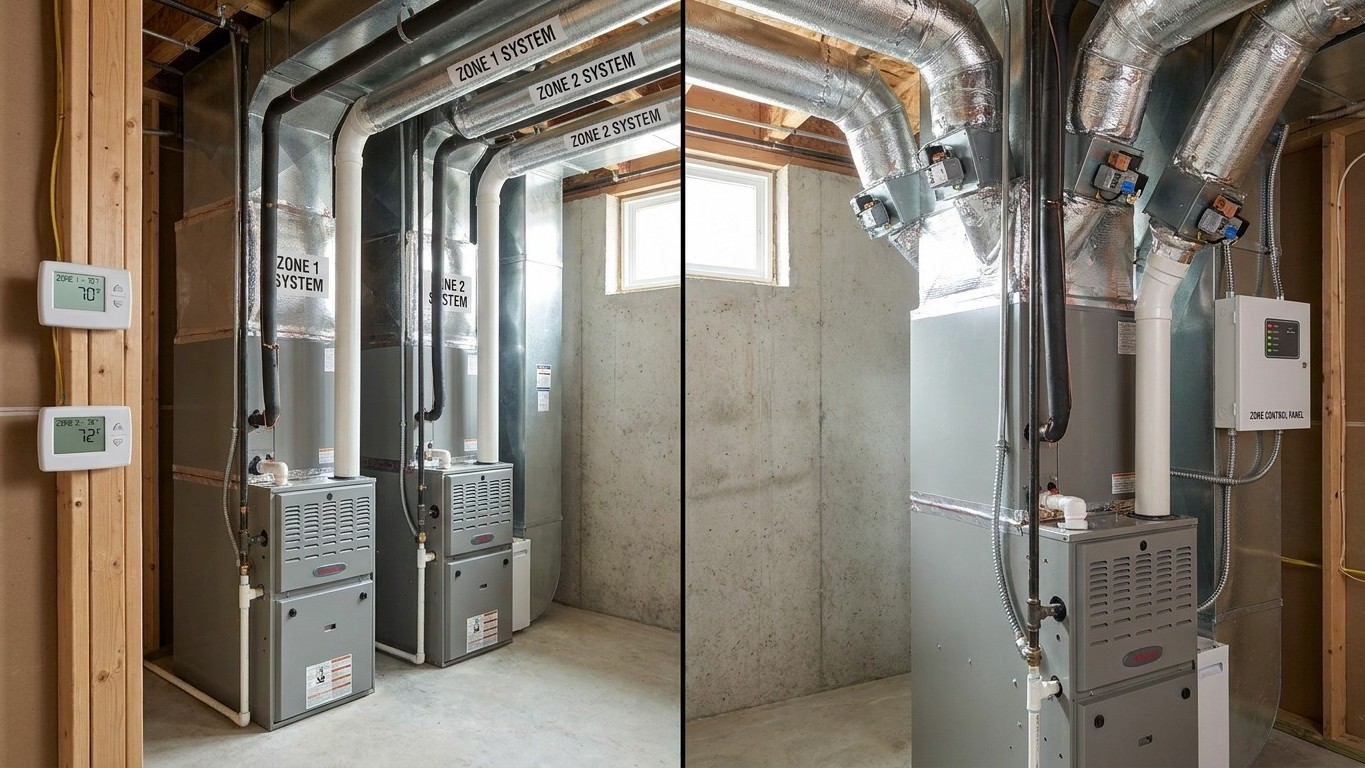

Two thermostats in one house means one of two very different setups: either you have two separate heating and cooling systems, each running its own equipment, or you have a single system split into zones by motorized dampers. That distinction decides whether the two thermostats can safely disagree, or whether they’re quietly competing for the same blower and the same compressor.
Why a house has two
The first thing to figure out is which situation you actually have, because the wall thermostat gives no clue. Two separate systems means two furnaces, two air handlers, or two heat pumps, each wired to its own thermostat and each feeding its own independent set of ducts. This is common in additions, in split-level homes, or in houses where a second floor was finished later and got its own small system rather than tying into the original ductwork. One system split into zones is different: there’s a single furnace or air handler, a single trunk duct, and inside that trunk, rectangular boxes with small motors, called dampers, that open and close to send air toward whichever zone is calling. A zone control panel, usually mounted near the equipment, reads both thermostats and tells the dampers what to do.
The tell isn’t on the wall, it’s in the basement or the attic. Walk down to where the equipment lives. If you see two separate furnaces or air handlers, each with its own supply and return ductwork that never merges, that’s two systems, and the two thermostats were always meant to run independently. If you see one furnace or one air handler with a single main trunk that splits into branches, and somewhere along those branches a box with wires labeled zone 1 and zone 2, that’s one system carved into zones. Look for the zone panel itself, a small metal box with several low-voltage wires running in, usually within a few feet of the furnace.
Why this matters before you touch a dial
Two separate systems can run at genuinely different temperatures all day without conflict, because each one has equipment sized and dedicated to its own space. A zoned system is a different animal. Both thermostats are ultimately asking one blower and one compressor to satisfy two demands, and that shared hardware is exactly where the friction starts. Knowing which setup you have changes how you should read every complaint that follows, from an upstairs that never cools to a system that seems to short cycle for no reason.
| Feature | Two separate systems | One system, multiple zones |
|---|---|---|
| Equipment | Two furnaces or air handlers | One furnace or air handler |
| Ductwork | Two independent sets, never joined | One trunk, split by dampers |
| Thermostats can disagree freely | Yes | Limited, equipment is shared |
| Where to check | Basement or attic, look for two units | One unit, plus a zone control panel |
Upstairs hot, downstairs cold
This is the complaint that sends most people looking for answers about two thermostats in the first place, and it usually shows up as a single-system house where one thermostat, downstairs, is trying to manage a floor it can’t reach. Warm air rises. In winter that means the upstairs runs warmer than the thermostat downstairs reads, so the furnace shuts off before the upper floor ever gets comfortable. In summer the same stack effect works against you differently: heat collects under the roof, the upstairs cooks, and the single downstairs thermostat, sitting in the coolest part of the house, calls it done long before the top floor catches up. A single thermostat on one floor is, in a two-story house without zoning, trying to solve two different thermal problems with one number, and it can’t.
Before assuming the house needs zoning, it’s worth working through cheaper fixes in order, because a lot of “needs two thermostats” problems are actually airflow problems in disguise.
- Balance the registers. Partially closing supply registers on the floor that runs too warm, and opening them fully on the floor that runs cold, can rebalance airflow without touching any equipment.
- Check the returns. A floor with too few return air openings fights the supply air constantly; adding or opening return grilles often does more than any register adjustment.
- Try the fan setting. Switching the thermostat’s fan from auto to on keeps air circulating between cycles, which can even out stubborn stratification between floors.
- Consider zoning only after the above. If registers are balanced, returns are open, and the fan runs continuously, and the split still doesn’t close, that’s when adding a second zone with its own thermostat starts to make sense.
One thing worth ruling out before any of this: a floor that never gets its fair share of conditioned air is often losing it somewhere along the way. As ENERGY STAR puts it, “In a typical house, however, about 20 to 30 percent of the air that moves through the duct system is lost due to leaks, holes, and poorly connected ducts.” If the upstairs branch runs through an unconditioned attic with disconnected joints, no amount of register balancing or thermostat tweaking will fully make up for air that’s escaping into the attic instead of reaching the room.
When the two fight each other
The stranger failure, and the one almost nobody explains, happens when one zone calls for heat while the other calls for cooling, or when a small zone satisfies its setpoint so fast that its damper slams nearly shut while the system is still running for the other zone. Most residential zoned systems have one compressor and one blower, and that hardware can only produce one mode at a time, either heat or cool, not both. When the two thermostats disagree on mode, the zone control panel has to make a call. Typically it gives priority to whichever thermostat asked first, runs that mode, and makes the other zone wait, sometimes locking it out for a set period before it gets another chance to call.
The short cycling problem is a separate mechanism but shows up alongside it. When one zone’s damper closes because that zone is satisfied, the air that would have gone there has to go somewhere, and in many systems a good chunk of the total airflow was still meant for that space. With the damper mostly shut, static pressure spikes, the blower is pushing against a smaller opening, and the system can trip a high-pressure or high-temperature safety and shut off, only to fire back up seconds later once pressure drops. That’s short cycling, and it wears on the equipment.
From the hallway, the symptoms are recognizable even without opening a single duct. A rattling or banging sound from inside the ductwork right after one zone’s thermostat clicks off. A faint hissing at registers in the zone that’s still calling, as air gets forced through a narrower path. A furnace or air handler that turns on and off in quick bursts rather than running a steady cycle. Any of these, especially paired with one zone that never quite reaches its setpoint while the other overshoots, points to a zone control panel struggling with conflicting calls rather than a broken thermostat.
Setting two thermostats sensibly
The most useful habit with two thermostats, in either setup, is setting the one for the space you’re actually using, not forcing both to match. In a two-system house, there’s no reason the upstairs and downstairs should read the same number, they’re different equipment serving different exposures, occupancy, and sun load. In a zoned system, let the two thermostats disagree too. A bonus room over the garage will always run a few degrees off from a shaded bedroom, and chasing an identical reading on both dials just means one zone is calling more often than it needs to.
Closing vents in an unused room to save money is one of the most common instincts here, and it usually doesn’t deliver what people expect. The furnace or air handler is producing roughly the same volume of conditioned air whether that room’s vent is open or shut, unless the equipment has a variable-speed blower that can genuinely scale back. Closing the vent doesn’t reduce that output, it raises pressure inside the ducts instead. That pressure has to go somewhere, and given that a typical duct system is already losing 20 to 30 percent of its air to leaks and poorly sealed joints, closing vents pushes more air out through exactly those gaps rather than delivering it to the rooms that need it. The practical result is a system working harder, sometimes running longer to satisfy the zones that are still open, for savings that rarely show up on the bill.
Anything beyond balancing registers and adjusting a thermostat schedule crosses into equipment work, and that’s the point to stop. Opening a zone control panel or a furnace cabinet means cutting power at the breaker first, and photographing wire terminals before disconnecting anything, since low-voltage zone wiring rarely comes labeled clearly enough to remember by the time you’re ready to put it back.
Common questions
Can I just set both thermostats to the same temperature?
You can, but in a zoned system it often causes more short cycling, not less, since both zones will call at nearly the same time and compete for the same blower and compressor. Letting each zone reflect its actual comfort need usually runs smoother.
Is it normal for one zone’s thermostat to read several degrees different from the other?
Yes, especially between floors or between rooms with different sun exposure. A few degrees of difference between zones is expected and isn’t a sign anything is broken.
Will adding a damper and a second thermostat fix an upstairs that’s always hot?
Often yes, but only after ruling out register balance, return airflow, and duct leaks first. Zoning a system that already has an airflow problem elsewhere just adds a second thermostat on top of the same underlying leak.
Why does my system seem to run constantly when both zones call at once?
That’s usually the zone control panel handling two active calls with equipment sized for one at a time. On smaller residential zoned systems, this pattern of extended runtime when both zones call together is close to how the equipment is expected to behave, though frequent short bursts instead of one steady run suggest a pressure or damper issue worth a technician’s look.