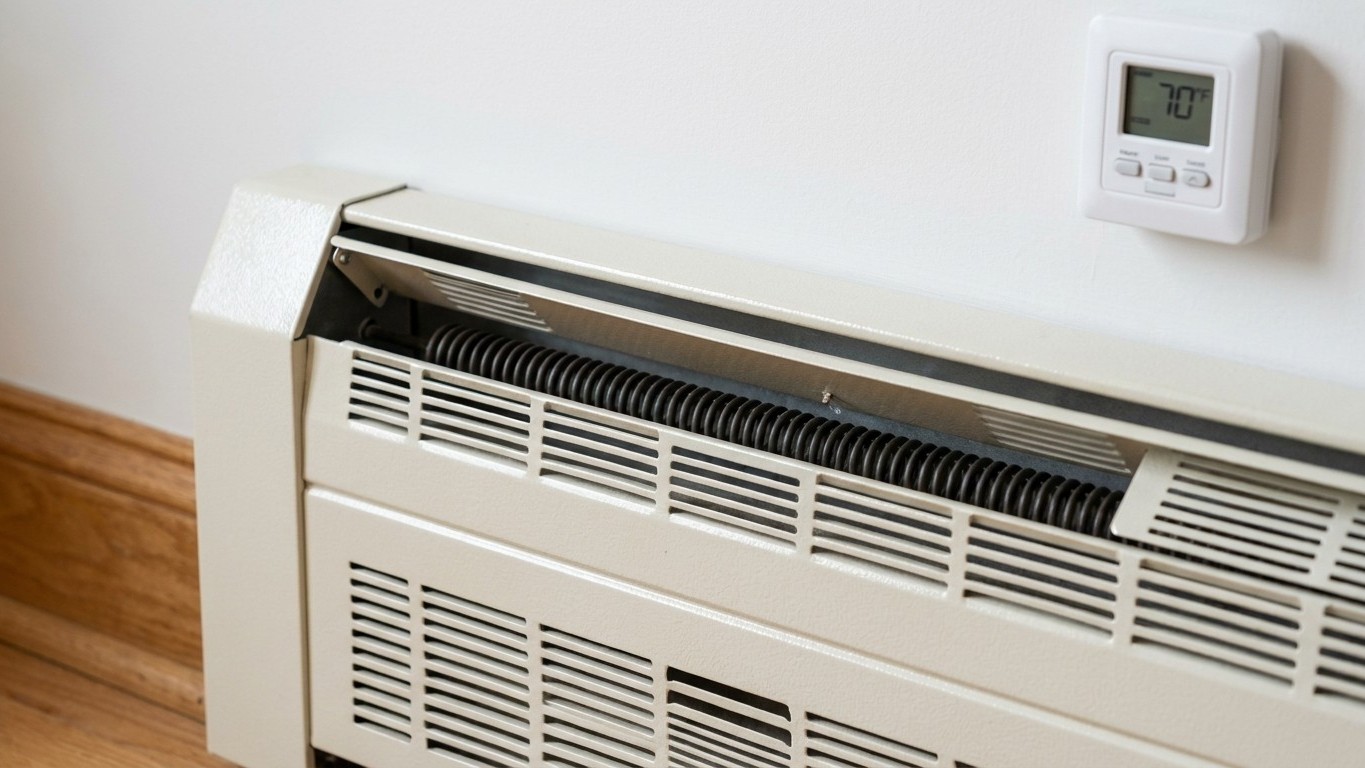

Two appliances share one name, and the fastest way to tell them apart is to check for a boiler in the basement or utility closet. If there’s one, and a loop of pipe runs to the unit under your window, you have hydronic baseboard heat. If the unit connects only to house wiring and has its own thermostat dial or a wall-mounted line-voltage thermostat wired directly to it, you have electric resistance baseboard heat.
First, this is not the wooden strip
Say “baseboard” to most people and they picture the wood or MDF trim that covers the gap where wall meets floor. That’s a real product, sold at every lumberyard, and it has nothing to do with heat. A baseboard heater is a different object entirely: a metal enclosure that runs along the same low position on a wall, but its job is to produce warmth, not to hide a construction seam.
The confusion is understandable because installers often mount heating baseboard right where trim baseboard would otherwise go, sometimes replacing a section of it. But once you know what to look for, the two are impossible to mix up in person.
What you’re looking at, in practice
A heating baseboard is metal, usually steel or aluminum, and it’s shaped to move air rather than just sit flush against the wall. Look for slots, fins, or a ribbed pattern along the front or top face. There’s almost always a hinged flap, called a damper, running the length of the top edge. Open it and you can often see either a bare resistance element (electric) or a finned copper tube (hydronic) inside.
Touch is the other giveaway, once the heating system has been running for a few minutes. Wood trim baseboard stays at room temperature no matter what. A heating baseboard gets noticeably warm, sometimes hot enough that you wouldn’t want to rest a hand on it for long, especially near the ends where the heating element or water inlet sits.
One more tell: heating baseboards are never continuous around an entire room the way trim is. They run in defined sections, usually under windows or along exterior walls, because that’s where the heat loss is greatest and where a heating engineer would have placed the emitter. If the “baseboard” you’re examining runs uninterrupted along every wall in the room, including interior partitions, you’re looking at trim, not a heater.
The two families
Once you’ve confirmed you’re dealing with an actual heater, the next question is which of the two systems it belongs to. Electric baseboard heat is a self-contained resistance appliance, wired at line voltage, that turns electricity directly into heat inside its own enclosure. Hydronic baseboard heat is an emitter, a finned copper tube that hot water flows through on its way around a closed loop powered by a boiler somewhere else in the house. Same silhouette, completely different mechanism.
| Feature | Electric resistance | Hydronic |
|---|---|---|
| What’s inside | Resistance element in a metal case, wired at 120 or 240 volts | Finned copper tube carrying hot water from a boiler loop |
| Control | Line-voltage thermostat, often built into the unit or on the wall | Low-voltage wall thermostat operating a zone valve or circulator |
| Response time | Warms quickly, cools quickly once power cuts | Slower to heat up, holds warmth longer after the boiler cycles off |
| Feel when running | Drier, more localized heat near the unit | Steadier, more even warmth along the run |
| Boiler in the house | No boiler; each unit is independent | Yes, a central boiler feeds every unit on its loop |
| Common failure modes | Burned-out element, failed thermostat, tripped breaker | Trapped air, failed circulator or zone valve, boiler pressure issues |
The practical identification test comes down to three questions. Is there a boiler? Is the thermostat mounted on the wall as a separate low-voltage device, or is it built right into the heater itself? Does the house have one thermostat per room, or a single thermostat governing the whole system? Hydronic systems typically zone by area, sometimes floor by floor, while electric baseboard setups are often controlled room by room, since each unit can run independently of the others.
There’s a wrinkle worth flagging. Some products marketed as “hydronic” baseboard heaters are actually electric appliances filled with a heat-transfer fluid sealed inside the unit itself. There’s no boiler, no external plumbing, and no loop running through the house. That fluid just helps the unit hold and release heat more evenly than a bare element would. It’s still wired at line voltage, it still fails and gets repaired like an electric appliance, and the name is misleading. If the “hydronic” unit in question has no pipes connecting it to anything else in the house, treat it as electric for every practical purpose, including how you’d approach a repair.
Where they turn up
Geography offers a decent hint, even if it isn’t proof by itself. Data from the U.S. Energy Information Administration’s Residential Energy Consumption Survey (RECS 2020) shows how differently regions lean on electricity as their main heating fuel. In Washington State, 55% of homes report electricity as their main heating fuel, compared with 41% in Maryland and just 10% in Maine. Homes that heat primarily with electricity are far more likely to have electric baseboard units somewhere in the mix, particularly in additions or secondary rooms.
That same Washington data shows 47% of homes on a furnace and 9% on a central heat pump. Add those figures up with the 55% electricity share and you’ll notice they don’t reconcile neatly, and that’s the point: RECS reports electricity as a fuel and furnace or central heat pump as equipment categories, but it does not publish a separate share specifically for built-in electric baseboard units. It would be tempting to subtract one published number from another and call the remainder “the baseboard share,” but that math produces a number nobody actually measured. The honest answer is that the survey simply doesn’t publish it, and a gap between two categories is not the same thing as a third data point.
The practical pattern, regardless of the exact split
What shows up consistently, in survey data and in the field, is where these units cluster:
- Additions and bump-outs built after the main heating system was sized, where running new ductwork or hydronic loop wasn’t practical
- Converted attics and finished basements, often heated as an afterthought
- Apartments and condo units, where a shared boiler feeds hydronic baseboard heat to individual units without a furnace anywhere in sight
- Single rooms that stayed cold under the original system and got a standalone electric unit as a fix
Older homes in colder states, especially in the Northeast, are more likely to have hydronic baseboard tied to an oil or gas boiler as the primary system. Homes in the Pacific Northwest, where the RECS numbers above lean heavily electric, are more likely to have baseboard heat that’s electric resistance from the start, sometimes as the only heat source in the house rather than a supplement.
What the answer changes
Knowing which family you own isn’t just trivia. It decides who you call and what actually needs fixing. An electric baseboard problem is an electrical problem: a dead element, a failed line-voltage thermostat, a tripped breaker. A hydronic baseboard problem is a plumbing and heating problem: trapped air in the line, a stuck zone valve, a circulator pump that’s quit, or a boiler that isn’t building pressure. Send an electrician to a hydronic complaint and they’ll find nothing wrong with the wiring, because the wiring was never the issue.
Cleaning differs too, in ways that matter for how the unit performs. Electric units just need the fins kept free of dust and pet hair, since airflow past a hot element is the whole mechanism. Hydronic units need the same dust clearing, but they also depend on the water loop itself being free of trapped air and adequately pressurized, something dusting the fins won’t fix. For either type, always check the appliance’s own label before assuming anything about clearance or airflow requirements, since specifications vary by model.
Thermostat control is the other place the distinction pays off immediately. If your heater has a built-in dial or a wall unit wired at line voltage directly to it, that thermostat only talks to that one heater, electric-style. If a single low-voltage thermostat on the wall seems to control several units in different rooms at once, you’re almost certainly looking at a hydronic zone, and adjusting that thermostat changes conditions throughout the whole loop, not just in the room where the thermostat sits. For hands-on repair steps once you’ve confirmed which system you have, this site’s dedicated guides for electric baseboard heater repair and hydronic baseboard heater troubleshooting go through the specific failure points for each.
Common questions
Can a house have both electric and hydronic baseboard heat at the same time?
Yes. It’s common in homes where a hydronic system heats the main living areas and an electric unit was added later for a room the main loop doesn’t reach well, such as a converted attic or an addition.
Does a warm baseboard heater always mean it’s working correctly?
Not necessarily. An electric unit that’s only warm at one end may have a partially failed element, and a hydronic unit that’s warm at the inlet but cool further along the run may have trapped air blocking flow.
Is there a way to tell the two apart without a boiler in view?
Check the thermostat. A dial built into the heater itself, or a wall thermostat with no low-voltage wiring, points to electric. A wall thermostat that appears to control multiple rooms through thin control wiring points to hydronic.
Are units labeled “hydronic” always connected to a boiler?
No. Some are electric appliances filled with a sealed heat-transfer fluid and marketed as hydronic, with no pipes or boiler involved. If there’s no plumbing connecting the unit to anything else in the house, it’s an electric appliance regardless of the name on the box.