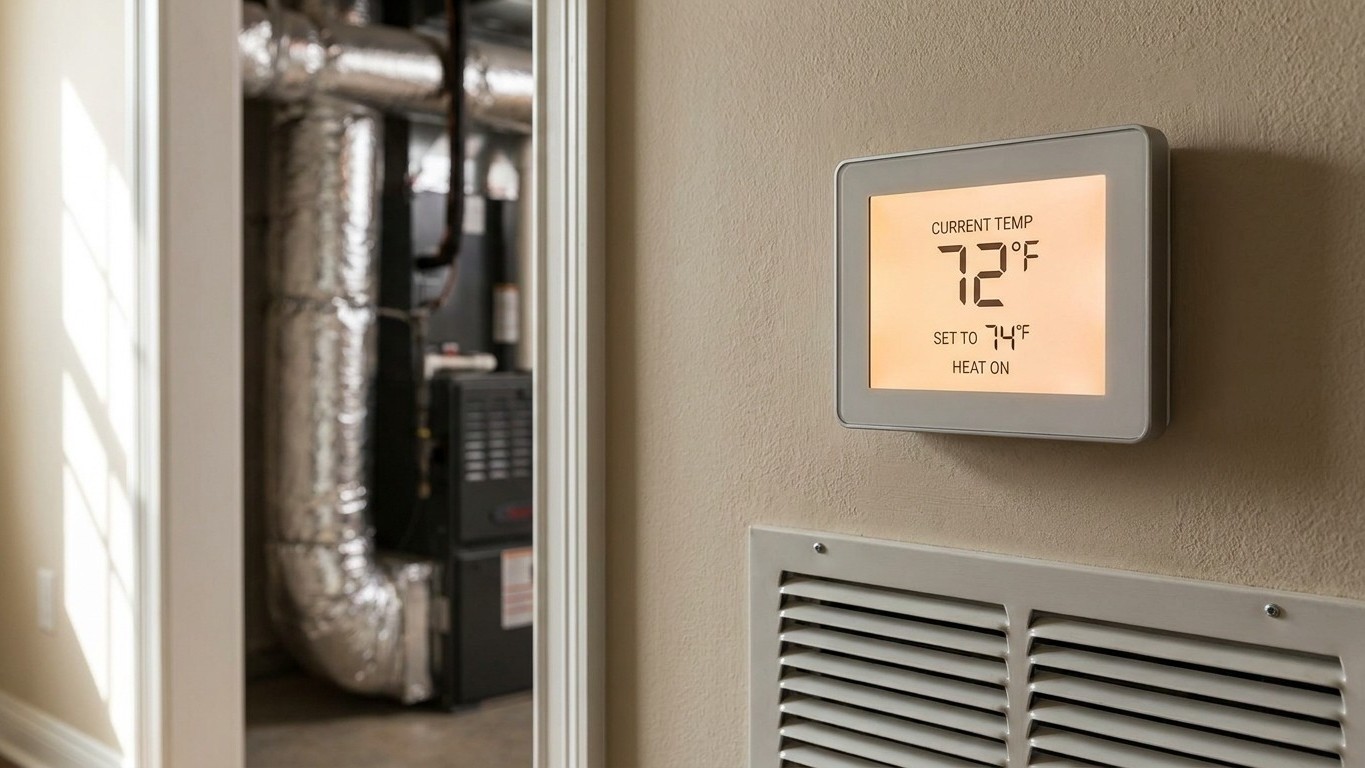

Furnace short cycling almost always traces back to one of two places: airflow that’s restricted somewhere between the furnace and the rooms, or a thermostat that’s reading the wrong temperature. A thermostat mounted near a heat source shuts the system off before the house actually warms up, while a dirty filter or blocked vent makes the unit overheat and cut out on its own safety switch. Figuring out which one it is takes about ten minutes with the power off.
What short cycling is, and why it matters
Here’s a definition you can check against your own house right now: the furnace starts, runs for only a few minutes, shuts off, then starts again a short while later, without the rooms ever reaching the temperature on the thermostat. If you’re hearing the burner or blower kick on and off every five to ten minutes all day, that’s short cycling. A normal heating cycle runs anywhere from ten to twenty minutes and satisfies the thermostat before it stops. Short cycling never gets there.
The reason it’s worth fixing rather than living with it comes down to how furnaces actually work. Starting up is the hardest thing any piece of heating or cooling equipment does. The ignition sequence, the draft motor spinning up, the blower ramping in: all of that draws more current and puts more wear on components than the steady middle of a normal run. A furnace that starts forty times a day instead of eight is wearing out its igniter, its blower motor, and its relays at roughly five times the rate, even though it’s not delivering more heat.
Comfort takes a hit too, and this is the part homeowners notice first. A five-minute run doesn’t have time to push warm air through the whole duct system. The room with the thermostat might feel fine while the bedroom at the far end of the house stays cold, because the air never made it that far before the burner shut off. Rooms on the same floor as the thermostat get treated, rooms upstairs or at the end of a long duct run get ignored.
The same short-cycle problem shows up on the cooling side of the system, and it’s worth understanding even if this article is about the furnace, because the failure mode is nearly identical. An air conditioner that runs in short bursts removes almost no humidity from the air, because the coil barely has time to get cold enough to condense moisture before the compressor shuts off. That’s why a short-cycling system can leave a house feeling both cold and clammy at the same time. Whether it’s heating or cooling, the underlying issue is the same: short runs move less air and do less real work than a handful of longer, complete cycles.
The causes that are the thermostat’s fault
Before blaming the furnace, rule out the thermostat itself, because placement problems are common and easy to fix. A thermostat mounted near a supply vent, on a wall that gets direct afternoon sun, above a floor lamp, or next to a kitchen doorway is reading its own little microclimate rather than the house. Warm air from the vent or the lamp hits the sensor, the thermostat thinks the house has reached the setpoint, and it shuts the furnace down. Two minutes later, once that pocket of warm air dissipates, the sensor cools back off and the furnace fires again. The rest of the house was never actually warm.
This is worth checking first because it costs nothing and takes five minutes: hold your hand near the thermostat right after the furnace shuts off. If you feel warm air still drifting past it, or if it’s in direct sun at that hour, that’s very likely your short-cycling culprit.
Cycle rate and swing settings
Most thermostats, especially programmable and smart models, have a setting sometimes called “cycle rate,” sometimes called “swing,” and sometimes buried in installer or advanced menus. In plain terms, this setting controls how far the room temperature is allowed to drift from the setpoint before the thermostat acts. A wide swing, say a full degree or two, lets the temperature drop a bit before calling for heat, and lets it climb a bit before calling for the furnace to shut off. A narrow swing, something like a quarter of a degree, forces the thermostat to react to tiny temperature changes almost immediately.
A very narrow swing setting produces frequent short runs by design, not by malfunction. The thermostat is doing exactly what it was told to do: react instantly to small changes. On some systems this setting was left on an aggressive factory default meant for a different type of furnace or a different climate. If your thermostat has an installer menu with a cycle-rate or swing option, opening it up to a wider setting is one of the few genuine software fixes for short cycling that doesn’t involve touching the furnace at all.
The causes that are not
Being honest about this matters: most short cycling has nothing to do with the thermostat. The thermostat just reports what the house is doing, and if the furnace is genuinely struggling to move air or is shutting itself down on a safety fault, no thermostat setting will fix that. The table below covers the mechanical causes that show up far more often than a bad thermostat location or a bad swing setting.
| Cause | What happens | Typical clue |
|---|---|---|
| Choked air filter | Restricted airflow makes the heat exchanger overheat, tripping the high-limit switch early | Filter visibly gray or clogged; furnace runs shorter as the season goes on |
| Blocked return or supply vents | Same overheating mechanism as a dirty filter, just caused by furniture or closed registers instead | Rooms with closed vents or furniture pushed against a return grille |
| Oversized system | The furnace has more capacity than the house needs, so it satisfies the room near the thermostat almost immediately | Furnace is noticeably newer or larger than the old one it replaced |
| Flame-sensor or limit fault | A dirty or failing flame sensor causes the control board to shut the burner down on what it reads as a safety issue, not a comfort issue | Furnace shuts off well before the thermostat is satisfied, sometimes with an error code on the board |
| Duct losses | Heated air escapes before it reaches the rooms, so the thermostat never gets an accurate read on whether the house is actually warm | Uneven room temperatures, ducts running through an unconditioned attic or crawlspace |
Two of those causes connect to numbers worth knowing. According to ENERGY STAR, “Airflow problems can reduce your system’s efficiency by up to 15 percent,” which is exactly what a clogged filter or a blocked vent does: it restricts the air the furnace needs to move, forcing it to work harder and shut down sooner. And on the duct side, ENERGY STAR notes that “In a typical house, however, about 20 to 30 percent of the air that moves through the duct system is lost due to leaks, holes, and poorly connected ducts.” That’s air the furnace already heated, gone before it ever reached a register, which is one reason a house can feel unevenly heated even when the furnace itself is running fine.
An oversized system deserves its own mention because it’s the hardest of these to fix cheaply. A furnace sized for a house twice as large heats the air near the thermostat fast, shuts off, and the rest of the house never quite catches up before the cycle repeats. Unlike a filter or a vent, this one usually isn’t a weekend fix. It’s a sizing conversation for whenever the equipment eventually gets replaced.
What to check, in order
Work through these from cheapest and least invasive to most involved. The order matters: most short-cycling calls get solved in the first three steps, and stepping past those first is how people end up replacing thermostats that were never the problem.
- Check the filter first. Pull it out, hold it up to a light. If you can’t see light through it, replace it. This alone resolves a large share of short-cycling complaints.
- Check every supply and return vent. Make sure none are blocked by furniture, rugs, or curtains, and that closed registers aren’t cutting off too much of the system’s airflow.
- Check what’s around the thermostat. Look for a supply vent nearby, direct sun at some point in the day, or a lamp or appliance on the same wall throwing off heat.
- Check the swing or cycle-rate setting. If your thermostat has an installer or advanced menu, look for this setting and widen it if it’s set narrow.
- Watch whether the pattern changes on the coldest days of the year. If short cycling only shows up when it’s mild outside but the furnace runs normally on the coldest days, that points toward oversizing rather than a fault. If it happens on the coldest days too, that points more toward airflow or a sensor issue.
- Stop and call a technician if the furnace displays an error code, if you smell anything unusual, or if the filter and vents are clear but the short cycling continues. A flame-sensor or limit-switch fault requires opening the furnace cabinet, and that’s where DIY should end.
If any of this requires opening the thermostat’s wall plate or the furnace’s control panel, cut power at the breaker first, and take a photo of the wiring terminals before disconnecting anything. It’s a two-second step that saves a service call if a wire falls out of place while you’re working.
Common questions
Can a bad thermostat battery cause short cycling?
Yes, in some systems. A battery running low can cause a thermostat to send inconsistent signals to the furnace, including calling for heat and then canceling the call moments later. It’s a quick, free thing to rule out before looking at anything mechanical.
Does short cycling raise heating bills?
It can, mainly because frequent starts waste the energy spent on ignition and blower ramp-up without delivering a full cycle’s worth of heat to the rooms. Airflow restrictions that cause short cycling also make the system less efficient overall, per ENERGY STAR’s note that airflow problems can reduce efficiency by up to 15 percent.
Is short cycling dangerous?
Not usually by itself, but a furnace that’s short cycling because of a flame-sensor or limit-switch fault is shutting itself down as a safety response, and that fault should be checked by a technician rather than ignored, since it exists precisely because something is running hotter or less safely than it should.
Will replacing the thermostat fix short cycling?
Sometimes, if the old thermostat was misreading temperature due to a failing sensor or was stuck on a narrow swing setting with no way to adjust it. But since most short cycling traces back to airflow, filters, or an oversized furnace rather than the thermostat, it’s worth working through the filter, vents, and placement checks first before spending money on new equipment.