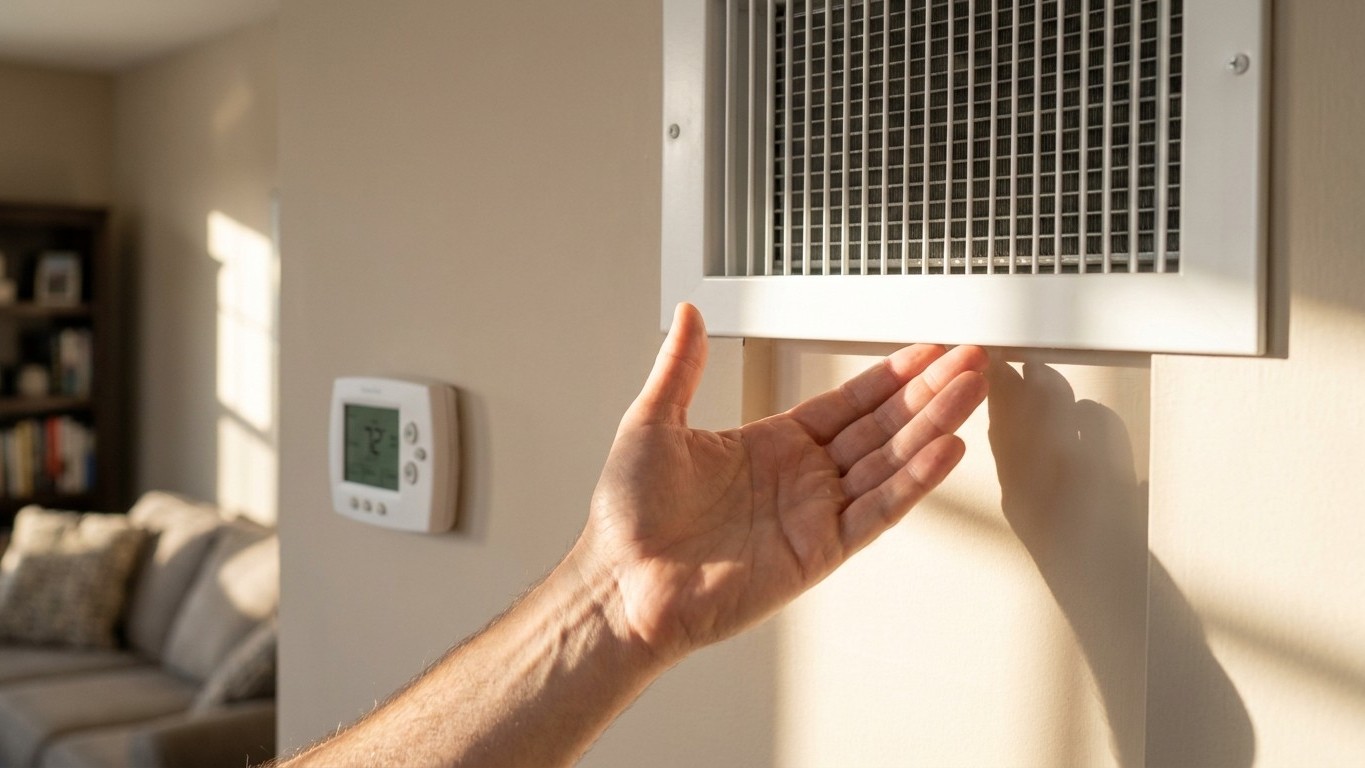

Cold air from the vents doesn’t always mean the furnace has failed. Sometimes it’s just the normal lag before the burner catches up, and other times the thermostat fan setting is doing exactly what it was told to do. The trick is knowing which pattern you’re looking at, because the fix ranges from doing nothing at all to flipping a single switch to calling for service.
Some of it is normal

Every forced-air furnace has a startup lag. The blower motor and the burner don’t ignite in perfect sync: on many systems the fan kicks on a few seconds before the heat exchanger has actually warmed up, so the first blast out of the vent is closer to room temperature than to “hot.” That’s not a malfunction. It’s the sequence the control board was built to run, and it usually resolves within a minute or two once the burner has had time to heat the exchanger surface.
The same thing happens in reverse at the end of a cycle. When the thermostat is satisfied and the burner shuts off, the blower typically keeps running for a short period afterward. This is deliberate: it pulls the remaining heat off the exchanger instead of letting it go to waste, which is good for efficiency and good for the equipment’s lifespan. But it means the last stretch of airflow in any given cycle will feel progressively cooler, right up until the fan shuts off completely.
The one-line test
Put your hand near a vent close to the furnace and time it. If the air warms up noticeably within a couple of minutes of the burner starting, and if the cool air you’re feeling only shows up at the very start or the very tail end of a cycle, the system is doing its job. That pattern is not a symptom of anything wrong. It’s the ordinary rhythm of a gas or electric furnace cycling on and off through the day.
What separates this from a real problem is duration and consistency. Cold air for ninety seconds at the start of a cycle is normal. Cold air that lasts through the entire cycle, or cold air that shows up every single time the system runs with no warm stretch in between, is a different story and points toward one of the causes further down this page. The distinction matters because a lot of service calls get placed for furnaces that are working exactly as designed.
The switch that causes half of these
Before touching anything mechanical, look at the thermostat. A huge share of “furnace blowing cold air” complaints trace back to one setting: the fan switch left on ON instead of AUTO. On AUTO, the blower only runs when the burner is actively producing heat, so warm air and moving air happen together. On ON, the blower runs continuously, all day, whether or not the burner is firing. Between burner cycles, that fan is circulating air that’s sitting at room temperature or slightly cooler, and moving air across skin reads as cold air even when nothing is technically broken.
This is worth checking first because it costs nothing and takes ten seconds. Find the fan mode on the thermostat, confirm it reads AUTO rather than ON, and give the system a few minutes to settle into its normal cycle. If the cold-air complaint disappears once the setting is corrected, that was the entire problem. Households sometimes switch to ON deliberately, thinking constant circulation improves comfort or air mixing, without realizing it changes how every draft in the house feels. For a full breakdown of what each fan setting does and when ON actually makes sense, see the fan settings guide on this site.
Two other settings worth a glance
Fan mode isn’t the only setting that can produce a false alarm. Check the system mode next: if the thermostat is set to COOL rather than HEAT, the furnace’s burner won’t fire at all, no matter how cold it is outside, and any air moving through the ducts will be whatever temperature the space already is. It sounds obvious, but this setting gets bumped accidentally more often than people expect, especially on thermostats where heat and cool selections sit close together on a touchscreen.
Also confirm the setpoint itself. If the target temperature is set below the current room temperature, the thermostat has no reason to call for heat, so the burner stays idle and the blower (if it runs at all) is just moving ambient air. Both of these checks take less time than reading this paragraph, and both are free. Only after ruling out fan mode, system mode, and setpoint does it make sense to start looking at the furnace itself.
When it is a fault
Once the thermostat checks are ruled out, a furnace that keeps blowing cold air is usually telling you something specific through the pattern of the airflow. The table below lines up the most common mechanical causes with the tell that separates one from another, mainly whether the burner lights at all and, if it does, how long it stays lit before shutting back off.
| Cause | What it looks like | Distinguishing tell |
|---|---|---|
| Choked air filter | Burner shuts down on high-limit temperature while the blower keeps running | Burner lights, runs briefly, then cuts out repeatedly; filter is visibly clogged |
| Flame sensor issue | Ignition happens but the burner shuts off shortly after | Burner lights for a few seconds, then goes dark; blower continues on room-temperature air |
| Pilot or ignition failure | Burner never lights at all | No flame, no heat at any point in the cycle; blower may still run on schedule |
| Gas supply problem | Burner won’t ignite, or ignites and fails intermittently | If you smell gas, leave the house immediately and do not attempt to diagnose anything, then contact your gas provider or emergency services from outside |
| Tripped limit switch | System shuts down burner and sometimes blower as a safety response | Often follows overheating from restricted airflow; panel may need to be reset or read for a fault indication |
The filter cause deserves its own note because it’s both the most common and the easiest to prevent. A restricted filter chokes airflow across the heat exchanger, and according to the U.S. ENERGY STAR program, “airflow problems can reduce your system’s efficiency by up to 15 percent.” When airflow is restricted enough, the exchanger overheats, a safety switch shuts the burner down, and the blower keeps circulating air that’s no longer being heated. That’s the cold-air-with-a-running-blower pattern many homeowners describe. ENERGY STAR’s maintenance guidance is direct on how to prevent it: “Inspect, clean, or change air filters once a month in your central air conditioner, furnace, and/or heat pump.”
The gas supply problem and pilot/ignition failure rows are relevant to fuel-burning furnaces specifically. If your system doesn’t burn fuel at all, meaning it’s an electric furnace, heat pump, or electric baseboard setup, none of the gas-related rows apply to you, and there’s no combustion to worry about; the electric furnace guide covers the failure modes that actually apply to that equipment. One rule holds regardless of furnace type, and it’s the one exception to every diagnostic checklist on this site: a gas smell is not something to troubleshoot. It’s something to walk away from.
Reading the fault indication on the furnace’s own control panel, where equipped, is the fastest way to narrow down which of these is happening, since panels often display a blinking or coded signal tied to the specific fault the system detected. Because those codes vary by manufacturer, the only reliable instruction is to read what your particular panel shows rather than rely on a generic list.
Or it is only one room
Not every cold-air complaint is about the furnace at all. If the air coming out of vents near the furnace itself feels properly warm, but a room at the far end of the house is stuck feeling cold no matter how long the system runs, the furnace is doing its job and the problem is in delivery, not production. That’s a duct issue, not a furnace fault, and it calls for a different kind of check.
Ductwork loses conditioned air along the way more often than most homeowners assume. According to ENERGY STAR, “In a typical house, however, about 20 to 30 percent of the air that moves through the duct system is lost due to leaks, holes, and poorly connected ducts.” That’s not a rounding error. Losing a quarter of your heated air before it ever reaches a distant bedroom explains a lot about why one room runs warm while another stays chilly, even though the thermostat reads the same target temperature for the whole house.
The fix here isn’t anything you do at the furnace. It’s tracing the duct run to the affected room and checking the connections, seams, and any exposed sections in an unconditioned space like an attic or crawlspace, since that’s where leaks tend to concentrate and where the heat loss has the least chance of doing any good before it escapes. For a closer look at how to trace and address that kind of loss, the duct leak guide and the related duct sizing guide on this site walk through what to check room by room.
The practical way to tell the two situations apart: if every vent in the house runs cold, or runs cold in the same pattern described in the earlier sections, look at the furnace and the thermostat. If most rooms are fine and one or two are consistently behind, look at the ducts feeding those specific rooms instead. Chasing a furnace repair for what’s actually a duct leak wastes time without solving the room that’s actually cold.
Common questions
Why does my furnace blow cold air for a few minutes before it warms up?
That’s the normal startup lag: the blower can start moving air slightly before the heat exchanger has fully warmed, and the system often runs the fan briefly after the burner shuts off to recover leftover heat. Both are expected behavior, not a fault, as long as the air warms up within a couple of minutes.
What’s the fastest thing to check before calling for service?
The thermostat’s fan setting. If it’s set to ON instead of AUTO, the blower runs continuously and circulates room-temperature air between burner cycles, which feels like cold air even though nothing is broken. Confirming the system mode is set to HEAT and the setpoint is above room temperature covers the other two free checks.
Can a dirty filter really cause cold air?
Yes. A restricted filter chokes airflow across the heat exchanger, which can trigger a safety shutdown of the burner while the blower keeps running. ENERGY STAR notes that airflow problems can reduce a system’s efficiency by up to 15 percent, and recommends inspecting or changing filters once a month.
Why is only one room cold while the rest of the house is warm?
That pattern usually points to duct losses rather than a furnace problem. ENERGY STAR estimates that in a typical house, about 20 to 30 percent of the air moving through the duct system is lost to leaks, holes, and poorly connected ducts, and that loss often concentrates in runs feeding the rooms farthest from the furnace.