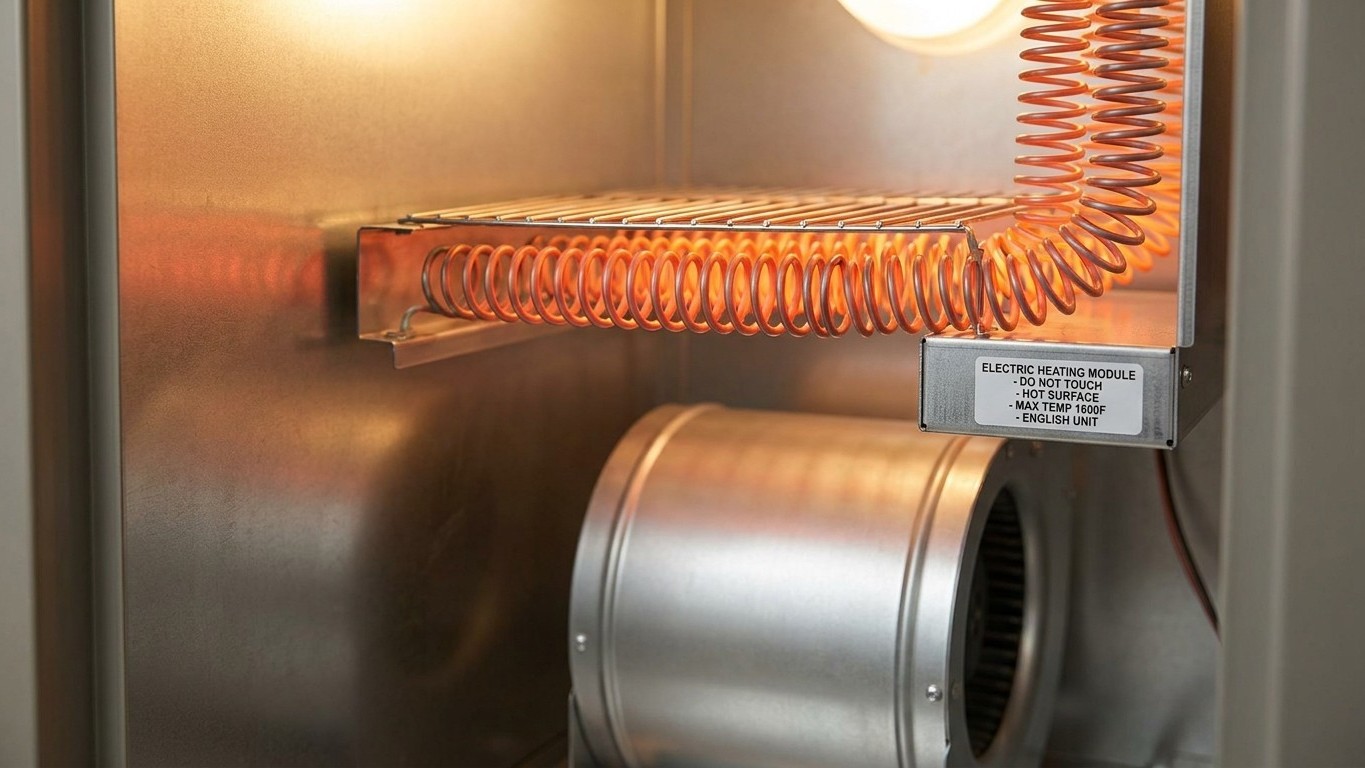

An electric furnace warms air by pushing it across resistance elements, the same principle as a toaster or a space heater, just scaled up and wired into a cabinet with a blower. There’s no flame, no burner, no flue pipe running to the roof, and no combustion byproduct to manage. That single fact reroutes almost everything a homeowner thinks they know about furnace safety and maintenance, because most of that advice was written for a different kind of appliance.
Nothing is burning
Say it plainly: an electric furnace has no flame. It heats air by running electricity through resistance elements, coils that glow with heat the way a stove burner does, and a blower moves that heated air through the ductwork. There is no combustion happening anywhere in the cabinet. No gas valve, no pilot light, no igniter, no flame sensor watching for a lit burner, and no flue or vent pipe carrying exhaust gases outside.
That matters because so much of what gets repeated about furnace safety is really about combustion appliances. The advice to install carbon monoxide detectors near sleeping areas, the recommendation for a yearly inspection of the burner and heat exchanger, the warning about a cracked flue or a blocked vent, the checklist item about testing the flame sensor. All of it exists because burning fuel indoors produces carbon monoxide, and a failure somewhere in the venting path can let that gas build up in a house. An electric furnace does not burn fuel. It cannot produce carbon monoxide, full stop, because there is no combustion reaction taking place inside it.
This is the piece of furnace advice that causes the most needless worry for the wrong homeowner. Someone with an electric furnace reads a general furnace safety article, sees the carbon monoxide warnings, and starts wondering if they need a combustion inspection they don’t actually need. They don’t. If the only heating appliance in the house is electric resistance heat, the entire category of combustion safety advice simply doesn’t apply to that equipment.
Here’s the honest caveat, though, and it’s worth sitting with for a second: a house with an electric furnace can still have other fuel-burning appliances under the same roof. A gas water heater in the utility closet. A wood-burning or gas fireplace in the living room. A gas range in the kitchen. Any of those can produce carbon monoxide if they malfunction or aren’t vented properly, and the standard combustion safety guidance, the detector placement, the annual inspection, the attention to yellow flames or soot, applies fully to those appliances. The electric furnace itself is off the hook. The rest of the house’s fuel-burning equipment is not. For a full breakdown of that guidance, see the site’s carbon monoxide and furnace safety guide.
What it does share with the others
None of this means an electric furnace is a different animal from top to bottom. Strip away the combustion, and what’s left is a blower pushing air through the same ducts, filters, and thermostat wiring that any forced-air gas or oil system uses. The parts of furnace maintenance that are really about airflow, not about fuel, carry over completely.
The filter is the clearest example. ENERGY STAR’s guidance doesn’t single out gas systems: “Inspect, clean, or change air filters once a month in your central air conditioner, furnace, and/or heat pump.” That instruction covers an electric furnace exactly as it covers every other type listed. A dirty filter restricts airflow across the heating elements the same way it restricts airflow across a gas heat exchanger, and the consequence is the same too. ENERGY STAR notes that “airflow problems can reduce your system’s efficiency by up to 15 percent,” a number that has nothing to do with what fuel, or lack of fuel, is heating the air.
Ductwork behaves identically as well. A leaky supply duct in an attic wastes heated air whether that air was warmed by a burner or by resistance elements. A closed or blocked return starves the blower for air regardless of what’s producing the heat downstream. And the thermostat, in most installations, is doing the exact same job: reading a set point, calling for heat, and cycling the system off once the space reaches temperature.
| Subject | Does it apply to an electric furnace? | Where to read more |
|---|---|---|
| Monthly filter checks | Yes, same as any furnace or heat pump | Filters and airflow guide |
| Duct leaks and airflow loss | Yes, no different from a gas system | Filters and airflow guide |
| Thermostat wiring and cycling | Yes, standard forced-air behavior | Thermostat troubleshooting |
| Carbon monoxide risk | No, no combustion occurs | Carbon monoxide guide |
The faults that are its own
What breaks on an electric furnace looks nothing like what breaks on a gas one, and the symptoms point to a fairly short list of causes.
- A failed heating element. Most electric furnaces have more than one element, often arranged in stages, so a single failed element rarely means no heat at all. It usually means weaker heat, air coming out of the registers noticeably cooler than it used to, or a system that runs longer to reach the same set point.
- A sequencer that isn’t bringing elements online. The sequencer’s job is to stagger the elements so they don’t all draw power at once. When it fails, some elements may never activate, again producing the same weak-heat pattern rather than a complete shutdown.
- A tripped high-limit switch. This safety device shuts the system down if airflow across the elements gets too restricted, often the downstream result of the dirty filter or blocked duct mentioned above. A tripped high-limit tends to produce no heat at all, since it’s a safety cutoff rather than a partial failure.
- A breaker that won’t hold. Electric furnaces draw enough current that a breaker repeatedly tripping is a signal worth taking seriously rather than resetting over and over.
The tell that separates these situations is whether the house is getting weak heat or no heat at all. Weak heat, air that’s warm but not hot, a system that runs constantly without quite catching up, points toward one or two elements out of several failing while the rest keep working. No heat at all points more toward the sequencer, the high-limit switch, or the breaker rather than the elements themselves.
This is also where a homeowner should stop, and stop early. An electric furnace cabinet carries high-current wiring to multiple heating elements, and diagnosing beyond checking the filter, the breaker panel, and the thermostat setting means opening a live electrical cabinet. That’s a job for a licensed technician, not a weekend project. No specific amperage, wattage, or wire-gauge figures apply universally here since those numbers vary by unit and manufacturer; a technician working from the equipment’s own panel and rating plate is the reliable path, not a generic troubleshooting checklist.
Where electric furnaces turn up
Federal survey data shows how differently regions rely on electric heat, though it’s worth being precise about what the numbers actually measure. The U.S. Energy Information Administration’s 2020 Residential Energy Consumption Survey (RECS) tracks two separate things: the type of equipment a home uses (furnace, central heat pump, boiler, etc.) and the main fuel that equipment runs on (natural gas, electricity, fuel oil or kerosene). Electricity as a fuel and “furnace” as equipment are reported separately, and the survey doesn’t break out how much of that electricity-fueled heat runs through an electric furnace specifically versus a heat pump, baseboard, or another electric setup.
| State | Furnace (equipment) | Central heat pump | Boiler (steam/hot-water) | Main fuel |
|---|---|---|---|---|
| Maryland | 64% | 19% | — | Natural gas, 49% |
| Washington | 47% | 9% | — | Electricity, 55% |
| Maine | 46% | — | 31% | Fuel oil/kerosene, 49% |
Maryland leans heavily on furnaces as equipment, with natural gas as the dominant fuel behind them. Washington shows electricity as the majority fuel statewide, spread across furnaces, heat pumps, and other electric equipment types the survey doesn’t separate further. Maine tells a different story again, splitting nearly evenly between furnaces and steam or hot-water boilers, with fuel oil and kerosene as the leading fuel. One caution worth repeating from the survey’s own methodology: where RECS marks a category “not reported” or “estimate suppressed,” that means the sample size was too small for a reliable figure, not that the number is zero.
What this data can’t do is tell a Washington homeowner whether their electric-fueled system is a furnace or a heat pump, and the two get confused constantly since both use ductwork, both use a thermostat, and both can be the sole heating source in a home. The practical difference matters for maintenance and efficiency expectations alike, and it’s covered in the site’s guide to telling electric resistance heat apart from a heat pump.
Common questions
Does an electric furnace need a carbon monoxide detector?
The furnace itself produces no carbon monoxide since it has no combustion process. A CO detector is still a good idea if any other fuel-burning appliance, like a gas water heater or fireplace, is present anywhere in the house.
Why does my electric furnace blow lukewarm air instead of shutting off completely?
That pattern usually points to one or more heating elements failing while others in the same unit keep working, or a sequencer not activating every stage. A technician can check the elements and sequencer directly.
How often should I change the filter on an electric furnace?
The same schedule applies as any forced-air system: ENERGY STAR recommends checking or changing filters once a month across central air conditioners, furnaces, and heat pumps alike.
Is it safe to reset a tripped breaker on an electric furnace myself?
Resetting it once is generally fine, but if the breaker trips repeatedly, that’s a signal to call a technician rather than keep resetting it, since it points to a load or wiring issue inside the cabinet.