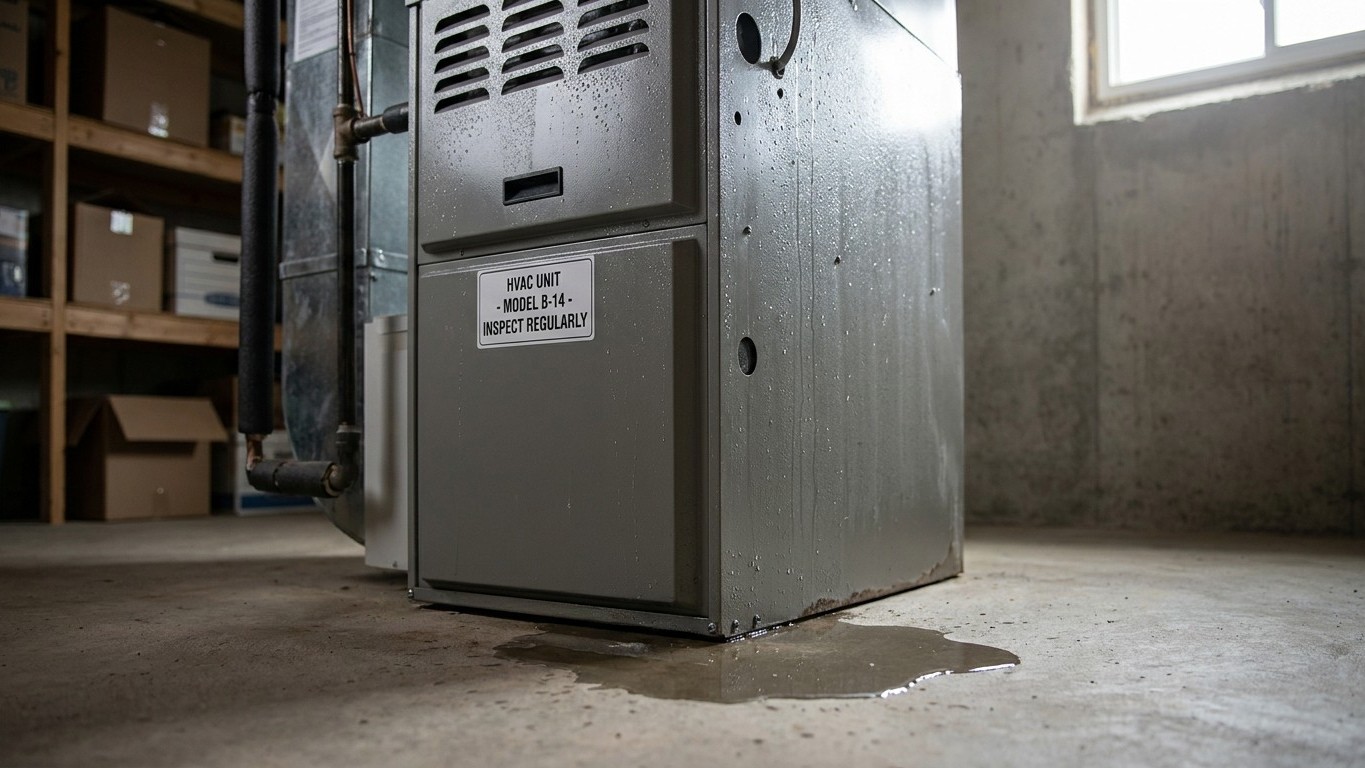

Water pooling near a furnace almost always traces back to one of three sources: a condensing furnace’s normal drain line that has clogged or failed, an air conditioner’s cooling coil sharing the same cabinet, or a humidifier or humid basement air condensing on cold metal nearby. None of these on their own signal an emergency, but each points to a different fix, and telling them apart starts with a question you can answer before you touch a single wire or pipe.
The season tells you which system leaked

Before opening a panel or grabbing a flashlight, ask what month it is. That single detail cuts the list of suspects in half.
If the puddle shows up in July or August, the furnace is very likely innocent. Central air conditioning shares the same indoor cabinet as the furnace in most homes, and the AC’s cooling coil sits right above or beside the furnace’s heat exchanger. As warm, humid air passes over that cold coil, moisture condenses out of it, the same way a cold glass of water sweats on a summer porch. That condensate is supposed to drip into a pan and drain away through a small tube. When it doesn’t, water shows up right at the base of the furnace cabinet, even though the furnace itself hasn’t run in months. This is the single most common cause of “furnace” water leaks reported in warm-weather states, and it has nothing to do with heating equipment.
If the water appears in December or January, while the system is actively heating, the furnace itself becomes the more likely source, but only for one category of equipment. Standard furnaces that vent through a metal flue and a chimney don’t produce condensate as part of normal operation. High-efficiency, condensing furnaces do, and they do it by design. So a winter leak from an older, standard-efficiency furnace is unusual and worth investigating for something other than normal condensate, such as a cracked heat exchanger allowing rainwater or ice melt to enter through the flue, or a humidifier saddle valve leaking onto the cabinet.
Shoulder-season leaks, in October or April, deserve a second look at both systems, since many homeowners run the AC on unseasonably warm days and the furnace on unseasonably cool nights within the same week. Checking the thermostat’s recent mode history, or simply asking which system ran most recently, narrows things down faster than inspecting both sets of components blind.
Why a high-efficiency furnace makes water on purpose
A condensing furnace is built to squeeze extra heat out of exhaust gas that older furnaces simply vent outside and waste. To do that, it cools the exhaust down enough that water vapor inside it turns back into liquid water, the same physics that fogs up a cold windshield from the inside. That water is not a malfunction. It’s the entire point of the design, and it’s why these furnaces achieve such high efficiency ratings compared to older standard models.
Because that condensate is acidic, roughly the pH of black coffee, these furnaces are built with a dedicated drain system made of PVC piping rather than the metal ductwork used for standard heat distribution. The water travels from a collector box, often near the bottom of the furnace cabinet, through a drain hose, sometimes through a small condensate pump, and finally to a floor drain, a sump, or a discharge line outside. Every part of that path is a spot where a blockage or a crack can send water where it doesn’t belong.
How to tell which type is installed
Look at where the exhaust vent leaves the house. A condensing furnace almost always vents through a plastic pipe (white or gray PVC) that exits through a side wall of the house, close to ground level, often alongside a second pipe that brings in combustion air. A standard-efficiency furnace vents through a metal pipe that rises up and typically connects to a masonry or metal chimney. If there’s a plastic pipe running out a wall low on the house, condensate production is normal and expected. If the furnace vents up through a traditional chimney, water at the unit is not a routine byproduct and points somewhere else, worth a look at the sections below.
This distinction matters because it changes what “normal” looks like. A little water in the collector box or drain line of a condensing furnace, especially right after a heating cycle, is not a leak. A pool of standing water anywhere near a standard-efficiency furnace with a metal flue usually is.
Following the drain path
Once it’s clear the furnace is a condensing model and water is appearing where it shouldn’t, the fix is almost always a tracing exercise rather than a repair. Follow the path the water is supposed to take, checking each junction for a blockage or a break.
- Switch the system off at the thermostat or the furnace’s power switch before touching anything. Water and low-voltage electrical components near a running blower are not a combination worth troubleshooting live.
- Locate the collector box or drain outlet at the bottom of the furnace cabinet, where the condensate first leaves the unit through a plastic hose or small pipe.
- Trace that line to its trap, a U-shaped bend in the tubing designed to hold a small amount of water and block sewer gas or air from being pulled back into the furnace.
- Follow the trap onward to wherever it discharges, either a floor drain, a utility sink, or a condensate pump with its own small reservoir and float switch.
- Check the trap itself for a clog. Algae, sediment, and general gunk build up in these low-lying bends over time and are the single most common blockage point in the whole system.
- If a condensate pump is involved, confirm it has power and listen for it cycling on. Check that the float inside the reservoir moves freely and isn’t stuck, coated in residue, or wedged against the housing.
- Look at the tubing itself for any sag or dip that has formed a second, unintended trap partway along its run. Water sitting in an accidental low point will eventually back up rather than drain.
⚠ A condensate pump that has failed rarely floods dramatically. It tends to overflow slowly, drop by drop, often near electrical connections or the furnace’s control board, for days before anyone notices standing water. Checking that pump periodically, especially at the start of the heating season, catches this before it becomes a bigger problem.
⚠ If a trap or drain line is blocked, clear it by removing and flushing the tubing, not by blowing compressed air or water back up the line toward the furnace. Forcing a blockage backward can push debris or water into the heat exchanger or collector box, turning a simple clog into a more serious repair.
When it is not the drain
Sometimes every inch of the condensate path checks out clean, the trap is clear, the pump cycles fine, and water still shows up. At that point the cause usually sits outside the drain system entirely.
| Cause | What to look for | Why it happens |
|---|---|---|
| Humidifier on the ductwork | Water at a saddle valve, supply line, or drain fitting near the humidifier unit itself, separate from the furnace cabinet | A whole-house humidifier taps into the water supply and drains excess water; a loose fitting or clogged drain line leaks locally |
| Condensation on cold metal ductwork | Sweating or dripping ducts in a humid basement, especially near supply trunks carrying cooled air | Warm, moist basement air meets cold metal surfaces and condenses, the same way a cold soda can sweats on a humid day |
| Poor flue draft | Water or staining inside the flue pipe itself, or moisture appearing near the vent connector rather than the drain system | Exhaust gas that should exit the house condenses inside the venting where it isn’t designed to, often from an undersized, blocked, or improperly pitched flue |
The first two causes are inconvenient but manageable with basic upkeep of the humidifier fittings or better dehumidification in the basement. The third one deserves more attention, since a flue that isn’t drafting correctly is a venting problem, not a plumbing one, and it can affect how safely combustion byproducts leave the house. That’s a question for a proper venting inspection rather than a bucket under the pipe, and it’s covered in more depth in this site’s guide to furnace venting problems.
Common questions
Is it safe to run the furnace while water is leaking?
It depends on where the water is landing. Water anywhere near the blower motor, control board, or other electrical components is a reason to shut the system off until the source is found. Water contained to a drain pan or condensate line, away from wiring, is less urgent but still worth addressing promptly.
Does a standard, non-condensing furnace ever produce condensate?
Not as part of normal operation. Its exhaust exits hot enough that water vapor stays as vapor all the way up the metal flue. Water appearing at one of these furnaces points to something outside normal function, such as flue condensation from a draft problem, a humidifier leak, or exterior water entering through the venting.
Can a clogged condensate line damage the furnace itself?
A backed-up drain can cause the furnace’s internal safety switch to shut the unit down before major damage occurs, since many condensing furnaces include a float switch that detects standing water in the collector box. That’s a protective response, not a failure, and it’s worth checking that switch and the drain path together.
Why does water only show up after the system has run for a while?
Condensate production builds up gradually during a heating or cooling cycle rather than all at once. A slow drain or a small pump reservoir may keep up for the first few minutes of a cycle and only overflow once enough water has accumulated, which is why a short test run sometimes looks fine while a longer, real-world cycle reveals the leak.