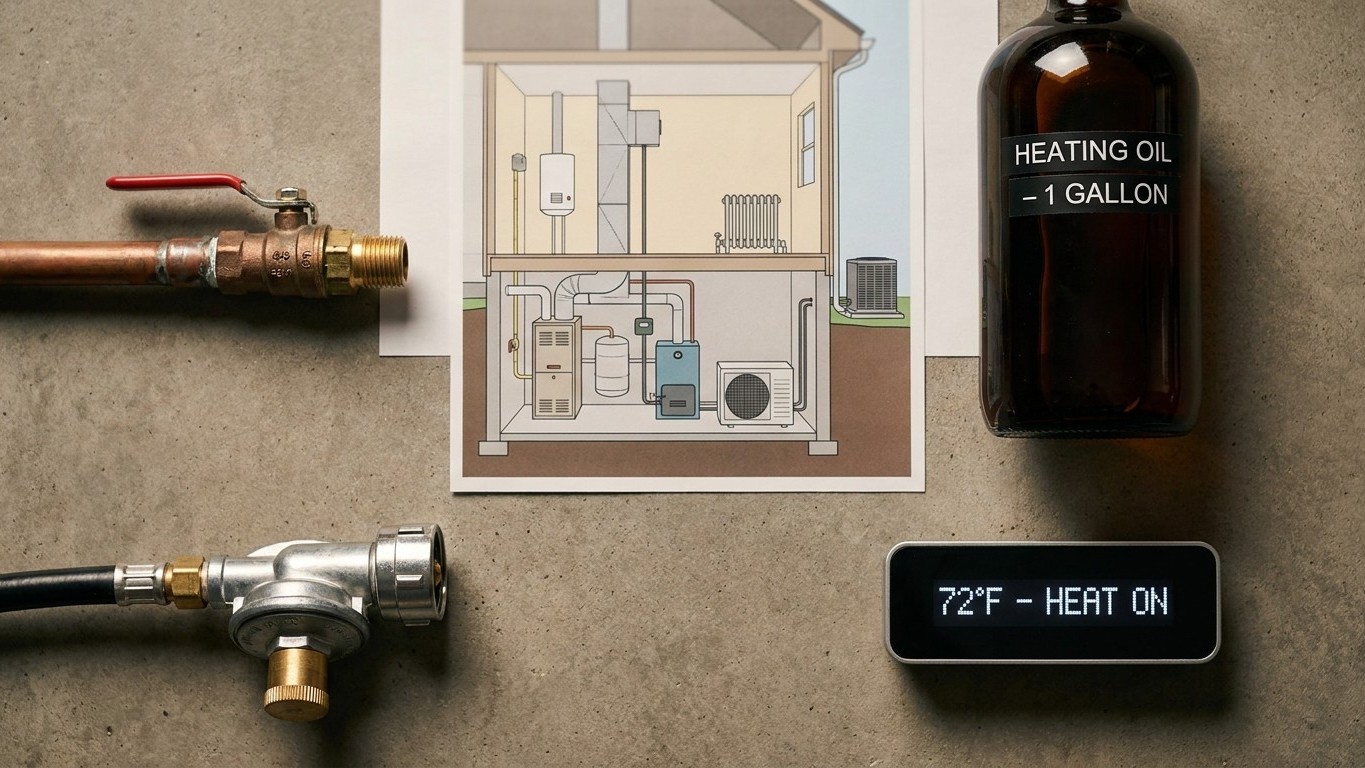

If you’re not sure whether your house runs on gas, oil, propane or electricity, the honest answer is: it depends where you live, and the equipment sitting in your basement or utility closet will tell you faster than any national statistic. Fuel choice tracks pipeline access, climate, and the decade your house was built more than any single “most common” answer.
Gas, Oil, Propane or Electric: What You Probably Have
The fuel a house burns for heat is mostly decided before you ever moved in. It follows the natural gas pipeline network, the local climate, and whether the builder had access to underground gas lines the year the foundation was poured. That’s why the answer changes so much from one state to the next, and why a national average tells you almost nothing about your own house.
Take New York State as one example, drawn from the U.S. Energy Information Administration’s Residential Energy Consumption Survey. Among homes there, natural gas is the dominant heating fuel at 61%, with fuel oil or kerosene at 17%, electricity at 16%, and propane at 4%. On the equipment side, furnaces show up in 44% of homes, steam or hot-water boilers in 35%, and central heat pumps in only 3%. That’s a state where more than a third of households are running a boiler and radiators, not a blower and ductwork, which is a very different maintenance and repair picture than a furnace-heavy state would produce.
| Category | Share of NY homes (RECS 2020) |
|---|---|
| Furnace | 44% |
| Steam or hot-water boiler | 35% |
| Central heat pump | 3% |
| Natural gas (fuel) | 61% |
| Fuel oil or kerosene (fuel) | 17% |
| Electricity (fuel) | 16% |
| Propane (fuel) | 4% |
Notice the equipment percentages and the fuel percentages don’t line up one-to-one, because a furnace can run on gas, oil, or propane, and a boiler can too. Equipment type tells you how heat moves through the house, air through ducts versus hot water or steam through pipes and radiators. Fuel type tells you what’s burning to make that heat. You need both answers, not just one, to know what you’re actually dealing with. A state with heavy gas pipeline coverage will lean toward gas furnaces and gas boilers; a state with older housing stock and no pipeline access in rural stretches will lean toward oil tanks and propane tanks instead. None of that is guesswork specific to your street, it’s the pattern that built your region’s housing.
How to tell, in your own house
Start with what costs nothing, and work toward what needs a professional. Stopping after the first three steps below will still tell most homeowners what they have.
- Look at your vents versus your radiators. Metal grilles blowing warm air from ductwork mean a furnace or heat pump, forced-air system. Metal radiators, baseboard units, or pipes running to a wall unit mean a boiler, hydronic system. This takes thirty seconds and costs nothing.
- Find the main unit in the basement, utility closet, or attic. A furnace looks like a large metal box with ductwork branching off the top. A boiler looks like a smaller sealed tank with copper or steel pipes running out, often with a pressure gauge on the front. A heat pump pairs an outdoor condenser unit with an indoor coil, usually mounted alongside or inside the furnace cabinet.
- Check for a fuel source outside or nearby. A gas meter near the foundation or a gas line running to the unit points to natural gas. A large tank in the basement, yard, or buried underground points to oil. A tank set apart from the house, often gray or white and cylindrical, points to propane. No visible fuel line or tank at all usually means straight electric resistance or an all-electric heat pump.
- Read the data plate on the unit itself, usually a metal or foil sticker on the side or front panel. It lists the fuel type, input rating, and manufacturer, and it’s designed to be read without opening anything.
- Pull your utility statements. A gas company billing you monthly, or oil and propane delivery receipts in a drawer somewhere, confirm what you’re paying for and how often.
That’s where homeowner work should stop. Do not remove burner covers, disconnect gas or oil lines, or probe electrical connections inside the unit to identify anything further, that’s a job for a licensed HVAC technician or your utility provider, both because of shock and fire risk and because disturbing a gas connection without training is exactly how small leaks turn into serious ones. If the five steps above leave you unsure, a technician can confirm the setup in a single visit without you touching the equipment yourself.
What it costs you to ignore it
Misreading which system you have doesn’t just cause confusion, it leads you to maintain, budget for, and repair the wrong thing. A homeowner who assumes they have a furnace when they actually have a boiler will hunt for an air filter that doesn’t exist, while the boiler’s own maintenance points, like checking pressure and bleeding radiators, get skipped entirely. Skipped hydronic maintenance lets air pockets build in the system, which shows up as cold spots in some rooms and a boiler working harder than it needs to just to heat the same square footage.
On the fuel side, the risk runs the other direction. Homes with an oil tank or propane tank rely on physical fuel levels that don’t announce themselves the way a gas or electric bill does; running out mid-winter means a cold house and, often, a service call just to restart and bleed the system before heat comes back at all. Homes with electric heat pumps that don’t realize they’re relying on backup electric resistance heat during cold snaps can watch bills climb without understanding why, since that backup heat is far less efficient than the heat pump’s normal operation.
None of that requires a dramatic failure to matter. It’s a slow drift, higher bills, uneven comfort, a system quietly working against itself, and it starts with something as simple as not knowing whether the box in the basement burns gas, burns oil, or just needs a wire.