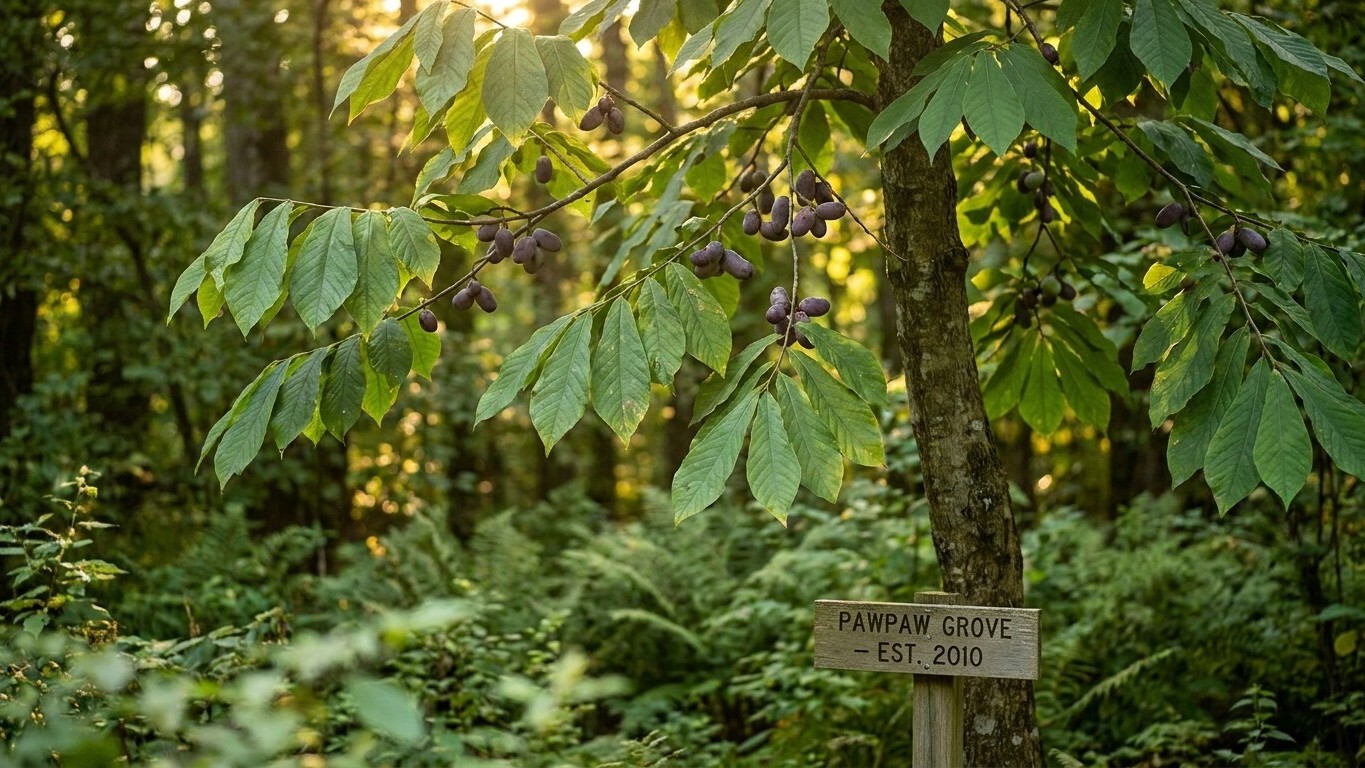

Asimina triloba, the pawpaw, survives across USDA hardiness zones 5a through 9b, tolerates acid soil that stays moist but drains well, and lives in anything from deep shade to full sun. None of that guarantees fruit. This tree needs a compatible partner nearby to set fruit, real room to spread at maturity, and patience before the first crop shows up at all. The zone number only answers whether the tree survives. Everything else here is about whether it ever produces the fruit it’s actually grown for.
Where it will and will not survive
The North Carolina Extension lists Asimina triloba as hardy across USDA zones 5a through 9b. That’s a wide band for a fruiting tree, but it’s a survival range, not a comfort range. A pawpaw at the cold edge of 5a is holding on through winters that push its limits every year; one at the warm edge of 9b faces the same pressure from heat and humidity. If your winter lows fall below 5a regularly, the tree won’t make it through, no matter how good the site is otherwise. If your summers sit above 9b for long stretches, the tree may survive on paper but struggle in practice. The zone number is the ceiling and the floor.
Hardiness zone maps shift by county, and even a river valley and a hilltop ten miles apart can land in different zones. Check the hardiness zone guide on this site for your own location before you plant, and cross that number against 5a-9b.
One classification detail worth flagging: the source also lists Asimina triloba as a Native Plant, alongside Perennial, Tree, Shrub, and Edible. Here, “native” means native to the southeastern United States specifically, not native across the entire 5a-9b range where it happens to survive. That distinction matters if you’re planting for wildlife value as well as fruit, since a native tree tends to support more local insects and birds than an import from elsewhere.
What it is called, and why that matters here
The names in circulation for this tree are Common Pawpaw and Pawpaw. Both point to the same species, and neither is flagged by the source as official. That’s why this page is titled by the botanical name, Asimina triloba, rather than picking one common name to run with.
“Pawpaw” as a word carries a separate confusion worth naming: in several English-speaking countries, “pawpaw” is the everyday word for papaya, Carica papaya, a completely different plant from a different family and climate. Asimina triloba is the temperate, deciduous, cold-hardy tree behind the pawpaw name in North American gardening use; papaya is the tropical fruit tree that shares the word elsewhere. They are not interchangeable, and a supplier who isn’t specific about which one they’re selling is worth a follow-up question before you buy.
Using the botanical name Asimina triloba when searching, ordering, or talking to a nursery removes the ambiguity the common names carry on their own, a small habit that saves a return shipment.
The site it needs to actually crop
Survival and fruiting are not the same question, and the growing conditions split cleanly along that line in places. The table below lays out what’s tolerated and what that tolerance actually buys you.
| Condition | Range tolerated | What it affects |
|---|---|---|
| Light | Deep shade, partial shade, or full sun | Survival across the whole range; the source does not say which light level produces the best fruit set |
| Soil pH | Acid, below 6.0 | General growth and health |
| Drainage | Good drainage, moist, or occasionally wet | Root health; constantly waterlogged is not the same as occasionally wet |
| Space at maturity | 3 to 6 feet, 6 to 12 feet, or 12 to 24 feet | Whether you can reach the fruit and whether it fits the site at all |
Light tolerance runs from deep shade (less than two hours of direct sun) to full sun (six hours or more). A pawpaw can survive at either end, but whether it fruits well in the shadiest conditions isn’t settled here, pawpaw is an understory species, so a shadier site is a reasonable bet for survival and a riskier one for a crop.
The space figure is the one most worth sitting with before you plant. The source gives three brackets, 3 to 6 feet, 6 to 12 feet, and 12 to 24 feet, treat the top end as the one to plan around if you want fruit you can reach without a ladder. The habit is pyramidal with a medium growth rate, so it won’t sprawl in three years, but it won’t stay small forever either. Plant it where 24 feet of eventual width won’t crowd a fence, foundation, or walkway.
When it crops, and whether it needs a partner
Bloom time is spring, given as a season rather than a month, since bloom timing shifts with latitude and elevation. A spring-blooming tree is exposed to the tail end of frost season, and a late cold snap after bud break can wipe out that year’s flowers before fruit sets. It’s worth knowing your area’s typical last frost date and watching bud stage against it.
The source is explicit that this plant needs a pollinizer to set fruit at all. That changes the planting plan more than almost anything else here: a single, isolated pawpaw can bloom every spring for years and never produce fruit. This brief doesn’t specify which varieties are compatible with which, or an age at first bearing, and guessing from the genus is a shortcut that can waste a decade, since self-fertility varies within a genus.
Before buying, ask directly: what pollination arrangement does this specific tree need, and how many years should I expect before it bears fruit? Get both answers before the tree goes in the ground. A tree that needs a partner and doesn’t have one isn’t failing, it’s doing exactly what an unpollinated fruit tree does, which is nothing.
What the fruit is, and what it is for
Per the source, the fruit becomes soft and custard-like as it ripens, with a glaucous (dusty, waxy) surface, and displays from August through October. The edibility note describes mature fruit as having “a banana custard flavor”, soft-fleshed, sweet, custardy rather than crisp or juicy, better suited to spooning or baking than slicing. It’s eaten fresh, out of hand, once fully ripe and soft.
The same note carries a caution worth repeating exactly: raw fruits can be eaten in small quantities but can cause stomach or skin irritation in some people. Combined with the source’s classification of this plant as Poisonous alongside Edible, the sensible approach is to start with a small amount and pay attention to how it sits. Skin contact with the fruit or plant tissue is the more common irritation pathway, so gloves aren’t a bad idea when handling large quantities.
Any nutrition claim belongs to the source, not this page. The description notes the fruit is “very nutritious”, offered here as a quote, not an endorsement with specifics attached. No vitamin counts or health comparisons are part of the record, and none should be invented to fill that gap.
What it resists, and what it does not
Resistance, on a plant record, means a tendency to shrug off a pressure, not a guarantee of immunity. A tree “resistant to deer” can still get browsed under enough pressure; “resistant to drought” typically describes an established specimen, not a young transplant.
For Asimina triloba, the source flags five categories, deer, fire, humidity, black walnut, and insect pests, but does not assign a specific rating to any of them.
| Challenge | What the source says | What that means for you |
|---|---|---|
| Deer | Not specified | Don’t assume browse protection without local observation |
| Fire | Not specified | No basis here for planting near a fire-prone area on this record alone |
| Humidity | Not specified | Relevant near the humid end of its hardiness range; watch the tree, not the label |
| Black walnut | Not specified | Worth confirming separately if planting near existing black walnut trees |
| Insect pests | Not specified | General tolerance unclear; monitor rather than assume |
This resistance list describes pressures on the tree itself, leaves, bark, wood, and says nothing about pests or diseases that go after the fruit specifically. Anyone growing this tree for a crop rather than as an ornamental or wildlife planting is dealing with an open question on the fruit side. That’s a gap to research locally, not one to fill with a guess.
Common questions
Can Asimina triloba grow in full shade?
It can survive in deep shade, according to the source’s light tolerance range, but the facts here don’t say whether shaded trees fruit as well as ones in more sun.
Does one pawpaw tree produce fruit on its own?
The source states plainly that this plant needs a pollinizer to set fruit. A single, isolated tree can bloom for years without producing a crop. Confirm the specific pollination requirement with a supplier before buying.
How much space does a mature pawpaw actually need?
The source gives a spread of 3 to 24 feet depending on conditions and habit, with the pyramidal, medium-growth-rate form reaching the top of that range at maturity. Plan for the higher figure rather than the lower one.
Is the fruit safe to eat?
The source notes mature fruit has a banana custard flavor and can be eaten raw in small quantities, but also warns it can cause stomach or skin irritation in some people. The plant itself is also classified as poisonous alongside edible, so starting with a small amount is the sensible approach.