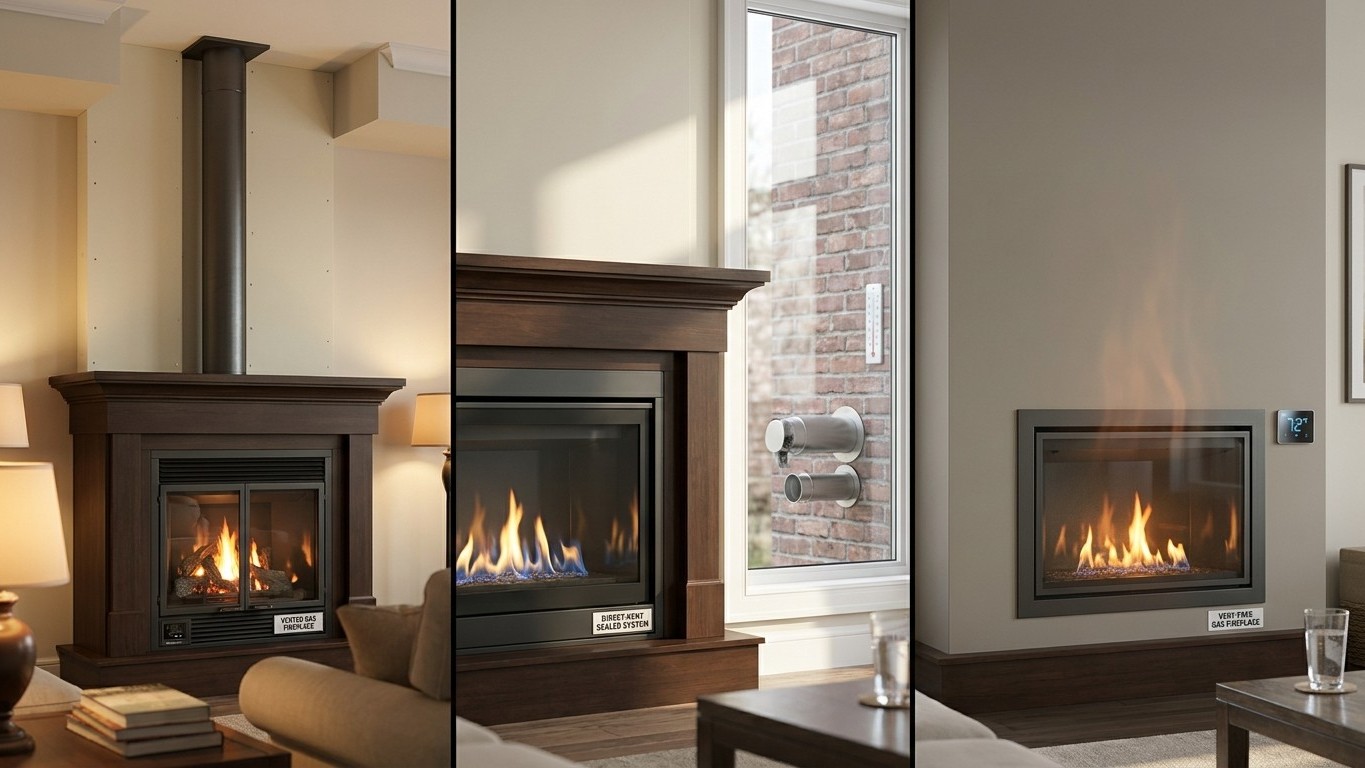

The word “fireplace” covers three different machines, and the difference isn’t cosmetic. A vented appliance pushes exhaust outside through a flue. A direct-vent unit does the same but seals the whole combustion process behind glass, pulling its air from outdoors too. A vent-free appliance burns gas and lets everything, heat, moisture, combustion byproducts, stay in the room. That single design choice determines efficiency, air quality, installation cost, and in some places, whether you’re even allowed to install one.
Three appliances, one name

Walk into a showroom and all three can look nearly identical: glass front, flame, mantel surround. What’s happening behind that glass is where they split apart. A vented gas fireplace, sometimes called a B-vent unit, draws combustion air from inside the room but sends exhaust up a metal flue to the outside, much like an old wood-burning chimney. A direct-vent fireplace goes a step further: it uses a sealed, two-pipe system that pulls fresh air in from outside and pushes exhaust back out, without touching the room’s air at all. A vent-free (or unvented) unit has no flue and no outside connection whatsoever. It burns room air and returns its combustion products, heat and water vapor included, directly into the living space.
That structural difference shows up immediately in two numbers homeowners actually care about: how much of the fuel’s heat ends up warming the room, and how much of the combustion process ends up in the air you’re breathing.
| Type | Where exhaust goes | Typical efficiency | Effect on room air |
|---|---|---|---|
| Vented (B-vent) | Flue to outside | Lower; heat is lost up the flue with the exhaust | Minimal; combustion byproducts leave the house |
| Direct-vent | Sealed pipe to outside | Higher than B-vent; sealed combustion loses less heat | None; combustion air and exhaust never mix with room air |
| Vent-free | No flue; stays in room | Highest; nearly all combustion heat stays indoors | Full; combustion byproducts and water vapor enter the room |
That last column is the one that gets glossed over in a sales pitch. A vent-free unit’s high efficiency number is real, almost none of the heat escapes up a chimney, but it’s a direct trade against what goes into the room along with that heat. A direct-vent system gives up a little of that efficiency in exchange for keeping the combustion process completely separate from the air the household breathes. A vented unit sits in between: it still shares the room’s air for combustion, but at least sends its exhaust outside.
None of this makes one option universally “better.” It makes them suited to different situations, which is the question the rest of this piece works through.
The sensor that vent-free appliances carry
Because a vent-free fireplace has no outside vent, it depends entirely on the room’s ambient air to keep the flame burning cleanly. That dependency is exactly why unvented appliances carry a safety component that vented and direct-vent units don’t need: an oxygen depletion sensor, or ODS.
According to the U.S. Consumer Product Safety Commission, currently manufactured unvented gas-fired room heaters are required by the industry’s voluntary standard to include an ODS, a device that monitors oxygen levels in the room and shuts off the gas supply before carbon monoxide can build up to a life-threatening level. The word “voluntary” matters here, and it’s worth getting the history right because it runs backward from what most people assume.
The CPSC did issue a mandatory standard on this feature at one point. But the agency revoked that mandatory rule in 1984, by which time, according to CPSC’s own findings, somewhere between 95 and 100 percent of manufacturers had already built the sensor into their products anyway. the industry standard survived the mandate’s repeal because manufacturers kept building to it voluntarily, not because a federal law still requires it today. A buyer looking at a modern vent-free fireplace should expect an ODS as a near-universal feature of anything currently manufactured and sold, but the legal backbone behind that expectation is an industry consensus, not an active government mandate.
Why that distinction matters at the point of purchase
It matters because “industry standard” and “federal law” carry different weight when something goes wrong, and because it explains why older, secondhand, or imported vent-free units deserve extra scrutiny. A unit built before manufacturers converged on the voluntary standard, or one that bypasses it, won’t necessarily carry the same protection. The ODS isn’t an optional upgrade on a new vent-free fireplace; it’s the baseline the entire product category has been built around for four decades. That’s a meaningfully different situation from a vented or direct-vent appliance, which doesn’t need the sensor in the first place because its exhaust never accumulates in the room.
An ODS is also not a substitute for a working carbon monoxide alarm. It’s colorless and odorless, so an alarm remains the only way a household actually detects it, regardless of what safety feature is built into the appliance producing it. An electric appliance, by contrast, burns nothing and produces none, which is worth remembering for a bedroom or a tightly sealed room where any combustion appliance raises the stakes.
What an unvented flame puts into the room
The ODS handles one failure mode: oxygen depletion serious enough to threaten a dangerous carbon monoxide buildup. But the CPSC’s underlying finding is broader than that single safeguard. An unvented heater has no outside vent to carry combustion products away, full stop, and it depends on ordinary room ventilation to manage what accumulates instead. Inadequate airflow, a maladjusted burner, or the normal drop in room oxygen that happens as any fuel burns can, together, let fatal levels build up even with a sensor in place doing its job as designed.
That’s the mechanical risk, and it’s the one most buying guides stop at. There’s a second consequence that rarely comes up in a showroom conversation, and it has nothing to do with carbon monoxide: water vapor.
The humidity nobody mentions
Burning natural gas or propane produces water vapor as a byproduct of combustion, chemistry, not a malfunction. A vented or direct-vent fireplace sends that moisture outside along with the rest of the exhaust. A vent-free fireplace releases it straight into the room, every time it runs.
In a drafty older house with naturally low indoor humidity, that extra moisture can be a genuine comfort improvement, taking the edge off the dry, static-prone air that gas heat and cold winters tend to produce. In a newer, tightly sealed home, the same moisture has nowhere to go. It settles into condensation on cold windows, contributes to damp corners, and in the wrong conditions feeds the same mold and moisture problems that show up behind poorly ventilated bathrooms and kitchens. For a closer look at how that plays out room by room and what it means for window condensation specifically, see this site’s coverage of indoor humidity and condensation from gas fireplaces.
The practical takeaway isn’t that vent-free is unsafe by design. It’s that its efficiency advantage and its air-quality cost are the same phenomenon viewed from two angles: nothing escapes the room, which is exactly why nothing escapes the room.
Which one belongs where
Once the mechanism is clear, matching the appliance to the space gets a lot simpler. An existing masonry chimney, still structurally sound, is often the natural fit for a vented insert; the flue is already built, and running exhaust up it is the path of least resistance. A room with an accessible exterior wall, a den, a family room, an addition, is prime direct-vent territory, since the sealed intake-and-exhaust pipe just needs a straight run through that wall rather than a full chimney.
A basement with no exterior wall within reach, or a room in the interior of a house where running venting would mean tearing into multiple floors, is where vent-free starts to look like the only realistic option without major construction. That’s precisely the situation the category was designed to solve, and it’s also where the tradeoffs discussed above deserve the closest attention, since a below-grade room often has worse natural air circulation to begin with.
A bedroom is the one space worth flagging specifically. Combustion appliance or not, a room where someone sleeps for hours with the door closed is a room with the least natural air exchange in the house, exactly the condition under which the CPSC’s findings about inadequate airflow and oxygen depletion matter most. It’s a scenario that calls for particularly careful judgment before choosing an unvented unit, regardless of what the sensor is rated to catch.
The legal map isn’t optional to check
None of this is purely a comfort decision, either. Several states and municipalities across the country restrict or outright prohibit vent-free gas appliances, sometimes for the whole structure and sometimes room by room, bedrooms in particular are singled out in a number of local codes. The rules aren’t uniform, and they change. The only reliable authority on what’s permitted at a specific address is the local building or code enforcement office, and that call should come before, not after, an appliance is chosen or installed.
The choice between vented, direct-vent, and vent-free ultimately comes down to what a given room can offer in return: an existing flue, an open exterior wall, or neither. Match the appliance to what the room actually has, not to whichever unit looked best in the showroom.
Common questions
Is a direct-vent fireplace safer than a vent-free one?
Direct-vent systems seal combustion air and exhaust away from the room entirely, so they don’t share the same dependency on room ventilation that vent-free units do. That structural separation is why many local codes treat direct-vent installations differently from vent-free ones, including in bedrooms where unvented units are often restricted.
Do all vent-free fireplaces have an oxygen depletion sensor?
Currently manufactured units are built to an industry voluntary standard requiring an ODS, according to the CPSC, and the vast majority of manufacturers had already adopted the feature even before the agency’s own mandatory rule was revoked in 1984. Older or non-standard units are the ones that warrant checking specifically.
Can a vent-free fireplace be installed in any room?
No. Room size, ventilation, and local code all factor in, and a number of states and municipalities restrict where vent-free appliances can be installed, sometimes excluding bedrooms altogether. The local code office is the authority to confirm before purchase, not the appliance’s own rating.
Why does a vent-free fireplace make windows sweat more?
Burning gas produces water vapor as a natural byproduct of combustion. Vented and direct-vent units carry that moisture outside with the rest of the exhaust; a vent-free unit releases it into the room instead, which raises indoor humidity and can show up as condensation on cold glass, particularly in newer, well-sealed homes.