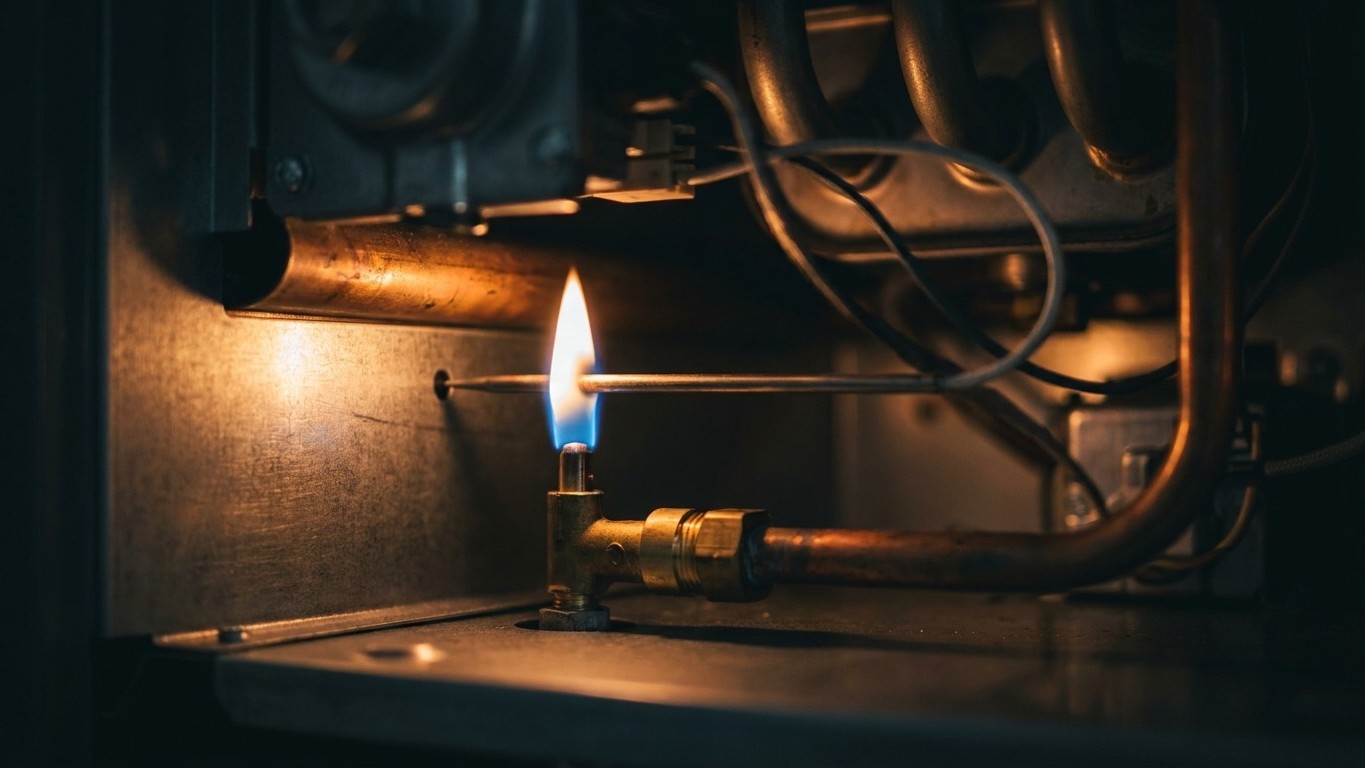

There’s no single right answer. A standing pilot light can stay lit year-round without much fuel cost on a vented appliance, but on many units, switching it off for the warm months is the smarter move. The real answer depends on the appliance type, the local climate, and what the manufacturer’s plate says about relighting it later. Get that plate wrong, and you’re looking at a service call instead of a five-minute fix.
What the small flame is doing

A standing pilot isn’t just there to save you a match. Its real job is twofold: light the main burner the instant you call for heat, and prove to the gas valve that a flame actually exists before the valve allows any more gas through. That second function runs through a thin metal probe called a thermocouple, sitting right in the pilot flame. As long as the thermocouple stays hot, it generates a tiny electrical signal that holds the gas valve open. Let that flame go out, and the thermocouple cools within seconds, the signal drops, and the valve slams shut automatically. No flame, no gas. That’s the whole safety interlock in a nutshell.
This is why you can’t just crank the gas knob and walk away during a relight. The system is built to distrust an open gas line until it has proof of ignition, and it keeps re-checking that proof for as long as the appliance runs.
What a healthy pilot looks like
Open the lower louvre or glass and look at the small flame near the burner ports. A pilot in good shape burns steady, not flickering or lifting off the orifice, and it should be mostly blue with maybe a hint of yellow at the very tip. That blue cone needs to fully wrap around the sensor tip, whether that’s a thermocouple or a flame-rectification rod on newer electronic ignition systems. If the flame is lazy, mostly yellow, or barely licking the sensor, something’s off: a dirty pilot orifice, a draft problem, or a sensor that’s drifted out of position. Any of those can cause nuisance shutoffs, where the appliance seems to light fine but cuts out a minute later.
A pilot that looks weak isn’t something to troubleshoot on your own past basic cleaning. Debris in the orifice or a bent sensor bracket are common, fixable issues, but flame quality is also a rough proxy for combustion health. A consistently yellow or sooty flame on a vented appliance can mean incomplete combustion, and that’s worth a technician’s attention rather than a guess.
Off for the summer, and what that costs
This is the question most homeowners actually want answered: do I really need to keep this thing burning gas from April to October? A standing pilot burns continuously, 24 hours a day, whether or not the fireplace ever gets used. Turn it off during the months you’re not running the fireplace, and you stop paying for gas that’s doing nothing but idling. That’s the fuel-savings case, and it’s straightforward.
The case for leaving it lit is less about money and more about moisture and readiness. A pilot flame generates a small amount of heat that keeps the flue or vent path warm and dry, which can matter in a damp basement installation or a climate with high humidity. It also means the appliance is instantly ready the first cold night in fall, no relighting required. For a vented, direct-vent unit that isn’t prone to draft issues, that convenience might outweigh the summer gas use. For a vent-free unit sitting in a room that already runs damp, or for a household that’s watching every therm on the gas bill, shutting it down for the season makes more sense.
What this article won’t do is hand you a dollar figure for what your pilot light costs to run per month. That number depends on the specific appliance’s pilot consumption rating, measured in BTUs per hour, and on your local gas rate, and neither of those is something a general guide can responsibly guess at. The rating you need is printed right on the appliance, usually on the same data plate that lists the input BTU rating for the main burner. Look for a separate, much smaller BTU/hr figure labeled for the pilot. If you can’t find it there, the owner’s manual for your specific model will list it, and your gas utility can tell you the current rate per therm or per hundred cubic feet on your bill. Multiply those together and you’ll have an actual number specific to your setup, rather than a generic estimate that might be off by a wide margin depending on your equipment.
Relighting, by the label
Every gas fireplace, insert, or log set sold in the U.S. comes with an instruction plate, typically a metal or laminated card mounted behind the lower louvre or control access panel. That plate is not a suggestion. It’s written for that specific valve and ignition system, and it takes precedence over any general description you’ll find online, including this one.
The general shape of a standing-pilot relight follows a familiar pattern across most appliances: turn the gas control knob to the “pilot” or “off” position and wait a few minutes to clear any residual gas, turn the knob to “pilot,” depress it, and hold it down while you spark the igniter or apply a match to the pilot burner. Once the pilot catches, you keep holding the knob down for a set period, often somewhere around 30 seconds to a minute, to give the thermocouple time to heat up and generate enough signal to hold the valve open on its own. Release too early and the pilot goes out the moment you let go, because the thermocouple hadn’t gotten hot enough yet. That’s the most common reason a first relight attempt fails.
Why the timing on the plate matters more than any general rule
Hold times, knob positions, and the exact sequence of steps vary by manufacturer and even by model year, especially between older thermocouple-based systems and newer electronic ignition or intermittent pilot systems that spark on demand rather than burning continuously. Some appliances use a push-button igniter, others need a separate long-reach lighter. Some require you to remove a glass front first; others have everything accessible from a control compartment door. Treat the plate’s sequence and timing as the governing instructions, and treat any general description, including the one above, as background only. If the plate is missing, faded, or the appliance predates easy documentation, the manufacturer’s customer service line or a licensed technician is the right next call rather than improvising.
Vented, vent-free, and why that split changes everything
Before any pilot advice makes sense, you need to know which category your appliance falls into. A vented appliance sends its combustion byproducts outdoors through a flue or a direct-vent terminal, keeping those gases out of the living space entirely. A vent-free (or unvented) appliance releases its combustion products, including water vapor, directly into the room where it’s installed. That single distinction decides how much ventilation the room needs, how much moisture you’ll deal with, and how seriously you need to take flame-quality checks and CO monitoring.
Vent-free heaters depend entirely on ordinary room air for their oxygen supply and have no path to carry combustion products away. According to the U.S. Consumer Product Safety Commission, inadequate room airflow or a burner that’s fallen out of adjustment, combined with the normal drop in oxygen levels as the appliance burns fuel, can allow dangerous levels of carbon monoxide to build up in that space. That’s a real risk specific to unvented units and one vented appliances largely avoid by design, since their combustion byproducts leave the house.
The industry has addressed part of this risk directly. The CPSC notes that currently manufactured unvented gas-fired room heaters are required, under the industry’s voluntary standard, to include an oxygen depletion sensor, or ODS, which cuts off the gas supply before carbon monoxide can reach a life-threatening concentration in the room. That’s a voluntary industry standard rather than a federal mandate today, though the history here has a twist: the CPSC actually revoked its own mandatory federal standard back in 1984, and by that point somewhere between 95 and 100 percent of manufacturers were already building the safety feature in anyway. So the safeguard exists on virtually every unit made since, just not because a current federal law demands it.
None of this replaces a carbon monoxide alarm. CO is colorless and odorless, which means an alarm is the only realistic way a household detects it before symptoms show up. If you’re weighing a vent-free appliance against a vented one, or deciding whether an electric option might suit a particular room better, it’s worth remembering that electric appliances burn nothing and produce no carbon monoxide at all, removing that variable from the equation entirely.
Common questions
Is it normal for a Gas Fireplace pilot light to go out on its own?
It happens, and the usual suspects are a draft blowing across the flame, a thermocouple that’s drifted slightly out of position, or debris partially blocking the pilot orifice. An occasional outage during a windy spell isn’t unusual; a pilot that won’t stay lit repeatedly points to a component that needs cleaning or replacing.
Can I leave my gas fireplace pilot light on all year?
Many vented appliances can run their pilot continuously without issue, and doing so keeps the unit instantly ready and can help keep the flue path dry. Whether that’s worth the continuous gas use is a judgment call based on your appliance’s pilot rating and your gas costs, which you’ll find on the appliance’s data plate rather than in a general estimate.
What’s the difference between a standing pilot and electronic ignition?
A standing pilot burns continuously as a small, always-on flame, ready to light the main burner instantly. Electronic or intermittent ignition systems spark a pilot flame only when you call for heat and shut it off afterward, using little to no gas between cycles, though the relight sequence and any battery or electrical requirements differ from a standing-pilot setup.
Do vent-free gas fireplaces need a carbon monoxide detector?
Given that CO is colorless and odorless and that vent-free appliances release combustion products directly into the room, a working CO alarm is the only practical way to catch a dangerous buildup before anyone notices symptoms. This holds regardless of the appliance’s built-in oxygen depletion sensor, which addresses gas supply shutoff but isn’t a substitute for a standalone alarm in the home.