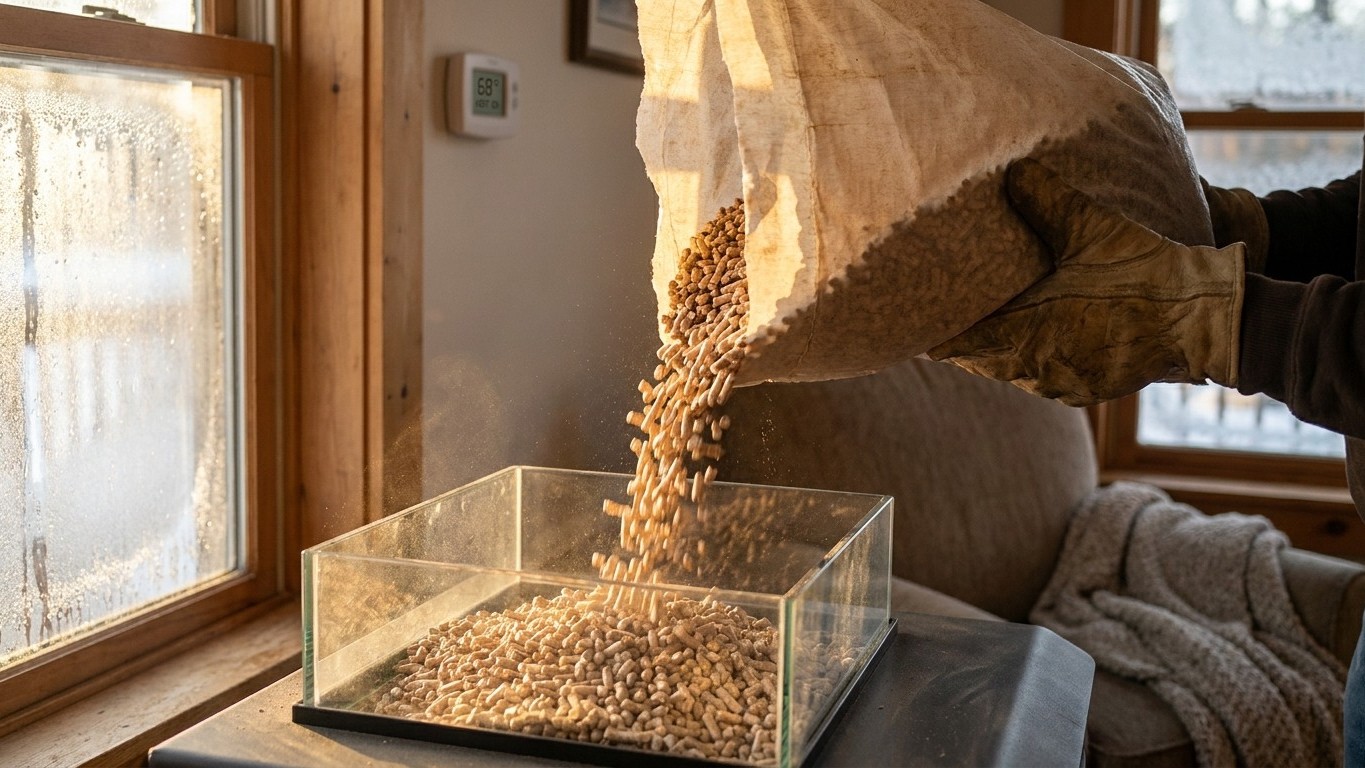

There’s no fixed number of pellets a winter takes, because “a winter” isn’t a fixed thing. A mild season in North Carolina and a hard one in Minnesota can differ by three or four tons of demand on the exact same stove. The honest answer is a method, not a figure: track your own hopper fills, and let your house tell you what it needs, since no chart or average will match your walls, your thermostat habits, or your particular pellets.
The calculation, not the rule of thumb

Start with the units instead of a guess. A standard bag of wood pellets weighs 40 pounds. Fifty of those bags make a ton. That part is simple math, and it’s the only part that stays constant from house to house. What changes everything downstream is how much heat you’re actually asking the stove to produce, hour by hour, not how much it’s capable of producing at full tilt.
The U.S. EPA notes that “EPA-certified pellet stoves usually fall into the 70-83% efficiency range, while heating capacities range from 8,000-90,000 Btu per hour.” That range matters more than most buyers realize. A stove rated near the top of that Btu window, run on a low or medium setting because the room is small or well insulated, will burn through fuel at a fraction of the rate of the same stove pushed to max output in a drafty farmhouse. Consumption tracks the setting you choose, not the number printed on the spec sheet.
The chain that actually determines your pellet use looks like this: hours the stove runs per day, multiplied by the feed rate at whatever setting you’ve dialed in, gives you pounds burned per day. Multiply that by the number of heating days in your season, and you get total pounds, which converts to bags, which converts to tons. Every one of those inputs is personal to your house. The feed rate at “3” on one stove isn’t identical to “3” on another model, and the number of true heating days depends on where you live and how you use supplemental heat, if any.
This is also where electricity enters the picture in a way people forget. The EPA points out that “pellet stoves need an electrical supply to work because they use motorized components to feed the fire and blow out hot air.” The auger that meters pellets into the burn pot is doing the actual work of turning your chosen setting into fuel consumption. A power outage stops that feed entirely, which is a separate cost of pellet heat worth knowing but has no bearing on the pounds-per-day math once the power is on.
None of this produces a tons-per-winter figure that applies broadly, because the sources that matter here, the EPA and fire safety data, don’t publish one. What they give you is the framework: bag weight, ton conversion, efficiency range, and the reminder that output depends on setting. The number itself comes from your own stove’s data plate and your own thermostat habits, not from an article.
What moves the number
Once you accept that there’s no universal figure, the useful question becomes which factors push your own total up or down. Five variables do most of the work, and knowing the direction each one pushes helps explain why your pellet use might look nothing like a neighbor’s.
- The local winter — more cold days and lower average temperatures push consumption up; a shorter, milder heating season pushes it down.
- Insulation and air sealing — a tight, well-insulated house holds heat and pushes consumption down; drafts, old windows, and uninsulated attics push it up.
- Whether the stove heats one room or the whole house — a stove supplementing a single living room burns far less than one asked to carry an entire floor plan, which pushes whole-house setups up.
- The thermostat or feed-rate setting — running the stove on a high setting to hit 74°F pushes consumption up; running it lower and layering on a sweater pushes it down.
- The fuel’s own heat content and quality — pellets that burn cleanly and completely push consumption down for the same comfort level; poor-quality pellets push it up because you need more of them to get the same warmth.
That last point is easy to underestimate. The EPA is direct about it: “Pellets can differ significantly in how well they’re made and how well they burn. Lower quality pellets may provide less heat and create a fine dust. Higher quality pellets tend to burn cleaner and produce less ash.” Two identical stoves burning two different bags of pellets, at the same setting, in the same house, can produce noticeably different amounts of usable heat, which means the lower-quality bag gets you a colder room unless you compensate by running the stove harder, and harder running means more bags bought.
This is exactly why two neighbors with the same stove model can end up a full ton or more apart over a season. One keeps the house at 68°F and closes off unused rooms; the other keeps it at 74°F throughout. One has attic Insulation rated for the climate; the other’s home was built decades before current codes. One buys a consistent, well-made pellet; the other buys whatever’s cheapest that week. Stack those differences together and a factor-of-two gap between otherwise similar households isn’t unusual at all, it’s the expected outcome of how many variables sit between “stove capacity” and “pellets purchased.”
Measuring your own house
Given how many variables are in play, the only number worth trusting is the one you generate yourself. The method is simple. During your first winter with the stove, count every bag you load into the hopper, keep the receipts or a running tally, and jot down roughly how cold the season was, whether it was a mild year or a brutal one for your region. By the time spring arrives, you’ll have a real baseline: total bags burned, converted to tons, tied to an actual set of weather conditions and an actual thermostat habit.
That baseline becomes far more useful than any published estimate, because it already accounts for your Insulation, your stove’s real-world feed rate at the setting you actually use, and the quality of pellets you actually buy. Next winter, if it runs colder or warmer than the one you measured, you can adjust your order up or down from that known point instead of guessing blind. For a fuller picture of what that baseline costs in dollars, not just bags, the running-cost breakdown walks through how to turn a season’s bag count into an actual seasonal spend.
Keep the measurement honest with basic upkeep
A poorly maintained stove will throw off your bag count in ways that have nothing to do with the weather. The EPA explains the basic mechanism: “The pellets are poured into a hopper, which automatically feeds into the stove,” and that feed system, along with the burn pot and exhaust path, needs regular attention to keep performance consistent. The agency is specific about the minimum: “Pellet stoves need to be regularly cleaned to ensure that the stove runs efficiently and safely. Additionally, you should have your stove professionally cleaned at least once a year.” A stove overdue for cleaning can quietly burn less efficiently, pushing your bag count up for the same comfort level and muddying the baseline you’re trying to build.
Safety upkeep matters just as much as fuel accounting. The U.S. Fire Administration advises that you “maintain heating equipment and chimneys by having them cleaned and inspected each year by a professional,” and separately reminds owners to “keep anything that can burn at least 3 feet from all heat sources including fireplaces, wood stoves, radiators, space heaters or candles.” Neither of those recommendations changes how many pellets you’ll use, but skipping them can turn a fuel question into a far more serious one. For context on the market you’re choosing from, the EPA notes it “currently certifies over 90 different pellet stoves,” which is worth remembering when comparing a dealer’s efficiency claims against the certified range the agency actually publishes.
Common questions
Does a bigger stove always burn more pellets?
Not necessarily. A larger-capacity stove run on a low setting in a small, tight room can burn less than a smaller stove pushed hard in a drafty space. Heating capacity on the label describes a maximum, not what the stove actually consumes at the setting you choose day to day.
Can I estimate pellet use before my first winter?
You can build a rough guess from your stove’s rated Btu output and your local heating degree days, but treat it as a placeholder. The only figure worth planning next season’s fuel order around is the one you measure yourself during an actual heating season in your actual house.
Does pellet quality really change how many bags I need?
Yes, according to the EPA, since lower-quality pellets “may provide less heat and create a fine dust” while higher-quality ones “tend to burn cleaner and produce less ash.” Less heat per bag means you either accept a cooler room or burn more bags to compensate.
Do I need electricity to run a pellet stove all winter?
Yes. The EPA states plainly that pellet stoves “need an electrical supply to work because they use motorized components to feed the fire and blow out hot air.” Without power, the auger that feeds pellets and the fan that distributes heat both stop working, regardless of how many bags you have on hand.