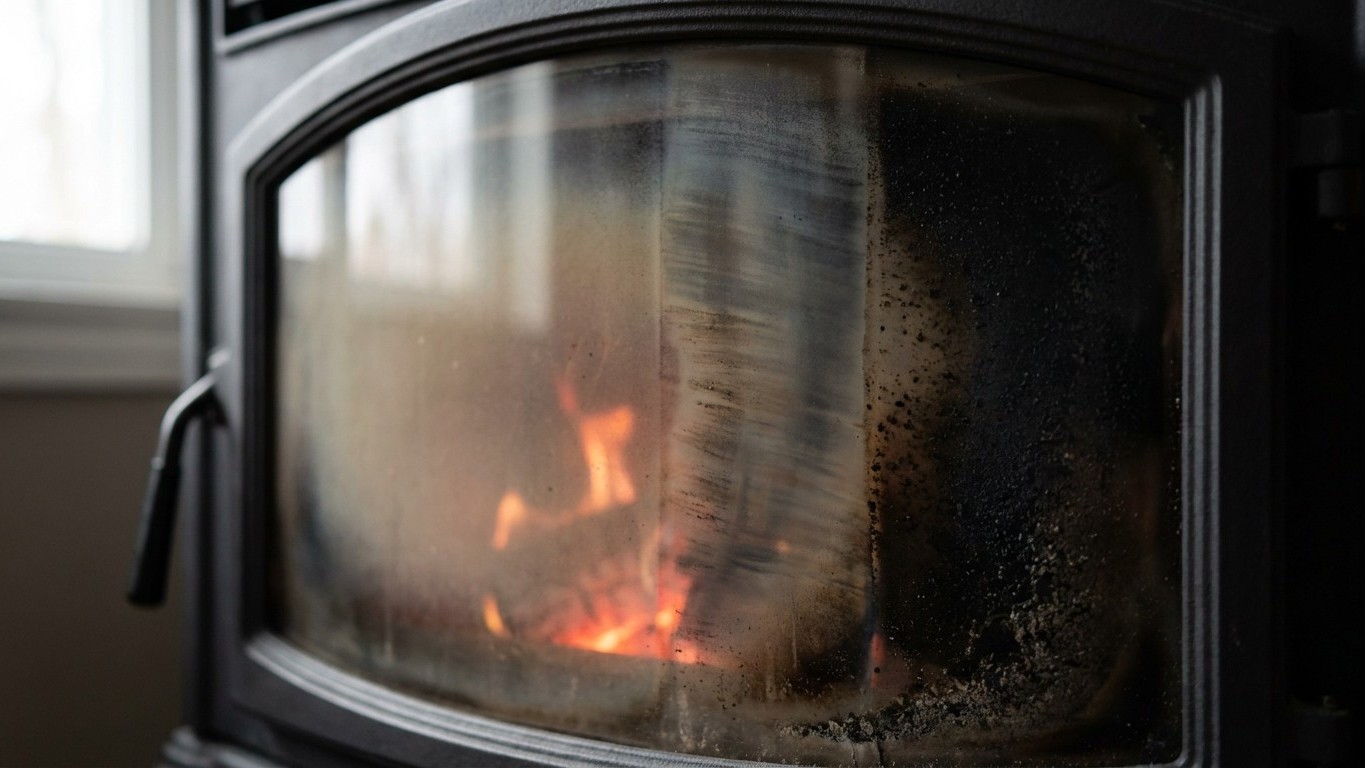

Black glass on a pellet stove almost always points to incomplete combustion rather than a lazy cleaning habit. The stove isn’t getting enough air relative to the fuel it’s burning, the pellets themselves are low grade, the burn pot is clogged with ash, or a gasket or vent restriction is choking the fire. Each cause leaves a slightly different residue, and reading that residue is the fastest way to know what to fix before the problem gets worse.
The glass is a gauge

Most people treat a sooty window as a chore. It’s actually a readout. Pellet stoves rely on an air wash system, a thin curtain of combustion air pulled down across the inside of the glass, to keep soot from settling there in the first place. When that air wash is doing its job and the fire is burning hot and complete, the glass stays mostly clear except for a light haze that wipes off in seconds. When the glass goes gray, then brown, then flat black within a single burn cycle, the air wash isn’t winning, which means the fire isn’t getting enough oxygen to finish burning the fuel completely.
Incomplete combustion doesn’t just dirty the glass. It wastes fuel and pushes unburned particles up the flue instead of turning them into heat in the room. The U.S. EPA notes that “EPA-certified pellet stoves usually fall into the 70-83% efficiency range, while heating capacities range from 8,000-90,000 Btu per hour.” A stove running near the bottom of that range, coughing out soot instead of clean flame, is very likely the same stove leaving heat behind in the chimney rather than delivering it to the living room.
Why fuel quality changes the reading
The glass also tells you something about what you’re feeding the hopper. The EPA is blunt about this: “Pellets can differ significantly in how well they’re made and how well they burn. Lower quality pellets may provide less heat and create a fine dust. Higher quality pellets tend to burn cleaner and produce less ash.” Swap a bag of dense, low-moisture pellets for a cheaper batch full of fines and bark, and you can watch the glass darken faster within the same afternoon, even with nothing else changed on the appliance. That’s worth knowing before you assume the stove itself is failing. For a closer look at what separates a clean-burning pellet from a dusty one, see our guide to pellet quality.
None of this means black glass is dangerous by itself. It’s a symptom, not a fire risk on its own. But treating it as a signal, rather than an annoyance, changes how you respond. Instead of wiping and moving on, the smarter move is tracing why the fire needed more air than it got.
What to check, in order
When the glass darkens faster than usual, work through the stove in a sequence rather than guessing. Starting with the simplest, cheapest fix avoids tearing into gaskets or vent pipe before ruling out an overflowing ash pan.
- Ash in the burn pot. A burn pot packed with ash chokes the air holes that feed the fire from underneath. Once those holes are partly blocked, the flame starves for oxygen even though the stove’s settings haven’t changed. This is the single most common cause of a sudden shift from clear glass to black glass, and it’s also the fastest to fix.
- The air intake and its setting. Check that the combustion air intake, wherever it draws from, isn’t obstructed by dust, pet hair, or a nearby object. Then confirm the stove’s air or feed setting matches the pellets you’re burning; a setting tuned for dense pellets will run rich and sooty on a lighter, drier batch.
- The vent terminal outside. Wind-driven debris, spider nests, and even snow can partially block the outside termination point, restricting the draft the fire needs to pull air in and push exhaust out. A partially blocked vent can produce the same sooty glass as a dirty burn pot, but the fix is outdoors, not inside the firebox. Our venting guide walks through what a blocked or undersized termination looks like.
- Gaskets. The door and glass gaskets are supposed to force incoming air through the controlled air-wash path rather than around it. A worn, flattened, or cracked gasket lets air leak in the wrong place, which can starve the air wash of the pressure it needs to keep the glass clean even while the fire itself burns fine.
- The fuel itself. If everything mechanical checks out, look at the bag. Pellets with excess fines, inconsistent size, or high moisture content burn less completely and leave more residue on the glass, exactly as the EPA describes.
Working this list top to bottom usually finds the cause within a single inspection, and it avoids the common mistake of blaming the appliance when the real issue is a fuller ash pan or three months of dust in the outside vent cap.
Cleaning it without ruining it
Once the cause is addressed, the glass itself needs cleaning, and this is where a lot of damage happens from good intentions. Ceramic glass on a pellet stove is built to handle heat, not household chemicals or aggressive scrubbing, and treating it like a kitchen window will shorten its life.
The method that works
Let the stove go completely cold first. Cleaning warm or hot glass risks a thermal shock crack, and it also means you’re wiping soot with your hand close to an active heat source. Once it’s cold, dampen a soft cloth or paper towel and dip it lightly in cold ash from the burn pot. That ash acts as a very mild, natural abrasive, fine enough not to scratch the ceramic surface but gritty enough to lift baked-on soot that a plain damp cloth won’t budge. Wipe in small circles, rinse the cloth, and repeat until the glass clears.
Skip the glass cleaner from under the sink. Ammonia-based and many general-purpose glass cleaners aren’t formulated for ceramic glass exposed to repeated high heat, and they can leave streaking or a film that actually attracts more soot on the next burn. Paper towels alone, without the ash, tend to just smear black residue rather than lift it. And never use a metal scraper, steel wool, or an abrasive scouring pad. All three will scratch ceramic glass permanently, and once it’s scratched, that surface holds soot more aggressively going forward, so the glass will look dirty faster after every cycle from then on, regardless of how well the stove is burning.
Routine upkeep matters as much as the cleaning technique. The EPA is direct on this point: “Pellet stoves need to be regularly cleaned to ensure that the stove runs efficiently and safely. Additionally, you should have your stove professionally cleaned at least once a year.” Between those annual visits, a five-minute glass wipe and a quick ash-pan check every week or two during heating season keeps the whole system, and the glass along with it, running the way it should. For the full weekly and seasonal routine, see our pellet stove cleaning guide.
Common questions
Is black glass on a pellet stove a safety hazard?
Not by itself. It’s a sign of incomplete combustion, not an active fire risk, but it’s worth investigating since the same conditions that darken glass can also mean wasted fuel and reduced heat output. Keep the area around the stove clear regardless: the U.S. Fire Administration advises to “keep anything that can burn at least 3 feet from all heat sources including fireplaces, wood stoves, radiators, space heaters or candles.”
Can the electrical supply affect how the glass looks?
Indirectly, yes. The EPA notes that “pellet stoves need an electrical supply to work because they use motorized components to feed the fire and blow out hot air.” If a combustion blower is underperforming or a feed auger is running inconsistently, the air-to-fuel balance shifts, and that imbalance shows up on the glass before it shows up anywhere else.
Does the hopper design have anything to do with sooting?
Not directly, since as the EPA describes, “the pellets are poured into a hopper, which automatically feeds into the stove,” and the hopper itself is just a fuel reservoir. What matters more is what’s inside it: the consistency and quality of the pellets being fed determine how cleanly the fire burns once they reach the burn pot.
How often should a professional look at the stove if the glass keeps blackening?
At least once a year regardless of symptoms, per EPA guidance on regular cleaning, and the U.S. Fire Administration recommends the same cadence for the whole heating system: “maintain heating equipment and chimneys by having them cleaned and inspected each year by a professional.” If black glass shows up repeatedly between those visits despite clean fuel and a clear burn pot, that’s a sign to move the professional inspection up rather than wait for the annual schedule.